ATARN Letter, May 2001
Text and photographs © Stephen Selby, 2001.
A1, Cloudridge,
30, Plunkett’s Road,
The Peak, Hong Kong.
Fax: (852) 2808-2887
email: srselby@atarn.org
May 2001
Dear All,
The World Wide Web Consortium, the body which sets the policies and norms for the Web, held its tenth annual meeting, WWW10, in Hong Kong from 1 - 5 May. I took part as one of the presenters at the 'Culture Track' (one of the parallel sessions) and presented the work of ATARN. The audience included members of the WWW Consortium, and delegates from G8 (the World Bank), UNESCO and a number of international agencies working on coordinating cultural projects on the Web.
Apart from introducing ATARN as set out in our on 'What is ATARN?' section, I said -
"Asian archery is, with a small number of exceptions, a formerly-important cultural tradition which is now dying. The complete decline of archery traditions in the West has been staved off by the involvement of crafts groups, historical reenactment groups and academics. We hope to achieve the same for Asian traditional archery though ATARN. ATARN exploits the speed, flexibility and inexpensive nature of the WWW to permit interchange between isolated groups of practitioners. ATARN is starting to show the following benefits:
- Making information on Asian archery traditions readily available to interest groups worldwide through the Internet.
- As a result of the increase of interest in Asian archery, traditional bow and arrow makers will gain an increasing market for products for which their local market is barely sustainable.
- Historians and ethnologists can share information with craftsmen, archers and reenactment groups to help them gain a more correct interpretation of the signification of historical and archeological data.
- Linking different traditional archers in Asia provides for encouragement and mutual support between isolated groups of archers and bowyers."
As you would expect (?), the audience were enthralled by out subject matter and the idea of bring the culture of far-flung people from Central and Southeast Asia to a worldwide audience. Other presenters and audience members in my session made the following general comments on cultural work on the WWW which we might find useful.
- Historical and Archaeological re-constructions are becoming common on the WWW, what with virtual museums and 3-D modelling. However, there can be no guarantee of the authenticity of reconstructions. There is a particular danger that reconstructions put together with the most impressive technology will be regarded by the public as the most authoritative.
- Culture as recorded on the WWW is the culture of the 'haves'. 'Have-nots' who cannot get access to the INTERNET are poorly represented. Even many well-meaning efforts to record the cultural experiences of illiterate people can fail because the interviewees cannot read and correct purported 'quotes'.
- Asian people include a different set of phenomena in their definitions of 'Culture'. Folk art, traditional technical and medicinal knowledge and 'community cultural assets' (such as tribal totems and designs) play a more prominent part in Asian concepts of 'culture', where as fiction is often less highly-regarded.
I look forward to keeping in touch with some of the delegates and I hope some of them will get involved in ATARN.
This letter announces a new article on Two Turkish Bows by Adam Karpowicz. The article describes two working reproductions of Turkish infantry bows that Adam made.
I thought I would add some photographs of an old Turkish bow made in about 1837. The length of the bow (measured along the limb from string nock to string nock) is 106cm.
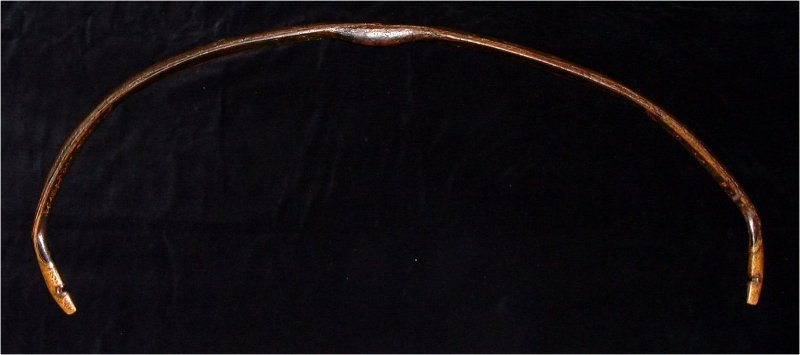
The whole bow. 106cm string-nock to string-nock
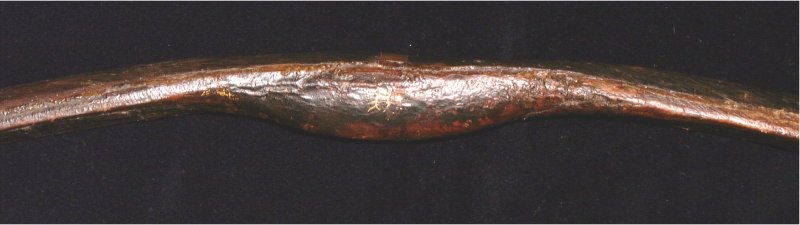
Side view of grip

Decoration on back of bow limb

Detail of limb decoration
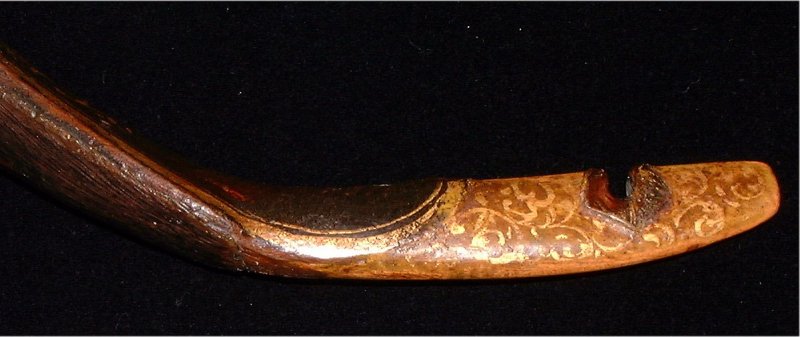
Bow tip with bone insert at the string nock and gilt decoration
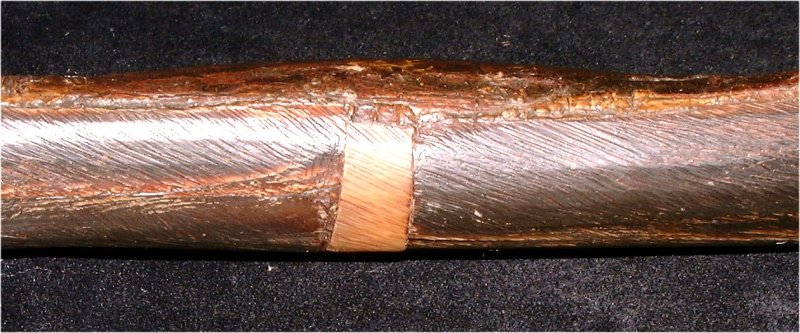
'Chelik' or bone insert at grip between horn sections. (Note deliberate
roughening of the horn)
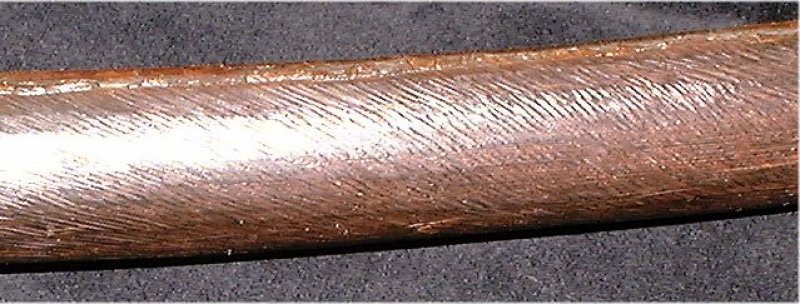
Horn belly of the bow limb. (Note deliberate roughening of the horn)
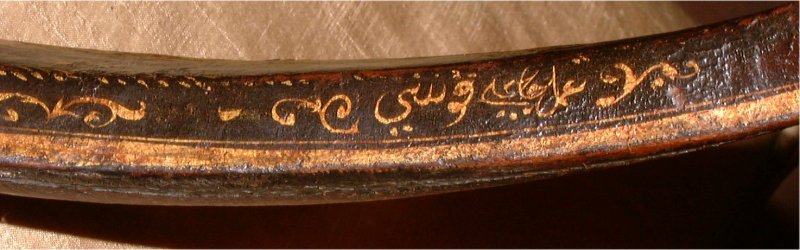
Signature of the bowyer, 'Ali Kawwsi'
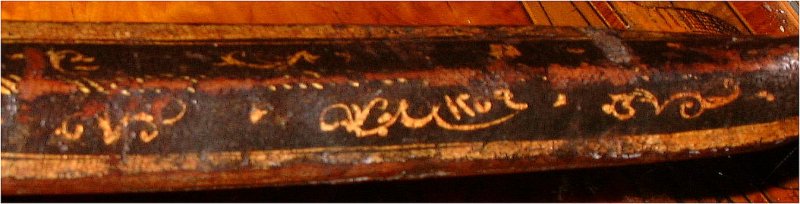
Date (1837 in the Western Calendar.)
At first I was puzzled that a bow with such an artistic finish would have such crude roughening of the horn belly of the limbs. But perhaps the roughening is there for a specific purpose: to reduce glare from bright sunlight, which could impair the archer's aim. I checked using a Korean horn bow and found that at some angles, with the sun behind the archer, there can be an annoying glare.
Alternatively, is there any stricture in Islamic law against mirrors where the human face can be seen? Please would Muslim Members of ATARN let me know?
|
(Signed) (Stephen Selby) |