
What quiver to use with a Mamluk outfit?
Would a Central Asian-style closed quiver go well with a 12th- or 13th-century Mamluk outfit, or would I have to use an open design like the ones by Cherie? It's a bit hard to guess because the Mamluk training regime was after all a combination of Greek, Turkic, Arabic, and Persian practice, and I don't know which heritage(s) passed on its (their) quiver to the Mamluks proper. Or was there more than one possible option for a historically correct impression?
The paintings from Egypt of the Mamluk period usually show open quivers like the contemporary Mongol ones. The style of painting makes them look blockier, but a sketch from Pisanello suggests that they were slender. The best depictions I have seen are in Jalayarid paintings from Iraq.
Due to the number of Mongol and Khwarezmian deserters in the early Mamluk armies, it is easy to see why they might adopt Mongol and Eastern Turkish style quivers.
I haven't seen much evidence of closed quivers, though they are mentioned in the literature.
Due to the number of Mongol and Khwarezmian deserters in the early Mamluk armies, it is easy to see why they might adopt Mongol and Eastern Turkish style quivers.
I haven't seen much evidence of closed quivers, though they are mentioned in the literature.
As in literature specifically dealing with the Mamluks?Bede wrote:
I haven't seen much evidence of closed quivers, though they are mentioned in the literature.
Furusiya literature was predominately produced under the Mamluks and that is where a lot of this information comes from. However, in this case I was referring to a book written when the Mamluks were in Egypt, but not in control. A book was written for Salah-ed-Din which had details of quiver names and their uses.
Oh, so it's something from before the period of Mamluk domination? Not a problem, since it's still well within the timeframe I have in mind. Any idea of where I can find scholarly treatments of the book, or at least a summary of what the book says about closed quivers?
(Thanks for the help so far, BTW.)
(Thanks for the help so far, BTW.)
Bede; maybe it is time to reformulate a name for closed quivers because there were many of those hourglass shaped quivers without a top or lid. -j-
Jack,
The archaeological remains I have seen reported usually had at least one third to one half of the top opening enclosed by a fixed part of the quiver. This is not apparent in paintings where the separate hinged lids are more common. It is my guess that like many other devices, closed quivers started out one way and were further developed to solve different problems. My study suggested that earlier ones had bottom hinged doors on the outside. By the Mongol period they have side hinged ones.
I think that the hinged lids could be detached or the leather hinges just wore out eventually. There is one type that has a particularly elaborate opening. It has the top of the opening almost closed off. Perhaps it never was designed to have a lid that was permanently attached. However, I think all these quivers can properly called closed or enclosed.
In comparison, there is a part of the scabbard that closes the slot in the back of scabbards for highly curved Turkish swords. These are almost always missing because they break off easily. However nearly all such scabbards originally had these strips of metal.
The archaeological remains I have seen reported usually had at least one third to one half of the top opening enclosed by a fixed part of the quiver. This is not apparent in paintings where the separate hinged lids are more common. It is my guess that like many other devices, closed quivers started out one way and were further developed to solve different problems. My study suggested that earlier ones had bottom hinged doors on the outside. By the Mongol period they have side hinged ones.
I think that the hinged lids could be detached or the leather hinges just wore out eventually. There is one type that has a particularly elaborate opening. It has the top of the opening almost closed off. Perhaps it never was designed to have a lid that was permanently attached. However, I think all these quivers can properly called closed or enclosed.
In comparison, there is a part of the scabbard that closes the slot in the back of scabbards for highly curved Turkish swords. These are almost always missing because they break off easily. However nearly all such scabbards originally had these strips of metal.
There's also the pattern for Mamluk quiver right here on ATARN for consideration:
http://www.atarn.org/islamic/patterns/m ... quiver.jpg
http://www.atarn.org/islamic/patterns/m ... quiver.jpg
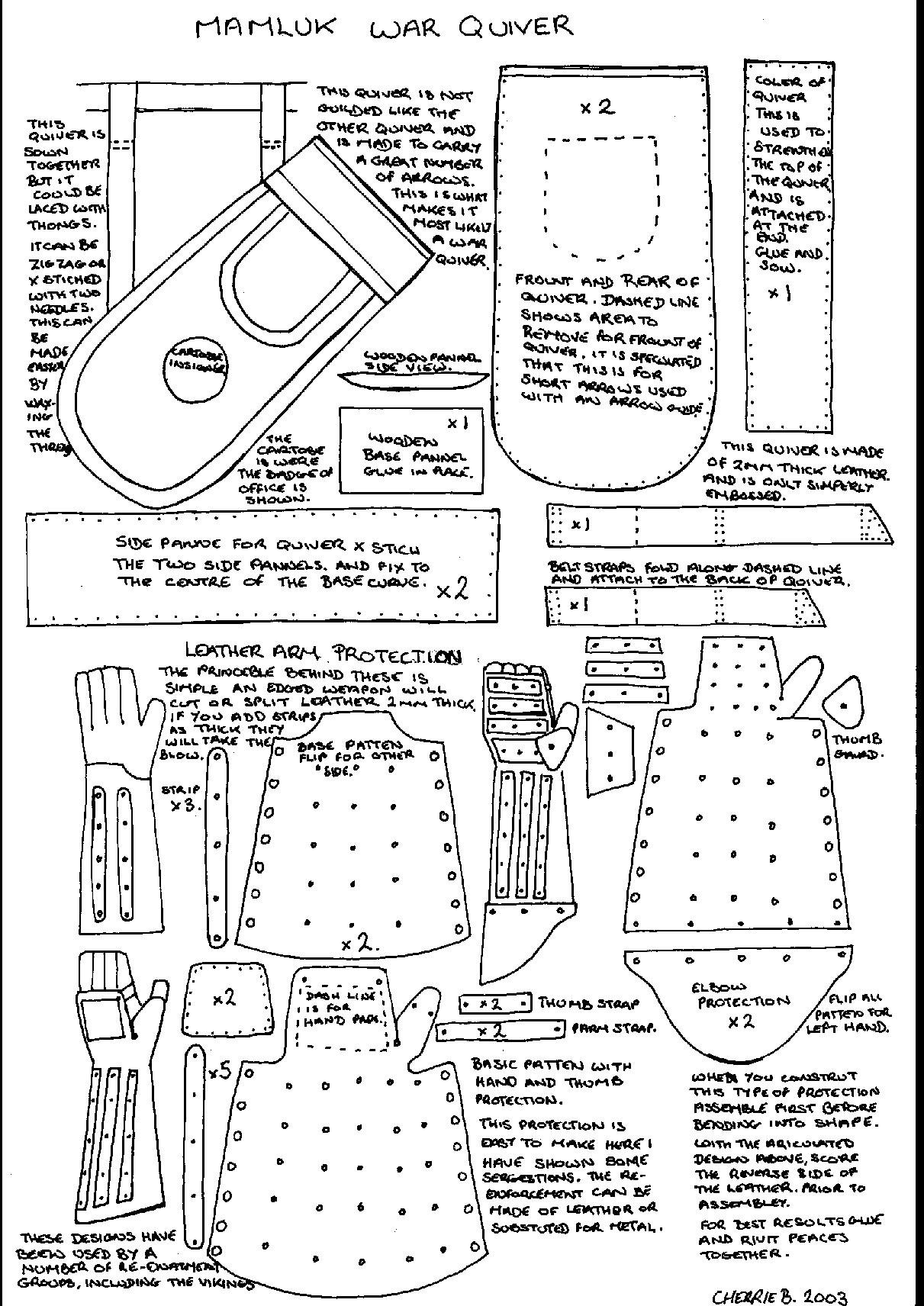
That's one of the designs I referred to in my original post--I was wondering whether I could use the closed quiver I'm already working on, because if not then I'd have to use that depicted design if I don't want to have knowledgeable people looking funny at me when I put the reconstructed outfit on.robno wrote:
There's also the pattern for Mamluk quiver right here on ATARN for consideration:
http://www.atarn.org/islamic/patterns/m ... quiver.jpg
There is considerable ambiguity in the quiver referred to the plan. It reflects the blockiness of the original artwork, but does not follow the detail that is available from contemporary paintings. The suggestions for construction are based more of contemporary medievalist reconstruction practices rather than relating to how things were done at the time.
I have attached a picture of a similar sort of quiver. If you remove the leopard tail which appears to have been a Mongol affectation, you are getting close to one of the Mamluk styles.
I have attached a picture of a similar sort of quiver. If you remove the leopard tail which appears to have been a Mongol affectation, you are getting close to one of the Mamluk styles.
Hmm...that picture is going to be very helpful. I might end up making both kinds of quiver after all, since I'm that kind of person....
Does the quiver shown in the last picture use the same suspension method as this Turkish quiver depicted in a related thread (i.e. should it be built with a third strap)?
There also seems to be a notable difference in the attachment method of the bowcase--the Turkish bowcase attached to the belt at only one point, while the Mongol example seems to have a small colored strap attached to second attachment point placed lower on the case's edge. Which one would be more appropriate for a Mamluk bowcase--the system depicted with the Turkish quiver, the one with the Mongol quiver, both, or neither?
There also seems to be a notable difference in the attachment method of the bowcase--the Turkish bowcase attached to the belt at only one point, while the Mongol example seems to have a small colored strap attached to second attachment point placed lower on the case's edge. Which one would be more appropriate for a Mamluk bowcase--the system depicted with the Turkish quiver, the one with the Mongol quiver, both, or neither?
The Mongol quiver was longer than the Turkish quiver and did not need a third strap to adjust its angle of suspension. It often had a wooden frame on three sides which also affected its centre of balance. In both styles, the quiver covered 60% of the arrows or more. The wooden framed quivers were more common on the steppe from what I can see.
The bow case with two straps is unique to the Mongol period up to the time of the Timurids. I have not seen it in art after the painting of Timur laying siege to Smyrna supposedly painted by Bihzad. I have not seen any evidence of its use by the Mamluks, though they were in contact with the Jalayirids and the Timurids. Perhaps there are some bow cases with the two metal suspention points in Mamluk art.
The bow case with two straps is unique to the Mongol period up to the time of the Timurids. I have not seen it in art after the painting of Timur laying siege to Smyrna supposedly painted by Bihzad. I have not seen any evidence of its use by the Mamluks, though they were in contact with the Jalayirids and the Timurids. Perhaps there are some bow cases with the two metal suspention points in Mamluk art.
It's always good to hear that the correct system to use is the simpler one. ;) Anyway, I'll probably add a Timurid impression into my list of reproduction projects just so that I'd have an excuse to make another bowcase with the two-point suspension system later....