
Jack Farrell's Subeixi Bow Reconstruction
My Subeixi bow now has much sinew on the back. The back goes over the tips onto the belly for a few inches. It seemed a good idea to put the sinew skin on the grip and because the tips cannot be altered, they got sinew skin. A cotton rope held the skin into the bottom of the groove while drying. This was not so hard. This has been complete for several weeks. About two months or more will be allowed before trial stringing.
Enough sinew for two bows has already been used.
Can't wait for the stringing and shooting part.
Good luck!
So now I will wait.
S
As historical paintings proove, Scythian bows are not to much reflexed, just as Jack has done it.
Waiting time now.
Michael
Once you start scraping the bow to tiller, you may end with another fantasy bow (as per Stephen's remark).... You have the measurements of the original already fixed.
Adam
thanks for stephen do the first base work the info form a real Scythian bowStephen Selby wrote:
Good work, Jack. At least now we can get people away from the 'fantasy' Scythian bows and focussing on the challenge presented by the real thing. Any estimate of draw-weight yet?
S
jack , very nice sinew back , greet,
adam, thanks for you Share your Experience here
Dusan:for the Balance i need do a nice sound bird man :lol:
That looks an excellent job. The original bows probably lost a little reflex with age and use. I think you have come very close to the one I saw. I think Adam's advice might be good too. The bow I saw and the photos of others indicate that they were fully wrapped.
This is all for the moment. Patience! -j-
I am sure I have seen bows this shape on Greek vases. Good luck when you draw it.
Excellent craft!!!!,
wonder if you could provide some dimensions (about the wood core thickness and width (regarding the buckling stability problem, i had recently failures in an ash bow that reversed every now and then!)).
Thank you Jack, keep us posted please!
http://atarn.net/phpBB2/viewtopic.php?t ... c&start=90
I have to chuckle wondering if there is a mathematical formula which can describe this bow's workings.
JJ
Since then, I have induced some small amount more bend to the lower limb.
The overall bow is a bit unstable but probably needs more curing. It is also very easy to correct, like a piece of wire. All the parts do bend but mostly in the grip and deflexed part of the limbs.
It will be too strong for me to draw fully. The exhilaration is blissful. Advice?
What is the mass of the bow?
Adam
Cem
Cem; I would say it is not stable, but there is time yet. It is hard to keep straight. Interestingly enough, the string absolutely will not fall off because of the deep grooves.
JJ; the picture is at 90 degrees. Looks like an illusion but is true.
In a way it is successful because I am able to shoot it and can learn about the feel and maintenance. I would prefer the lower limb bent more.
Adam
You have a very good shape in the bow as you draw it. There are so many Greek depictions of this type of bow on vases that looked poorly drawn until you see a bow like yours and realise that they really look that way.
Your comment about the security of the string is very important because many later artistic depictions of bows show the strings in all kinds of positions. Your reconstruction shows that these artists had probably never saw a strung bow unlike the Greek vase painters.
BTW, folks, I have located a good maker of rawhide (deer skin) strings with loops for those who want them. He will make them to your spec (total length and loop size.) The loops are spliced, not knotted. Jack: if you want one for yours, send me an email or PM asap with the measurement, because I can get it mid-June when my wife is in Peking. Would not be expensive; but I haven't got a price.
S
Are these made in the same way of the Qing rawhide strings? I have now made gut, linen and silk strings for one of my bows and was going to test them, but a rawhide string would be an interesting addition to the group.
Do you mean they are multiple strands of thin rawhide?
The Middle Eastern way was to cut a strip of rawhide wider than the string, soak it, and then twist it. The resultant cord was pulled through a metal ring to give it a smooth, even surface. The cord was then hung out to dry under tension and prevented from untwisting itself. Once dry it was rubbed with a burnisher to get a smooth finish.
I was going to use a steel dowelling plate instead of a ring. One instruction was to vary the width of the strip of rawhide depending on the thickness of the skin. I have seen one of these from China in good condition on one of the Qianlong Emperor's hunting bows. It looked like a smooth white cylinder with fine diagonal lines showing where the twist was. It was very uniform and about 5 mm in diameter. It was self knotted in the standard fashion.
I guess so. Maybe three of four strands, because they are nicely spliced at the loop. I didn't have time to look carefully; but they're nicer than anything I've seen. Anyway, I've ordered some for me and Jack and we'll know soon enough.Bede wrote:
Stephen,
Do you mean they are multiple strands of thin rawhide?
S
Incidentally, he'll make archery-related leather goods for people who don't want to make their own. He's invented a rather neat leather keyring tab that doubles as a thumbring (or thumb protector). 8)
JJ
http://atarn.net/phpBB2/viewtopic.php?t ... sc&start=0
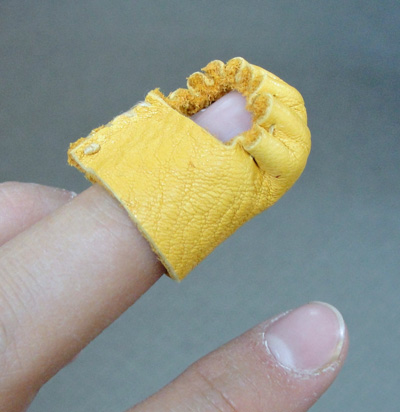
Ciao, Mr. Farrell, probably, you'd better to try your recontructed "Subeixi" bow with thumb ring or glove ("She" in Chinese. In this character, the left part is "Wei", which means the leather. For instance, the famous story of Confucious - "Wei Bian San Jue". The right part is "Die". Obviously and originally, this ware is made by leather. At present, we proved it by archaeological evidence. What is the Japanese name of "She" - the leather thumb glove?), because archaeologists excavated them from Yanghai Cemetery. As we know that, a part of remains in Yanghai Cemetery belonged to Subeixi Culture.jack farrell wrote:
Of course I have begun shooting this bow but with a very short draw. The place where I have gripped feels like a sweet spot, but the main grip lays below this spot. And since I (probably erroneously) made the lower limb similar in dimensions as the upper, and gave it a head start with the extra grip material below, it seems like the upper limb is doing most of the bending.
Since then, I have induced some small amount more bend to the lower limb.
The overall bow is a bit unstable but probably needs more curing. It is also very easy to correct, like a piece of wire. All the parts do bend but mostly in the grip and deflexed part of the limbs.
It will be too strong for me to draw fully. The exhilaration is blissful. Advice?
I have seen a bronze version of the bone one you illustrate first. The design was to protect the tip of the digit and the common use now is to force needles into some sort of material. On the bronze one there was no chance to see wear patterns on the surface because of centuries of patina.
The protection of the tip of the digit for archery purposes would indicate a finger stall as were used in South China during the Warring States period. I am not sure of the modern Chinese spelling for the name but it was pan chao in the Wade Giles system. The leather example reminds me of these. It is also similar in construction to the current Bhutanese examples which are made in groups of three. The old pan chao were bamboo in the south I think, but the similar use is clear.
The reason I make these comments is that these objects appear better suited to the protection of the tips of the digit rather than the distal joint, which is the area that the thumb ring sits. If the second one is large enough to cover the thumb, then I suggest that this is a transitional piece where a finger-stall using person has made an attempt to cover the thumb in the same manner. This might be the case where a local archer had decided to shoot like a Han soldier and made his equipment in the local manner.
My comments are speculative. There is other evidence of differing archery techniques. The existence of arm guards in some burials is not of itself a reason to believe that the Mediterranean release was in use locally. They could have been to keep wide sleeves out of the way of the bowstring. However, the garments had narrow sleeves and there is some later evidence of Western archery influence in cave paintings and tomb reliefs. If these object (or one of them) represent a transition between Western and Eastern techniques, this would be a great discovery. We already have Western-style bows (Scythian) represented in the graves.
This is not a thumbring. I spent a long time handling it in Urumqi. It is a thimble used by leather-working people.
S[/img]
Anyway it is so nice, thanx for sharing.
Michael
It could be a thimble - "Ding Zhen". However, as I know, remains of Yanhai Cemetery were never brought from Turfan to Urmuqi? Are you sure that you handled the same object, or there is another one from another site, which is kept in Urmuqi? It will be interesting.Stephen Selby wrote:
This is not a thumbring. I spent a long time handling it in Urumqi. It is a thimble used by leather-working people.
S[/img]
Please also add your opinion of Yanghai "thumb rings" in the lecture of NWU. At present, Turfan Musem has already displayed them together, and named as "thumb ring" with the archery ware.
The leather one is as 1/2 or 2/3 as my thumb. And it is excavated with other archery wares from the No.2 cemetery of Yanghai. Obviously, the date is much more earlier than Xiong-nu or Han conquering Serindia.Bede wrote:
While there is no doubt the Chinese were using thumb rings at this time, I am not sure that what you are illustrating are for shooting with the thumb.
I have seen a bronze version of the bone one you illustrate first. The design was to protect the tip of the digit and the common use now is to force needles into some sort of material. On the bronze one there was no chance to see wear patterns on the surface because of centuries of patina.
The protection of the tip of the digit for archery purposes would indicate a finger stall as were used in South China during the Warring States period. I am not sure of the modern Chinese spelling for the name but it was pan chao in the Wade Giles system. The leather example reminds me of these. It is also similar in construction to the current Bhutanese examples which are made in groups of three. The old pan chao were bamboo in the south I think, but the similar use is clear.
The reason I make these comments is that these objects appear better suited to the protection of the tips of the digit rather than the distal joint, which is the area that the thumb ring sits. If the second one is large enough to cover the thumb, then I suggest that this is a transitional piece where a finger-stall using person has made an attempt to cover the thumb in the same manner. This might be the case where a local archer had decided to shoot like a Han soldier and made his equipment in the local manner.
My comments are speculative. There is other evidence of differing archery techniques. The existence of arm guards in some burials is not of itself a reason to believe that the Mediterranean release was in use locally. They could have been to keep wide sleeves out of the way of the bowstring. However, the garments had narrow sleeves and there is some later evidence of Western archery influence in cave paintings and tomb reliefs. If these object (or one of them) represent a transition between Western and Eastern techniques, this would be a great discovery. We already have Western-style bows (Scythian) represented in the graves.
This leather protection is really cool. It is only a question of it?s dimension to determine if it was a finger tab or thumb protection. Can we get information on length/ width of this exceptional find?
As far as I know, old chinese thumb rings indicate that their thumbs were much smaller than ours are today. Of hundreds of old manchu design thumbrings I?ve had in my hands, maybe 2 or three fitted on my thumb, which is quite small.... That would be in favour of a thumb protection.
JJ
Bede, I admire your scientific spirit. Probably, the last photo is too large, make people to think that leather thumb glove is as big as a a sock?Bede wrote:
Another question, are you writing about the width of your thumb or the length? It is starting to sound like a finger stall from your comment unless you have a very large thumb.
Furthermore, archaeologists just discovered one leather thumb glove in a grave.
BTW: Stephen, I still have a problem to upload the photo in the forum of "Archery literature". Do you think it is kind of bug of this BBS?
You are welcome. The director of Turfan Bureau of Cultural Heritage, Dr. LI Xiao and the researcher of Xinjiang Institute of Cultural Relics & Archaeology, Prof. L? Enguo are invited by DAINST. They will visit Eurasin Department of DAI in Berlin on Jun 14th. Generally, they will give some lectures in the DAI. If you are interested, please contact with the Deputy Director of Eurasian Department of DAI, Prof. M. Wagner. I think the event could be arranged by her.JJ wrote:
Serindia, thank you very much for these pictures!
This leather protection is really cool. It is only a question of it?s dimension to determine if it was a finger tab or thumb protection. Can we get information on length/ width of this exceptional find?
As far as I know, old chinese thumb rings indicate that their thumbs were much smaller than ours are today. Of hundreds of old manchu design thumbrings I?ve had in my hands, maybe 2 or three fitted on my thumb, which is quite small.... That would be in favour of a thumb protection.
JJ
It's fine to label it as a 'thumb-ring', but it is not an archer's thumb-ring. It is constructed so as to stop it slipping up the thumb on applying downward pressure, like piercing thick hide with a needle; but it would be useless for shooting as it would come off the tip of the thumb on release. Even when I asked a lady colleague with small hands to put it on, she couldn't get it over her thumb to the first joint. Hence it's not an archer's thumb-ring. Given the strong economic interest of the inhabitants of the graves in leather-work, a thimble would be a more natural explanation.
I don't know if it was excavated with a male or a female corps. The females often had sewing equipment buried with them.
Sir, you are reasonable! I suggest you to add the discussion in your presentation of NWU on Sep.Stephen Selby wrote:
Maybe I'm a bit hazy about exactly where I handled the thumb-ring. It wasn't at the actual Yanghai site but at the store where the Yanghai excavation materials were being stored.
It's fine to label it as a 'thumb-ring', but it is not an archer's thumb-ring. It is constructed so as to stop it slipping up the thumb on applying downward pressure, like piercing thick hide with a needle; but it would be useless for shooting as it would come off the tip of the thumb on release. Even when I asked a lady colleague with small hands to put it on, she couldn't get it over her thumb to the first joint. Hence it's not an archer's thumb-ring. Given the strong economic interest of the inhabitants of the graves in leather-work, a thimble would be a more natural explanation.
I don't know if it was excavated with a male or a female corps. The females often had sewing equipment buried with them.
Futhermore, at Dongheigou Site, Barkol, Dr. MA Jian and our colleagues excavated many bone objects, which including the plate armour. Probably, you can help them to identify some archery wares. I heard that, they are kept in the store of Xi'an Section, Archaeology Institute of CASS.
http://www.alaskafurexchange.com/images ... himble.jpg
I doubt if any one using any of the more powerful bows in Xinjiang used a pinch draw. Pinch draws are relatively rare except for children's bows and other moderately light bows. Large nocks are not necessarily an indication of a pinch draw.
I think the leather protector is functionally related to the leather finger stalls used but the Bhutanese. Such a device is probably not suited to a standard thumb draw. I would not rule it out, but there would have to be more evidence to narrow it down. It is perfectly reasonable that the object is a finger stall. Individual ones of the type the Bhutanese archers use would easily become separated and lost. Modern ones are connected to a wrist strap to prevent that problem.
The Bhutanese archers I met could make a set of finger stalls in minutes. These finger stalls were used to pull heavy bows in my presence though I don't think any were 100 pounds.
It seems the arrows were used with the three-finger draw (or two-finger). In this case the shallow nocks will be useable, and the leather protector could then be one of the surviving finger stalls as Bede suggests.
Adam
Thanks for the explanation. I personally believe from related material that a two or three finger draw is likely.
I must have missed something about the arrows. The ones I saw in Seoul associated with the Scythian-style bow there had nocks with a depth of 1.5 or 2 times their width, I think. Some were deeper. There was doubtless a greater range of sizes present in the museum in Xinjiang. When I was making flight arrows, I made a set that was had nocks that were 3 mm wide and 5.5 mm deep. These I shot through a siper, which requires very light contact with the nock using a thumb draw, and three fingered, without the siper. Since I had fletched them right down to with 8 mm of the nock, three fingered shooting was not that smooth, but it still worked. The two fingered Sasanian draw worked perfectly. They were not a tight fit on the string, but would fall off under their own weight.
Secondary and Tertiary pinch grips also have fingers on the string but the grip does not seem to be indicated by the nocks on Scythian arrows. This finger protector could have been used that way also; but with a #100 bow?
You could be right. Secondary and Tertiary releases both have the tip of the index finger on the string while the middle segment and the thumb steadies the arrow. The index finger could be under more stress than the others.
The fact that some bow reconstructions turn out 100 lb bows does not imply all buried bows were that strong. On the other hand, Tertiary releases are strong enough for a hundred pound bow. They are as strong as a Mediterranean draw and only a little clumsier in the actual release. At least three fingers are on the string at an angle. The have the same effect on paradox as the Mediterranean and in the case of New Guinea, where the Tertiary release is still used, they could be used with bracers on the bow arm.
Second that. I have arrows from Eastern Han and Imperial Mongol periods, and I have handled lots of Saka ones. There's little to choose. Also, I have fistfuls of arrows from the Tibetan people of Qinghai and they are mostly identical in construction to the ancient arrows.jack farrell wrote:
In fact in the Silk Road museum there were three groups of arrows; Scythian, Hunn and Mongol Empire. The similarity between the arrows was marked. None had deep nocks.
This brings up an interesting topic, Stephen. The arrows accompanying the SRMS Scythian arrows have fake looking wood pionts, and the Hunn arrows also look to have once had points, now removed. Can you think of any belief system which would dictate this practice?
Second there was the widespreaded belief among our ancestors that the dead ones could not threaten seriously the living ones with somehow poor tips.
Michael
Only the Mongol period arrows that I have, which are in quiver, have their original points. All the Saka and Xiongnu arrowheads in my possession/that I have seen have been crudely broken off.jack farrell wrote:
This brings up an interesting topic, Stephen. The arrows accompanying the SRMS Scythian arrows have fake looking wood pionts, and the Hunn arrows also look to have once had points, now removed. Can you think of any belief system which would dictate this practice?
The Saka bows I see in burials are usually intact (i.e. not broken on burial); but the Xiongu ones were broken and burned. I understood that burials were sometimes disinterred, the old remains burned.
I have another case of a Xiongnu-style bow for which only a painted core was buried. In the case of another bow of the Mongol imperial period, the bow that was buried seems to be real but unused, without string nocks cut into the siyahs.
I can't really say anything clear about the burial practices now; but the conference I shall attend in Xi'an in September would allow things to be made clear. We should also recall the Xinjiang may have been remote from the heartlands of these different social groups and the burial customs might have been local to Eastern Xinjiang.
I think Serinidia could give us good insights on this question.
Alternately, I will sometime this summer go on vacation to the desert/mountains where the humidity is nice and low. But I would like to learn to approximate these conditions at home. Please advise.
I am also happy to report that once laid out and drawn on a board that the lower/smaller limb does bend tolerably. The sinew has a nice whiting color as would be desired along the limbs.
At this point, to balance the limbs, the top limb would now be best made less deflexed to show less bending at full draw. The bottom limb should now be made more deflexed. It is a good time to do it now, because the limbs are well humidified in this weather and will respond well to corrections.
I suggest to warm the top limb whole, gradually flexing the upper parts into more reflex, at he same time letting the warmed deflex part to open a little by itself with no pressure. It can be tempting to try flexing it back as the top part, but I would be rather careful here. It is because the reverse pressure, as such a small radius of the bend combined with the great thickness, may cause delamination of the horn (a lot of stress on the glue lines). So, reflex the mid-top sections with some pressure, but leave the deflex alone. All the time the whole limb is warmed.
Once finished, turn to the bottom limb. Warm it only at the deflexed section and force bend onto a form. The heat is best directed at (and a little beyond towards the tip) the narrowest place. Do not heat or do anything with the rest of the limb, since you want the string follow (if any) to remain as is.
Then leave the bow for a month like that with the former attached, then transfer to a drier place as you like. When strung, keep a good barshak on the top limb all the time. The bow will still be assymetrical as it should, but useable.
The nock fit is another matter. I noticed the horn stubs, if not very curved forward or made longer (as it can be seen on some of the bows), may not keep the string loops secure enough. I suggest to file a groove for the loops on the back side at the base of the stubs. And make the string loops very tight, or tie the string there instead with a timber hitch or something like that.
Adam
This gave some time for thought. As I want the bow as good as possible, I decided to add sinew to the weak limb- the long upper limb. It could have been done as the Yanghai and Miran bows were done, by adding the sinew over the spiral binding but it might have looked like a repair so I filed and scraped the long limb clean from tip to grip.
Now I intend to add another layer or two of sinew to strengthen the limb and reenforce the recurve so as to prevent the tip turning again. If this is successful, the spiral layer will be replaced.
So life goes by, glue and sinew are used up. It is now the end of Jul. -j-
Now I must decide whether to disassemble my original or start over.
Adam
Is it insanity to think that a flat could be rasped onto the edge of each side and the core widened slightly? This seems to be in the spirit of the originals.
Before adjusting, the bow turned at 22" and #65.-j-
65lb at 22" will be around 120lb at 28". Even in the heat and humidity of Texas! Very close (prob. a little heavier) to the bow I made .
Adam
So in dimensions the bow is the same as the original except for being slightly thinner. This should give a stabler cross section.
Both belly slats were cut from inner curve of Nubian Ibex.
Some other thoughts on making a Scythian type from a single Ibex horn; After removing the knobs,the first cut would be to remove the outer curve slat but stopping before getting to the tip.
The second cut would remove the inner curve also ending before the horn tip.
Then the two side slats would be separated leaving the entire original tip on one side strip and the fourth side strip would also have a thick but shorter tip.
As they are cut one would have the ingredients of an asymmetric Scythian bow; one long outside curve belly slat, one very long side slat for the upper vertical limb slat, another shorter inside curve belly slat and a shorter sidewall slat for the lower vertical core slat.
Adam, Considering the core and sinew drying time already elapsed, how long should I wait for the new belly to cure?
The sequence sounds very probable and it would be very efficient. Then one horn = one bow. It is quite possible they used other scraps of horn for the bellies as well. Since you you have experience with ibex, perhaps you could do a few mechanical tests, such as bending tests for the modulus, and compare with buff horn? I do not expect anything dramatic, but it can be interesting and helpful for the replicas. Not the Siberan or Persian ibex, but still a different species.
I usually wait for a month for glue joints to dry. Perhaps you may want to consider thinning, or better narrowing the outer limbs and tips, so that the bow gains in cast and be more in proportions to the original? It could be done after tillering.
Adam
bending tests for the modulus
i think you are said the very important thing share to us, thanks !
maybe many test (bending and others) follow each step , if you bend it it is break or not fine, you has time redo it and think a few or more glue or weak glue,at least you need made other one bow for test
Using my cutting method, the greater part of each sidewall would remain but of shorter length.
I am taking my bow to the Silk Road Symposium in Philadelphia this weekend but do not know if any archers are in attendance. But carrying a Scythian bow around should ferret them out if there are!
The test can give a rough idea about the stiffness of horn within, realistically, say 20%. It is more than enough for our purposes, because in the laminated construction one layer contributes only a fraction to the overal stiffness of limbs and therefore to the draw weight of the bow. Even if the stiffness (resistance to bending, not the resilience) of one horn is twice as much than the other, the bow will be only perhaps 15% heavier.
The resilience, or hysteresis, can be tested by Dick Baugh method, which is a modified Tim Baker bending test if I recall. I have not done that, but it is not too difficult.
The properties of the horn, however, depend heavily on its moisture content. The sample must be kept together to equilibrate for a long time and the tests done in the same room.
Adam
I have the impression that the strength of horn can be variable inside the species. It will be probably depend also on the shape, e. g more or less curve in the horn.
So, comparing horn can be difficult...
JJ
All those contrivances described above have borne fruit. My beloved bow is up and shooting; stable, flexible, manageable. Right now I have drawn it to 26" but it is not stacking.
You can see the new belly and how it was spliced in. There is no wrapping yet, it was left off for tillering. The upper top limb needed warming and flattening as Adam described so long ago. This was done with the heating pad and a former made for the backing side. Later left strung overnight, relaxed and braced several times, then braced and shot.
You can see that the grip and hooks are not out of proportion.
Never give up a bow, until it has broken.
Michael
Inevitably the question of why they were shaped like this comes up. I some times think it is a bad question because we will probably never know the real reasons their original makers had. Our reasoning may be much more attached to technical solutions than the original intention. Anyway, it seems you are both (Jack, Adam) suggesting that the ease of construction, with regards to the avaliable materials, led to this shape. A thought that probably would never have occured if it was not for the reconstruction of these bows. It is a good example of what I like to think of as reconstructional archaeology.
Perhaps some shooting will lead to other reasons for this "unprobable" shape?
A serpentine shape allows a longer bow to occupy a shorter space- Stephen.
Adam's and Stephen's thesis is that the shape of Ibex horns are manifest in the bow shape. I however use the horn backwards and forwards as needed except to assist with the hooks, which require the greatest cajoling to take their shape. Therefore I find the shape of Ibex horns as incidental to the bow shape. Any horns should work; for instance sheep rather than goat.
Right now I take Michael Redhawk's position that the bow is a cultural attribute of Scythians who obviously took great pride in the beautiful shape.
Soon I will take more informative pics and do some tests.
Michael; the string lay is very true, right now.
Ivar, same question is about the split-limb bows of the Egyptians. The figure 2 was the most holy symbol for the ancient Egyptians. Maybe there is a relationship of the Angular bows to the angles within the pyramides?
Michael
Decoration would be a clear example of a non-techincal attribute, but perhaps the overall shape of the bow can be said to have had a "decorative" aspect. As tradition had settled in, its shape would probably be a clear identifying symbol of the object. - but what reasons could there be for taking up or starting the tradition of making such serpentined bows?
Hm, was that clear?
The protective skin on my rebuilt Subeixi Scythian is now cured and I have begun shooting it. Twice I have stopped for maintenance but looks like things are stabilizing nicely. This FD test ended when it was apparent things needed more lining up. I made a deer raw hide string, 5 strand, which works much better than anticipated. A figure 8 knot is softened and worked into the loops- timber hitch? When plucked the string resonates for 3 or 4 seconds. I do not remember a dacron string doing this.
Comments?
I am trying to compare your bow with the replica I made to the original dimensions of these bows. Yours is a little thinner mid limb (by about 5mm - 18 vs 23mm), so the draw weight is lower. It is difficult to calculate the weights by calculation, because your grip dimensions are closer to the original than the (thinner) mid limb, but it seems the originals would be roughly twice as heavy - (23/18)^3.
Assuming the draw weight grows abut 3lb per inch, the draw weight at 28 inches would be about 67lb for yours, but some 130lb for the originals. Mine showed 120lb at 28in, a little less. This is somewhat surprising, since the ambient humidity you had was so much higher than mine, which should reduce the weight even by about 10%.
Why your bow, if made to the original dimensions, would be heavier? I think this can be explained by looking at the bending characteristics of the bows. Your bow, with the grip of original dimensions, but the limbs thinner (where bending), flexes less at the grip, but more at the limbs. My bow, made to the original dimensions, definitely flexes quite a bit at the grip (see the video). The flex at the grip reduces the draw weight and makes the bow stack less - apparently by some 10lb, probably even more, given the humidity differences. This also means the f-d curve of your bow is not the perfect representation of the f-d curve of the original bows, if that matters to people.
I know of someone making another replica and we will see what happens again.
Adam
Adam
This is my stash of Youpon arrow sticks.
btw.the nocks in the thumb glove picture look exactly like Iranian arrows!
can you tell a bit more about the string?
Back to arrow making. The small whittled hollow allows you to insert a miniature plane diagonally and enlarge the hollow moving forward. Whenever working on arrows I like to keep the tools diagonal to avoid a transverse flaw.
Finish with the plane blade set very shallow for a good surface. A hole gauge- a metal plate with graduated hole sizes makes the arrows all the same size.
Next smooth with a scraper with a hook ground into it such as my Little Bird Scraper cut from a hand saw blade.
This cresting is made from hematite powder (red) and pearl glue and smut from a wood stove (black) and pearl glue. I do use artist's final spray matt fixative to fix the paint but the hard liners will never know if you don't tell them.
Take the crested shaft and nock the shaft onto a strung bow, any bow. Mark a small pencil dash at the beginning and end of where the quill is desired. Take a utility razor blade and drag it flat across the crested shaft several times between the marks to reveal fresh wood to glue to. Apply a bead of Tightbond or white wood glue and use pins to make the fletch stand straight up.
When the cock feather has dried, release the pins and mark the other two locations by dividing the circumference into three equal parts, mark, scrape and glue and pin.
did you sand the arrow heads for weight control?
jack farrell wrote:
Here is a way to do perfect fletching by hand with few tools. The quill is worked down in thickness to 1 mm or less. A belt sander is an invaluable tool for this operation. Then take the wide side of the quill and cut down to 2 mm or less with smallest surgical scissors. If the quill is curved, then crimp along the edge between the thumb nail and finger tip to straighten. Cut the vane down to any manageable height. Pull one or two barbs off the front at a time to bare just a little of the fletch.
Take the crested shaft and nock the shaft onto a strung bow, any bow. Mark a small pencil dash at the beginning and end of where the quill is desired. Take a utility razor blade and drag it flat across the crested shaft several times between the marks to reveal fresh wood to glue to. Apply a bead of Tightbond or white wood glue and use pins to make the fletch stand straight up.
When the cock feather has dried, release the pins and mark the other two locations by dividing the circumference into three equal parts, mark, scrape and glue and pin.
Francesco
Not worth covering up all the work for.
I want to take this one to a flight field. Will work on that.
Would like to make another, Just when though?
You have to be proud because you and Adam make some forgotten history alive. I hope we will see another beauty.
Cem
The best shot was with the heavier flight arrow, which consistently out performed the light one at 196 yards but the real shocker was that the war arrows were never more than 10 yards behind and one war even went to 195 yards. These can only be approximations.
The flight arrows of perfectly aligned grain Sitka spruce fishtailed wildly which most likely took up a good deal of speed while the war arrows flew beautifully and consistently. I think the thing to do then is to make a hardwood flight arrow without the heavy point.
I apologize for all the issues and will be better prepared next time. Experienced flight shooters please help. Jack
Now you must have a gorytos and a scythian hat.