here is a good example of the similarity between
tatar bows (from turkish museums) and the
korean bow (a hwarang)
:wink:
Uli
next
scemdonmez
Uli, is it possible to take cross section photo in broken place?
Cem
Stephen Selby
Is the Korean bow used for comparison a hornbow?
Uli
Stephen Selby wrote:
Is the Korean bow used for comparison a hornbow?
no its a laminated Hwarang I got from Thomas Duvernay
I never shot a real korean or turk hornbow :-(
nevertheless this laminated bow has a stunning performance
there is a lot of "string follow" that would probably only be seen
in the korean horn-bow directly after unstringing or so
;-)
Uli
scemdonmez wrote:
Uli, is it possible to take cross section photo in broken place?
Cem
I wish it would be ! (also for my own bow project)
but the tatar bows you see are only paper copies
scaled to about 48 ntn length
Dusan
Uli , why you dont working vith pic real Korean horn bow too ? Than you can see very close similarity between this too tipe of bows. You cant turn vith pics angel :lol: .
Bede
Having actually laid a Crimean Tatar bow and a Korean horn and sinew bow next to each other, I have to say that the similarities are a bit superficial.
The cross sections and which parts bend are different. The Korean limbs are much narrower and the limbs bend almost as far as the string bridge. The Tatar bows have wider bending sections of the limb and the kasan is ridged and rigid.
In my limited experience of strung Tatar bows (all replicas), I also observed that the set back in the handle is not so pronounced. I have seen quite a few Korean horn/wood/sinew composites strung and strung one myself with help and they keep more of the reflex in the grip.
Tatar bows come in different sizes, but all have more massive limbs than contemporary Korean composite bows. This may be because surviving Tatar bows are often war bows while most Korean composite bows are target bows and are optimised for that function.
But they both take advantage of a long draw to get much more energy into the arrow. I have seen two Korean bows classed as war bows in the Grayson Collection and several in Korean in a museum and they are longer and more massive in the limbs than current target bows. They also had wooden bellies laminated to the core instead of horn. They looked very effective. These are not the Qing style bows and have siyahs that resemble heavy duty versions of the standard Korean target bows.
I am not trying to discourage looking for similarities between different bows, but photographs are two dimensional and so some features seem less important. In profile, there are similarities, but in bending and structure there are dissimilarities.
Uli
thanks Bede
that's interesting facts
Dusan
This thread start vith -soryUli- vith naive pic colage , but have interesting ground.
Bede i cant agree vith your position. You thinking about todays sporting Korean hornbow. This bow is very modern variation from old war and hunting bow , who is more similar to the "tatar bows." This old war bows have -like tatar bows longer not working kasan vith ridge, another disain but still bash , like tatar bows, wider limbs - like tatar bows. Somtime tatarbows have even greater angel in handle section than tatar bows. Both bows are longer than todays - korean bows - about 130-+ cm.Very similar bows. I mean here is place to more teoretical - historician questions...
(This problem was very interesting for me , because i am now in work in some tatar bows ...And first what i see is very close similarities between this bows and mi Korean hornbow.)
Bede
Dusan,
I don't think you have seen the Korean war bows I mentioned. They are very similar to a bigger more robust form of the target bow. They have the same form of kasan to use the Turkish word and the tip is the same as a modern Korean target bow but thicker.
147.5 cm nock-to-nock around curve; 5.1 cm wide at mid-limb; 1.8 cm thick at mid-limb.
Also MAC 1998-0112, which is described
Length is 164 cm; mid-limb width is 5.2 cm; mid-limb thickness is 1.7 cm.
These bows are bigger and more robust than Korean target bows and conform to Korean subscriptions of war bows. There are other bows that resemble Qing Manchu bows. Due to the relationship between Qing China in the latter part of the dynasty, it is likely the Qing style bows are either gifts, purchases or built to conform with Qing military regulations.
I agree that we were discussing more theoretical historical questions in this thread, but it is best to start one's theory from accurate facts. The problem I saw in the thread was that no one had commented on the difference between the structures of the two types of bows. It seemed to be based on profiles which do look similar. Looking at historical bows in the flesh reveals that the similarities are superficial. This does not invalidate the proposition that there are connections between the two types of bow. I think that the late Yuan and Ming bows were part of a continuum of bow types characterised by set back handles, short working limbs and long kasans. However, there is a native tradition of bow building in Korea that seems to have absorbed these ideas without giving up rectangular-sectioned kasans and a number of other features. On the other hand, Korean bow making tools and approaches are so similar to equipment from China to Turkey that one is forced to assume there was a common technology despite distance and the difference in bow design.
What I think has been missed is that, excluding the Turks, everyone in contact with steppe cultures after the 1600s moved to using bows with longer draws and heavier arrows. At the same time, muzzle loading guns like muskets became common as the long distance weapon of choice. It seems that the bow became the medium range weapon preferred by horsemen because their rate fire was higher than any combination of pistols carried on horseback. Guns had initially resulted in heavier armour being used to counter their penetration so bows had to deliver a more energetic and penetrating arrow to compete. Later armour was discarded because it was ineffective against guns making the arrows more effective. It is interesting that in the Austro-Hungarian Empire, armour was given up fighting on the Western fronts against European foes while it was retained on the Eastern front against the Turks and their Tatar auxiliary cavalry. However, archery never came back as major weapon because its advantage was on horseback and missile cavalry was in decline in general as infantry tactics improved.
Stephen Selby
Always at the risk of being yelled at by Korean friends, I am convinced that the Korean model was based on the Turkish (including Crimean) designs brought in by the Turkish mercenaries serving under the Mongols.
Kudos to the Koreans and Chinese of the Ming Dynasty for adopting a really efficient design, and hanging on to it and improving it while and Chinese of the Qing Dynasty together with the rest of Asia became infatuated with the Manchu fashion which, imho, was inferior. :twisted:
Dusan
Well, i made some pics for more understable what i think. here is old Korean Chosean era war and hunting long (156 cm ) bow :
You are making a good point Dusan. These bows are indeed functionally very similar = rigid kasan + set-back grip (the tip shape is a minor issue as to the workings of the bows). Thanks for the pictures. Tatar bows varied quite a bit, mainly in the degree of grip setback and in recurvature of kasans, as well as in the relative lengths/widths of the sections, so Bede may be right, depending on what you look at.
To add to Stephen's comment on Ming: I have seen a couple of bows in the Museum of War in Warsaw - presumably coming from China, but of unknown provenance. One of them had Chinese decoration. I could not tell the difference between these two and the Crim-Tatar bows, although the side ridges in sal were absent. These two bows may be the only known survivors from Ming?
Adam
Bede
Dusan,
While I have seen some of those bows in photographs before, I had not seen Korean bows with ridged kasans in the flesh. I had been looking for them because I also see influences in Korean bows from outside. Some of the photos I did see were not as clear as yours and your ones are very useful. It would be even better if you had larger images.
It was not until I saw bows of the Central Asian Turkish style that I saw bows with similar kasan cross sections to Korean bows that I had seen. 10th century bows had kasans of a rectangular cross section which persisted into the early Mongol era. In Korea, this idea survived into modern times though the Koreans used their distinctive belly-ridged tips.
I would dispute with Stephen that the Manchu bows were inferior to Ming bows. The Manchu bows have a number of features that were more important at the time they were used than those of their predecessors. Their primary disadvantages were that they were big, hence unwieldy, and did not have long range. Their advantages were stability, accuracy and force draw curve that made them easier to draw for a given weight at their length.
Once matchlocks took over both the long range missile role and rendered armour obsolete, then heavy arrow shooting accurate bows came into their own. Adam points out in his book that a Turkish bow can shoot a heavy arrow efficiently too. They are not limited to shooting light arrows and this would apply to Ming style bows. Unfortunately, people did not have research labs to test these simple physical claims. Decisions were probably made on "common sense" ideas that heavier arrows needed bigger bows. When the Manchus conquered China, it is unlikely they would have given up their bows to use the weapons of the vanquished, particularly since their bows fulfilled the new military requirement for archery. On the other hand, conservatism could keep an existing bow in use. The Turks did not change their design, but they were not overthrown by another bow using culture either.
I doubt that real history was as neat as this. When you look at wider historical trends, I think it is even harder to develop a clear picture of what happened. It is clear that similar problems led to similar solutions, particularly since the base bow types originated from innovations made by the Turks and/or the Mongols. Judging from wall paintings and the occasional bone lath, the early Korean bows were strongly influenced by steppe fashions. Did the bow type in the Grayson Collection and in some of Dusan's photographs develop the ridged kasan and then lose it or did it have it initially and then go to the rectilinear design to introduce kasan flexibility?
I would also like to add that there is another type of Korean war bow. I will qualify this by saying that I base the classification on historical descriptions related to real bows I have handled. They may not be war bows but cheap military practice bows. These bows are about the size of a Korean target bow, have wooden bellies, are completely sinew wrapped and black lacquered. One other peculiarity is that the tip is more like a triangle in section with the apex on the belly side. The area where the loop rests is not scooped out. I have seen these both in the Grayson Collection (MACs 1995-0658 and 1995-0702) and in the Military Museum in Seoul. I have handled them and can confirm that the bending section had a bamboo core.
jack farrell
Korean target hornbows have a single core lath with spliced in ears and a grip overlaid onto the back side of the core lath. My assumption is that the earlier war bows would have been constructed on the same model.
I believe that Adam stated earlier that a Turkish Tatar bow had that same construction.
The only angle which is permanent is the bend at the ear. Since both bows have all the same parts, one might assume that they had a similar origin.
Thanks Bede and Dusan for the sources. -j-
Bede
Jack,
Applying the handle riser to the back of the limb is noted on Persian bows based on the dissected one at the beginning of Turkish Archery and the Composite Bow. The diagram is attributed to Balfour. The Ming encyclopaedia also refers to a single piece of bamboo as the centre of the bow making up the handle and the bending sections. The book describes the bamboo strip as being about two ch'ih (61.2 cm in the Ming Dynasty where the ch'ih was 31.1 cm) long and narrower in the middle than the two ends. The siyahs are made from mulberry wood spliced into the bamboo. It is not specified in the text whether the length of the bamboo strip is its total length or the length to the beginning of the splice. The profiles of the Ming bows in paintings imply the handles have a riser on the back side.
To clarify the measurements, Stephen may offer some comments. In books of this time it was not uncommon to mention a measurement that in reality is part of an unacknowledged quotation so the ch'ih might have had a different length. Considering most ch'ih from previous dynasties were shorter, the quoted equivalent is more likely.
Getting back to bows with applied risers, the Qing bows had them too so we can split up bows into two groups: spliced handles including the Turkish bows and some Indian composites like the Sind bow; applied risers like the Korean, Qing, Ming, Persian and Crimean Tatar.
I think the crab bows had applied risers too, but I will check on that.
Dusan
I havnt nothing against your history teory abot Manchu/ Ming influences. I look in bows more from bowmaker practis position . From this reason i think that kasan rigid bows was evolution oldest tip of war and hunting bows. Rigid kasan give stronger faster bow . When bows lost his war and hunting sense , lost his kasans, because longer flexible bending section is less problem for bowmaker and give longer fluent draw for target archer.
This small pics is maximum what i found in net. Maybe sombody who was close to the Koreans museums can make better pics. I hope Bede, when you visit next WTAF, you can more interestined about this war bows. Its looks like Koreans "forget" about this variation of bows and prefer todais - modern target disain.
I know this all wood Korean military bows. I admire this master piece of bows. This is chalange for composite bowmaker...
Adam Karpowicz
The side profile and relative stiffness of the sections should not be confused with the construction of the interior core.
Crim-Tatar bow did not have bamboo, but two wooden limbs spliced to the grip (as Turkish). The tips were spliced too, but perhaps not always. The spliced-in grip could be laminated itself.
I have not seen or heard of a Tatar bow with one long piece of wood (to replace bamboo in the Far Eastern construction) for both limbs with the overlayed grip. If the Tatars had bamboo, perhaps they would use it in this way.
The function and perforamnce depends on the side profile and the behaviour of the sections as the bows are bent. The flexibility of the sections is related to the final width and thickness of the components, as well as to the cross-sectional profile. I do not see how a bow with the overlayed grip in the core would fuction differently from a bow with the spliced-in grip, as long as the relative stiffness of the sections is the same in the finished bow. Kasans made rigid, regardless whether triangular or rectanguar, will behave identically when the bow is shot, provided the mass of the parts is similar. This is why I maintain the Korean/Ming bow with rigid siyahs is practically the same bow as the Tatar as far as the cast is concerned. The differences between the two bows will not be greater than the differences within the particular styles, where the size, thicknesses, widths, length of parts varied quite a bit anyway.
Adam
jiao
i see the male do more manly things at spring :D let us say all we want to say before 2012 :?
see the ming hornbow, it has a kansan but handle differ to turkish, has not any bow in tomb or picture of turks hornbows show the early times turkish bow, maybe there bow same as huns long ear bow, the short ear design main is form chinese but kansan is turks invent, the lose the bell huns and turks make Europe deep dread and hatred to china.....the huns is a embranchment of chinese , so i sound like korean, all of hornbow design inspirational headspring is form chinese!
:D :oops:
jiao
china tang dynasty praetorian hornbow in a tiger hide quivers [external image]
Jiao, thanks for pics. there is , i think no doubt that all variation of composite bow evolution was born an mostly changed i China (or near) teriritory.We only founding litlle pieces of history and try understand why, how , where ?...
Bede
Jiao,
Several early Turkish bows have been excavated from tombs in Mongolia. They date between the 8th and 10th centuries. They have been published in catalogues of exhibitions about Chinggis Khan.
Adam,
I was relying on an earlier reference to your book in this thread and did not look it up again myself. I did remember you mentioning the overlays. Your description of the Tatar bows puts it closer to the Turkish bow in construction.
If you mean by your comment that a rectangular sectioned kasan would behave the same as a triangular one of the same stiffness, I agree, but they would probably have different masses. My point was the the constructional techniques are a better guide to relationships between bows than general form because for is easily copied or can be developed because it is best fit solution to a problem. Constructional techniques tend to be inherited in workshops taught from father to son or master to apprentice. I think that changing the functional design, like stiffening the kasan area, would be easier to achieve than changing how the core was joined together.
Bede
Jiao,
The kasan is clearly depicted in the Ming painting. The angle of the kasan to the working part of the limb at what is called the kasan eye is pronounced.
jack farrell
This is a small point but I think important nonetheless. The earliest Turkic period bows do not have kasans, that is, the ridged section of the upper limb. Serindia posted two early Turkic type bows
neither of which has a kasan. The Shiluustei sum bow of the 13th century from Mongolia lacks a kasan, as do the contemporary Mongol Empire bows of Hunnic developed types. Late bows lacking kasans are not regressions on Turkic styles, these are bows which failed to assimilate this later design feature. One possible explaination could be a desire to make the bow more tolerant of extreme weather conditions in which a Turkish type bow would be vulnerable to breakage. Qing, Buryat, North India crab, Hunza and other bows do not have kasans but are contemporary to Turkic construction.
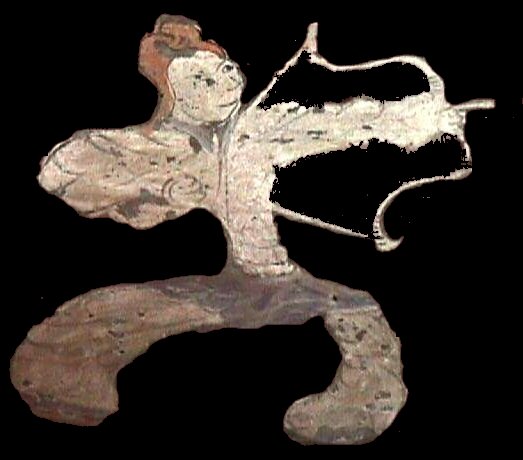
Jiao: can we have more info on this picture? My interpretation: it is a Tang dynasty image of an Apsara (head obliterated in the late Tang anti-Buddhist movement ) breaking the bow of a defeated enemy.
S
jiao
about this picture show string a bow or breaking bow, if bend the bow to front it is a good method?but bend the bow to the back maybe break the long ears and handle
it has no word info about it but maybe i can try ask where find it, i guess these books has lots thread find tang dynasty and earliest Turkic period bows,
You are right Jack. When i talk about Kasan in history i mean rigid siahs vith longer or shorter non working ridge too. Not only Turkish stile kasan. Turkish kasan is genial construction vith working and non working parts...
Adam Karpowicz
It depends how one defines kasan. Is it only the ridged section, or all stiff or (semi-stiff) sections below the tips are kasans? If the latter, then most these bows have kasans. The crab bow certainly does (not only rigid, but also triangular).
I think it is a useful word to use for all (semi) rigid, sinew-backed, often horn-bellied sections between the bending parts and the uncovered tips.
Adam
jack farrell
My Turkish is not so good, but I did qualify what I meant, the ridged section of the upper limb. I meant below the bend of the ear.
Semantics besides, I believe this is a correct statement.
Bede
What Jack points out is important. These early Central Asian Turkish bows had a thickened portion before the tip which was roughly rectangular in section. I was using the word kasan as I understood Kani to use it, but it is not significant. I was attempting to contrast a bow with a triangular sectioned transition between the bending part and the tip to one with a rectangular section. In the old days we used to refer to this as the neck and the tip as the ear.
My point is: did these rectangular sectioned necks bend like contemporary Korean bows or were they rigid? Looking at the cross-section of the crab bow, it was clear that the basic shape of the core was rectangular with a microscopic ridge to guide the laying of the sinew.
It has occurred to me that by changing from a rectangular section to a triangular one, the bow maker was able to maintain rigidity without carrying as much weight. Perhaps the the rectangular section was replaced by one with a sinew ridge as in the crab bow, but then it was worked out that by making most of the ridge from the wood of the core a smaller amount of the relatively heavy sinew could be used.
Adam Karpowicz
"by changing from a rectangular section to a triangular one, the bow maker was able to maintain rigidity without carrying as much weight"
This is a very good observation and I have pondered for a long time why the sinew ridge had appeared in the kasan section of bows. In truth, the rectangular section can be made as rigid and as low mass as the triangilar section, when the proportion of the wooden core to the sinew backing are chosen correctly. I'd rather think the choice was made to follow a local tradition, not necessarily to improve the bows' performance.
We tend to look at any particular bow desingn as a deliberate, time proven choice, always leading to an improvement in cast. I am no longer so sure it is always the case.
Adam
Bede
Adam,
I completely agree. Local traditions and attempts to improve were not motivated by the scientific method. Trial and error were used I am sure just as we all do when making something. People learned by watching their masters or parents, not out of books or by being able to lay a whole lot of examples down on the table to compare them.
We are very lucky to be able to do what we are doing. Two hundred years ago, who in Turkey knew about Korean bows and vice versa?
I think that explains many of the inconsistencies we see in the development of bow design. My description of the possible development of the ridge was meant to show that the process could have happened without any conscious choice to design it but by making small changes to existing designs.
Do you think the triangular section was more stable regarding twisting when compared to a rectangular section of the same weight and stiffness?
jiao
Dusan wrote:
Jiao, thanks for pics. there is , i think no doubt that all variation of composite bow evolution was born an mostly changed i China (or near) teriritory.We only founding litlle pieces of history and try understand why, how , where ?...
thanks for your thanks for pics same also. :)
yes , it is right we We only founding litlle pieces , when archaeology find more thread in tomb, when bioscience can reappearance all life a bowyer form his head, my proposition(all is china) is too big , are you think Egypt hornbow has any contact to china?it seem has no literate do some new research why, how, where
about china tang bows, the short and longer and crab, has no any guess and professional comment on it?
jiao
Bede wrote:
Jiao,
The kasan is clearly depicted in the Ming painting. The angle of the kasan to the working part of the limb at what is called the kasan eye is pronounced.
Several early Turkish bows have been excavated from tombs in Mongolia. They date between the 8th and 10th centuries. They have been published in catalogues of exhibitions about Chinggis Khan.
bede :
this pic is show a emperor of ming he go some where, 明世宗(1507?1566)朱厚熜,明朝第十一位皇帝),it save in Taipei's National Palace Museum,there consider he is other emperor 朱翊钧(1563年?1620年)
look at your hornbow adam send to you and adam call it turkish mix korean
I can not say the triangular section is more resistant to twist. Actually, it is rather the opposite (it is easier to correct twist in bows with triangular sections).
The triangular section could be a result of the ease of construction, plus the presence of the tip's V-splice. The splice's male tip's part is normally raised above the level of the female kasan's part (the tips have to be made of thicker wood than the sal and kasan wood). To keep the thickness of the core high as far as possible into the limb, the ridge is the best option. Also, even in the 3-part bows with no splice at the tips, when one uses an adze to form the core betw. the kasan and the tip, the sides of the core are safer to work down, as opposed to the inside of the bend, thus a triangle is made on the back of the core. I hope it is not too complicated.
Adam
Bede
Adam,
Thanks for the clarification. I like your idea for the development of the shape. The reason I was stressing the craftsman orientation on production was to suggest that just such a progression could occur. We twenty-first century people are so used to looking thinks up in books and on the Internet that we forget than most people in historic times would have seen little of the outside world. Even nomads had their territories which they migrated through.
Large states or very sophisticated ones could set up research groups. Dionysios of Syracuse is supposed to have done this to improve catapults. But it was very rare before modern times and not always successful because the ideas on how to rigorously test new weapons were not well developed.


![[external image]](http://img.janforman.com/th/Koreanwarandhuntingbowchoseanera156cm1e0p0.jpg)

![[external image]](http://img.janforman.com/th/Koreanwarandhuntingbowkasanpartjx8d.jpg)

![[external image]](http://img.janforman.com/th/Koreanwarandhuntingbowkasanpart12zc8.jpg)

![[external image]](http://img.janforman.com/th/KorwanwarbowinFrancemusearcheriee360.jpg)

![[external image]](http://img.janforman.com/th/KorewanwarbowinFrancemusearcheriekasanpartfsx4.jpg)

![[external image]](http://img.janforman.com/th/42Bo.Mus.CrepyTartarenbogenh14z.jpg)

![[external image]](http://img.janforman.com/th/Tatarbows3car.jpg)

![[external image]](http://img.janforman.com/th/Tatarbows1gohm.jpg)
![[external image]](http://www.hornbow.com/AdamK.jpg)
![[external image]](http://user.chollian.net/~untitle1/2006/60320/19350606_d.jpg)
![[external image]](http://archery.news-paper.co.kr/usr_img/usr/index/2001/kimjh.jpg)
![[external image]](http://hfsword.com/bbs/attachments/n8as_P8190200.jpg)
![[external image]](http://hfsword.com/bbs/attachments/4z1J_aa.jpg)
![[external image]](http://hfsword.com/bbs/attachments/7AZR_t1.jpg)
![[external image]](http://hfsword.com/bbs/attachments/HVKU_t2.jpg)
![[external image]](http://hfsword.com/bbs/attachments/Speb_t3.jpg)
![[external image]](http://hfsword.com/bbs/attachments/F1lA_t4.jpg)
![[external image]](http://hfsword.com/bbs/attachments/yehE_3.jpg)
![[external image]](http://hfsword.com/bbs/attachments/PfJc_SI850446.jpg)
![[external image]](http://hfsword.com/bbs/attachments/XzPg_6406.jpg)
![[external image]](http://hfsword.com/bbs/attachments/HonV_DSCN3914.jpg)