
typical dimensions of Ming bow
What are the typical dimensions of a Ming dynasty (1368--1644 CE) bow? That is, the length along the limbs, length of the string, ratio of siyah length to limb length.
I am particularly interested in the dimensions of the 小稍弓 (small siyah bow).
I am particularly interested in the dimensions of the 小稍弓 (small siyah bow).
i estimate that the dimension of the Mingbow is intermediate between Tatar and Turkish,maybe more like tatar
I think you will have to work it out from paintings. P. 64-65 of my 'Archery Traditions of Asia' should give a good pointer. Jaap Koppedreyer made me a Ming style bow which accords with those dimensions.
I see. Do you know where I can find that info online? Or could someone ask Jaap what dimensions he used for his Ming reproduction?
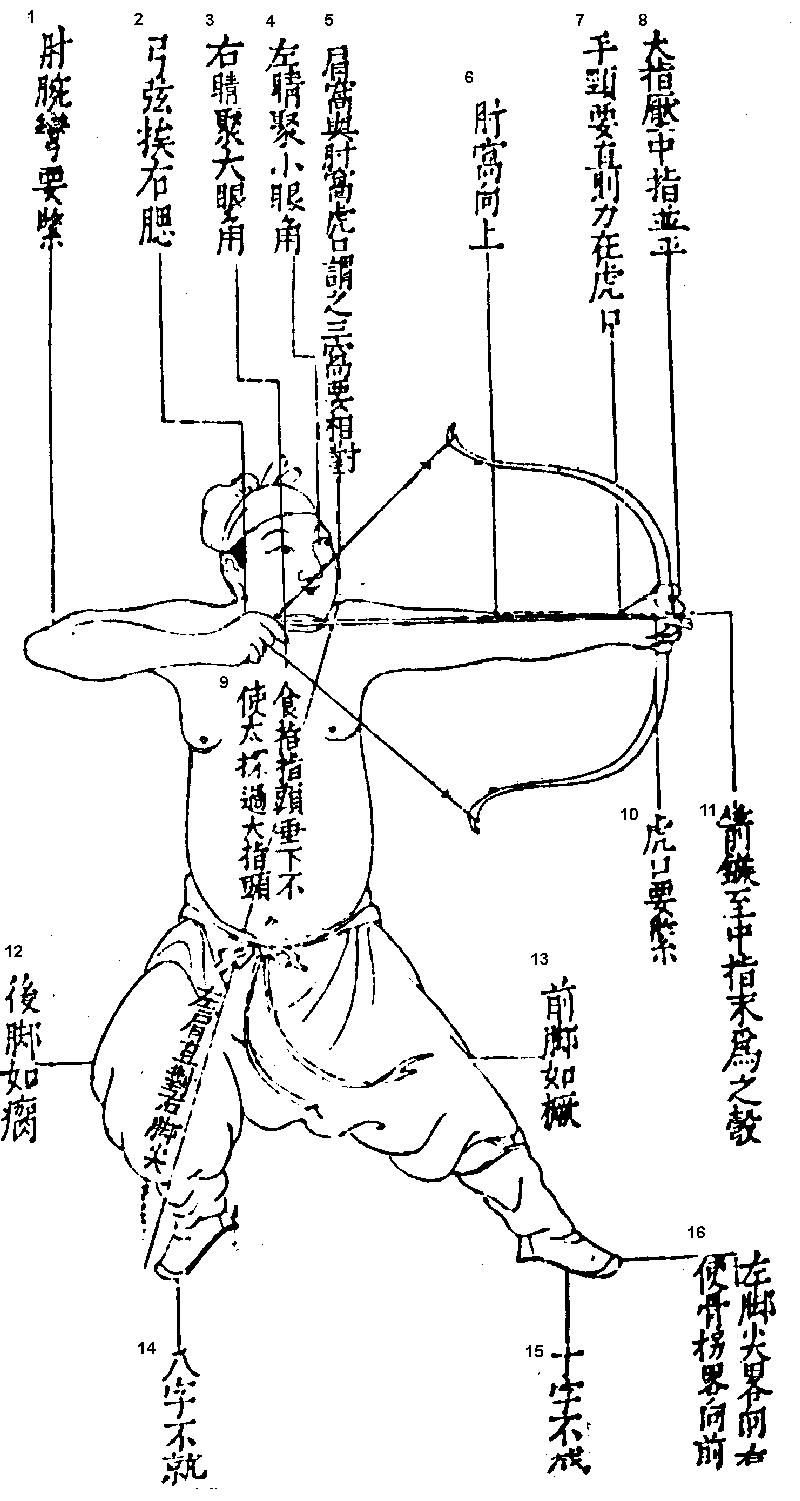
So based on that illustration and assuming the length from the height from the top of his head to the side of his waist is 75 cm (I'm going to assume my measurements are similar to a typical Ming dynasty archery :), the estimated dimensions would be (very roughly)...
Length: 120.8 cm
String: 108.3 cm
Based on the 小稍弓 illustration from your "Bows of China" article, the ratio of the siyah length to the limb length (down to the center of the grip) is about 1:8.9. Accordingly...
Length of siyah: 6.1 cm (entirely of horn is my guess)
Length of limb + half of grip: 54.3 cm
The siyah estimate may be too small (from the "Bows of China" illustration, I used the siyah/limb binding as the boundary). If the siyah is in fact longer, then I have a hard time finding the true siyah/limb boundary since the bows in the llustrations are so curvy.
Still, the dimensions are squarely between the Turkish bow (111.6 cm according to "Archery Traditions of Asia") and Tatar bow (130.8 cm according to Grozer's L2 Tatar bow). In fact, although the siyah dimensions don't match, the bow and string length match up very well with the Korean bow (118 cm in "Archery Traditions of Asia").
So based on that illustration and assuming the length from the height from the top of his head to the side of his waist is 75 cm (I'm going to assume my measurements are similar to a typical Ming dynasty archery :), the estimated dimensions would be (very roughly)...
Length: 120.8 cm
String: 108.3 cm
Based on the 小稍弓 illustration from your "Bows of China" article, the ratio of the siyah length to the limb length (down to the center of the grip) is about 1:8.9. Accordingly...
Length of siyah: 6.1 cm (entirely of horn is my guess)
Length of limb + half of grip: 54.3 cm
The siyah estimate may be too small (from the "Bows of China" illustration, I used the siyah/limb binding as the boundary). If the siyah is in fact longer, then I have a hard time finding the true siyah/limb boundary since the bows in the llustrations are so curvy.
Still, the dimensions are squarely between the Turkish bow (111.6 cm according to "Archery Traditions of Asia") and Tatar bow (130.8 cm according to Grozer's L2 Tatar bow). In fact, although the siyah dimensions don't match, the bow and string length match up very well with the Korean bow (118 cm in "Archery Traditions of Asia").
I found another version of the photo from "Archery Traditions of Asia":
http://www.atarn.org/chinese/wbyl.gif
It looks like there are small disc-like string bridges here (like in Turkish and Korean designs). Given the presence of these bridges, I'll have to revise my estimate of the siyah/limb ratio to 1:5.5 (where the siyah includes the string bridge). The revised length estimates would be...
Length: 120.8 cm
String: 108.3 cm
Siyah (plus string bridge): 9.3 cm
Limb + half of grip: 51.1 cm
http://www.atarn.org/chinese/wbyl.gif
It looks like there are small disc-like string bridges here (like in Turkish and Korean designs). Given the presence of these bridges, I'll have to revise my estimate of the siyah/limb ratio to 1:5.5 (where the siyah includes the string bridge). The revised length estimates would be...
Length: 120.8 cm
String: 108.3 cm
Siyah (plus string bridge): 9.3 cm
Limb + half of grip: 51.1 cm
Hi Justin! I am doing very similar measurements and calculations. My advice is to take multiple measurements on archers body. shoulder width, arm lenght... And maybe to rely on dimensions of body parts closest to the bow. Good luck
Good call. I decided to redo some measurements on the GIF only (http://www.atarn.org/chinese/wbyl.gif) and using a flexible metal tape measure (rather than a piece of string).
On my laptop screen, the overall bow length in the GIF is 6". So my measurements (the measurement on the GIF) [and the projected bow length] are the following
- Bow wrist to elbow pit: 10" (1.25") [48" --> 122 cm]
- Shoulder to hip: 19" (2.5") [45.6" -> 116 cm]
- Head to right hip: 29.5" (3.325") [53.2" -> 135 cm] <this is different from what I got using the piece of string on the book illustration>
- Head to right hip while scrunching neck (the guy in the illustration doesn't seem to have a neck!): 26.5 (3.325") [47.8" -> 121 cm]
- Bow shoulder (from clavicle) to wrist: 20.75" (2.5") [49.8" -> 127 cm]
So with the new estimates, the overall length is somewhere around {116, 121, 122, 127, 135} cm (between Turkish and Tatar lengths). Of course, the body proportions of the artist's rendition may not match well with mine, so variance of the estimate might be larger. As with bows today, there were probably variations in length even within the 'small siyah bow' genre.
Anyways, there's only so much we can do with a drawing. For my part, I'd be happy getting a custom design that is closer to 1.2 m in length.
On my laptop screen, the overall bow length in the GIF is 6". So my measurements (the measurement on the GIF) [and the projected bow length] are the following
- Bow wrist to elbow pit: 10" (1.25") [48" --> 122 cm]
- Shoulder to hip: 19" (2.5") [45.6" -> 116 cm]
- Head to right hip: 29.5" (3.325") [53.2" -> 135 cm] <this is different from what I got using the piece of string on the book illustration>
- Head to right hip while scrunching neck (the guy in the illustration doesn't seem to have a neck!): 26.5 (3.325") [47.8" -> 121 cm]
- Bow shoulder (from clavicle) to wrist: 20.75" (2.5") [49.8" -> 127 cm]
So with the new estimates, the overall length is somewhere around {116, 121, 122, 127, 135} cm (between Turkish and Tatar lengths). Of course, the body proportions of the artist's rendition may not match well with mine, so variance of the estimate might be larger. As with bows today, there were probably variations in length even within the 'small siyah bow' genre.
Anyways, there's only so much we can do with a drawing. For my part, I'd be happy getting a custom design that is closer to 1.2 m in length.
I've heard it suggested that Ming & Korean bows are very similar, some seem to be suggesting that there is no great difference. I'm wondering just what the salient differences between a Ming & Korean bow are?Justin Ma wrote:
... Based on the 小稍弓 illustration from your "Bows of China" ... although the siyah dimensions don't match, the bow and string length match up very well with the Korean bow (118 cm in "Archery Traditions of Asia").
Is there a Korean Bow on the market that is general accepted as little to no difference from a Ming type bow?
With some of the recent discussions about draw length and bow stability, I'm starting to believe the Ming small-siyah bow was closer to the Tatar bow in length rather than the Ottoman bow and modern Korean target bow. For heavy draw weights (around 100 lbs) a bow of Tatar dimensions would be stable for the longer Ming draw length. I wouldn't be surprised if the Korean traditional bow models on the market today are smaller than historical Ming bows.
An interesting point about the Ming military bow that you might have overlooked: the bow tip at one end formed a fork to allow mounted archers to pick up arrows off the ground.
Do you know this nice image?
Do you know this nice image?
Thanks for the input, but it doesn't really answer my question about how they are specifically different. Saying one bow is similar to another is not saying they are the same. So what makes them different?Justin Ma wrote:
... starting to believe the Ming small-siyah bow was closer to the Tatar bow... than the ... modern Korean target bows...
Scott,
The problem is there are no Ming bows to examine. Everyone is making educated guesses. The correlation between Crimean Tatar and some Ming bows are based on visual similarity and the likelihood of similar roots since both are effectively successor states of the Mongol Empire. However, based on the Ming encyclopaedias' description of their construction and the way surviving Tatar bows are constructed, there must have been differences. There is also considerable variation in Tatar bows. The two I have inspected were very different in their proportions, despite their obvious relationship. What they do have in common is general shape and long draw length. This distinguishes both bows from Turkish bows with a medium draw length and Persian bows with long draw length but different construction.
The problem is there are no Ming bows to examine. Everyone is making educated guesses. The correlation between Crimean Tatar and some Ming bows are based on visual similarity and the likelihood of similar roots since both are effectively successor states of the Mongol Empire. However, based on the Ming encyclopaedias' description of their construction and the way surviving Tatar bows are constructed, there must have been differences. There is also considerable variation in Tatar bows. The two I have inspected were very different in their proportions, despite their obvious relationship. What they do have in common is general shape and long draw length. This distinguishes both bows from Turkish bows with a medium draw length and Persian bows with long draw length but different construction.
I'm sorry I have been too busy to join in the discussions here (practice has to come first), but I came across this woodblock print dated 1604 that I thought might be of so interest, in a collection of prints published in Beijing, Gudai Muke Hua Xunji,(Chinese Ancient Woodblock Painting Collection), Zheng ZhenDuo editor.
According to the description, it is of an Imperial Procession, which appears to me to be returning from a hunt. I attached a close up of the Emperor where his quiver & the tip of his bow can been seen. Its not much, but it's something...
According to the description, it is of an Imperial Procession, which appears to me to be returning from a hunt. I attached a close up of the Emperor where his quiver & the tip of his bow can been seen. Its not much, but it's something...