This time in Xining I was able to take some photos of a bow that is on display in the Provincial Museum at Xining, Qinghai, China. The bow is labelled as 'Yuan', and in my view it is just that. As such, it would reflect the design used by the Mongols after their defeat of the Xixia, as Xining would have formed part of the old Xixia Kingdom.
As usual, the museum staff had not idea how to attach the fake string they had made for the bow, and the arrows and arrowheads are also modern confections.
Stephen Selby
This is the whole display. The bow is a standard. horn/wood/sinew composite with a birch bark overing on the back of the bow. It is not possible to tell what wood was used or what glue was used.
Stephen Selby
Here is the belly of the 'lower' limb (relative to the display) from above to show the bredth of the limb. The grip is uppermost and the siyah at the bottom.
Fox
Is this bow similiar to the one using by the girl April in your newsletter?
This is a detail of the 'upper' siyah and string nock.
Stephen Selby
Detail of the grip.
Stephen Selby
Is this bow similiar to the one using by the girl April in your newsletter?
This bow is quite a lot bigger, and the ends of the siyah were shaped differently from April's bow (which was made by Lucas Novotny).
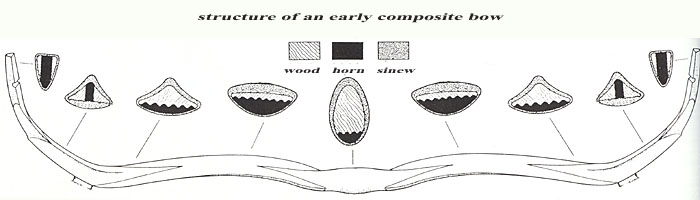
stephen,it is a mongolia hornbow structure picture,after the yuan dynasty end and split two country,i has a questions,after the mongolia inbreak Europe and close to all Asia ,they are glean(or captive) craft man such as bowyer make the hornbow,
also might contain Turkish, Persia,chinese hornbowyer ,it is a story real or not, but we and find at that times,the hornbow trun more transformation, the genghis khan's and hubilie khan's hornbow has showed at atarn, perhaps,some technology in common(the structure,the material the method)
at yuan dynasty, it is a gold times of the hornbow makeing?if they are not too barbarity and enjoy the money/wine/woman so much , all the world will be unite one country :lol:
Bede
Stephen,
A very special bow. What interests me is the cross sections of the siyah, near the nock, at its middle and near the working part of the limb.
The design seems appropriate for the time and still seems somewhat transitional between the Song and the later bows.
Great pictures.
Andrew Hall
Stephen, an interesting bow.
E.G. Heath's "The Grey Goose Wing" has a photograph of a Yuan dynasty Mongolian warrior with his bow, quiver and 11 arrows found in the Tsaidam Basin, Chinghai (I assume this is the old spelling of Qinghai). This bow is also damaged at one end of the grip, but does not appear to have as much reflex.
Do you have an estimate for the length of the bow?
Andrew
Stephen Selby
Do you have an estimate for the length of the bow?
I wasn't able to measure accurately; but 145-150 cm measured along the full length of the bow should be about right. Ignore the arrows completely: they are bogus.
What interests me is the cross sections of the siyah, near the nock, at its middle and near the working part of the limb.
If you took a cross-section at the middle of the working part of the limb, it would be 5.5cm wide and 1.5cm thick, flattened ovoid. That is noticeably wider in the limb than the modern 'Mongolian' hornbows that people are making; but consistent with what I have seen as a development from the Khotan bow (broadest limbs) to the Ming bows (getting close to the modern Korean form.)
The base of the siyah was about 2.7cm and almost circular in cross-section. The siyah flattens towards the tip from the point along the length where you start to see a sort of 'neck' from the side, so that the tip of the siyah is about 3cm in depth and about 5-6mm wide.
I'll try to sketch it.[/quote]
Stephen Selby
Some cross-sections (from memory)
Stephen Selby
Another view - blurry, but informative.
jack farrell
Stephen; A wonderful bow. Looks like someone also tried to shoot it backwards. Is that the horn sticking out? Can you tell if there were bone stiffiners in the siyahs? Are the limbs flat, lenticular, or other? Thanks for your detective work. -j-
Stephen Selby
I examined the bow carefully and I do not think there was any bone reinforcement either at the siyahs or on the grip.
I would put the limb cross-section as 'flat'. That is to say that although basically lenticular, at the middle of the working section of the limb, the back and belly surfaces (in cross-section) would be parallel. There was very limited rounding of the horn belly.
????
[Deleted by Stephen due to unreadable font]
jack farrell
I am going back a ways to this very interesting bow. If one enlarges the unedited pic of the siyah it is pretty clear that the horn sticking up has a square end. My thinking is that this end would rest against a square end in the wood. It seems unlikely that the siyah core was spliced in because the horn would be working against a spliced in siyah. Nor is the horn short enough at the grip end for the supposed bow tie shaped bone plate to be present.
The easiest way to make this bow would be to make it in one piece of wood, heating and bending the siyahs and cut out a place where the horn laths would be glued leaving the grip intact. Alternately a bone, horn or wood spacer could be placed in the grip.
I only say this because the technique appears to have been used, in some fashion, in both of the HMNS Mongol bows.
My guess is that the curators broke the bow themselves trying to shoot it backwards. Jack
jack farrell
This is my plan of how I think this bow might be built.
1. Because of the location of the raised horn in the grip, there is not enough space for the bow tie shaped bone grip slat said to be common to Mongol bows.
2. Because the raised horn in the ear has a thick butt end and it raises at the bend, it seems unlikely that the ear is spliced onto the core.
So this is one possibility of the construction technique. Any comments? -j-
Adam Karpowicz
As to #2: the ear could still be spliced to the sal and then the step for the horn carved in. I am not saying it was spliced (I actually thing this would not be needed), but it could.
I am tempted to make a bow like this once other projects are finished. The common length of such bows isn't quite certain though. I recall Andrew stated the Mongol bows could be as short as 40 inches? Or am I mistaken? This specimen seems rather long.
How long were the arrows?
Adam
Bede
Adam,
I don't think there are any early Mongol bows for adults that short. Andrew may have found some other information. There is a strange bow preserved in Japan from the invasion, but I think it is an early Korean bow and it might even be from a cross bow.
What I find interesting about these transitional bows (between non-contact siyahs and recurved siyahs) is whether they represent a conscious effort to improve bow design or are regional varieties that became more popular due to historical circumstances. I consider copying someone else's design as a conscious effort to improve a bow even if you didn't quite grasp the differences.
Much that is written about bows by non-specialist historians confuses bows from different periods, locations and cultural groups. The qualities of Turkish bows are often credited to earlier and sometimes unrelated bows because they all look similar when only known from books. This is not to say that things aren't improving, but old quotes keep turning up.
Andrew Hall
Adam, The 40" figure for bows using the bone grip plate with expanding ends came from Khudyakov Yu. S., "Armaments of the Nomads of South Siberia and Central Asia in the Epoch of the Developed Middle Ages", but on checking, was only based on a single find. None of the other finds had an estimated length. I should have worded my article better.
The belly strips set into the core at the ears reminds me of the construction of some of the Fenno-Urgian two-wood bows.
Although the position of the horn ends in the grip may be too short for the classic Mongolian bone plate with expanding ends, some of the earlier bows had shorter more parallel forms.
If making a bow where the horn strips were too short to meet in the handle, I would add a bone/horn/wood filler strip between them, rather than recessing the horn strips into the grip. Of course, this may due to a thought process which is used to modern power tools.
Andrew
Adam Karpowicz
Thanks. I did not think the shorter bow would necessarily be a better performer. This would depend on the length of arrows used.
The 57" length still seems longish to me. The apparent scarcity of bow finds from this period makes the 40" bow statistically relevant. Would it be correct to say these bows were generally, say, about 50 inches long? 52 inches?
You made a very good point Andrew abot the methods of construction. Actually to carve the belly of core for the horn would take a few minutes with hand tools, since only about 1/3rd of the length has to be recessed to gradually taper down into the step.
Adam
Redhorse
I have made a bow with this technique. But I use wood instead of horn. And thin wood did compress and wrinkle. Horn should do.
Puzio did try wood in between horn belly slats and the wood did compress and wrinkle. I recall someone did try this also and the shiyas did split at the butt.
So it can be done this way if every thing is on right place and right dimension.
jack farrell
Stephen indicates that the Xining bow is 145 or 150 cm so say 57". The HMNS curved bow is 57" over the belly. The HMNS straight bow is 62". The one in the Selby collection has a reconstructed length (add 7mm for horn nock inserts) of 62 1/2". The complete Mongol bow in the Silk Road museum has an estimated length of 60". There is one posted by Dusan from the Budapest museum which I cannot scale from lack of reference.
Throw out the extreme measurement, 40" and the average of what we have is about 60".
The HMNS quiver is 32", maybe 30 1/2 inside space. One set sticks out somewhat. The others fit correctly (I was told). -j-
Redhorse
Yes that length seams reasonably, in practical test I have done a bow of that length can be used from horse back easy.
One I made did fail in wood core but did shot pretty good. [external image]
I made one shorter to my son, 38" and that bow shot extremely well. [external image]
This was before my Turkish time when I try to invent the hornbow from two-wood bows :)

![[external image]](http://www.bahnhofbredband.se/~wb304054/core15.jpg)
![[external image]](http://images.yuku.com/image/jpeg/e51165150231476623d5245af504fe054cccc9f5.JPG)