
Sassanid / Khorasani quiver
Hi everyone
Does anyone know what sort of quivers were used in Sassanid Persia (particularly in Khorasan, if that's any different)?
The closed quiver article on ATARN seems to suggest that they used closed quivers, but references are made to the backwards facing type and feathers being ruffled when taking arrows out, which I'm a bit confused about ...
Thanks!
Does anyone know what sort of quivers were used in Sassanid Persia (particularly in Khorasan, if that's any different)?
The closed quiver article on ATARN seems to suggest that they used closed quivers, but references are made to the backwards facing type and feathers being ruffled when taking arrows out, which I'm a bit confused about ...
Thanks!
daryush
I don't know of any archaeological evidence, but some of the Sassanian plates with scenes of kings hunting appear to show a quiver that tapers slightly down its length and hangs vertically from the belt on the right side. There are no arrows visible in these quivers to indicate which way up they were placed, but the taper would tend to imply point down.
It is possible that you could ruffle the feathers on extraction if the quivers were as long as the arrow.
Andrew
I don't know of any archaeological evidence, but some of the Sassanian plates with scenes of kings hunting appear to show a quiver that tapers slightly down its length and hangs vertically from the belt on the right side. There are no arrows visible in these quivers to indicate which way up they were placed, but the taper would tend to imply point down.
It is possible that you could ruffle the feathers on extraction if the quivers were as long as the arrow.
Andrew
Cool, thanks for that.
I think I recall seeing one Sassanian plate somewhere where there were little vertical lines in the hanging quiver. It wasn't high res enough to see if it was points or fletches or just decoration.
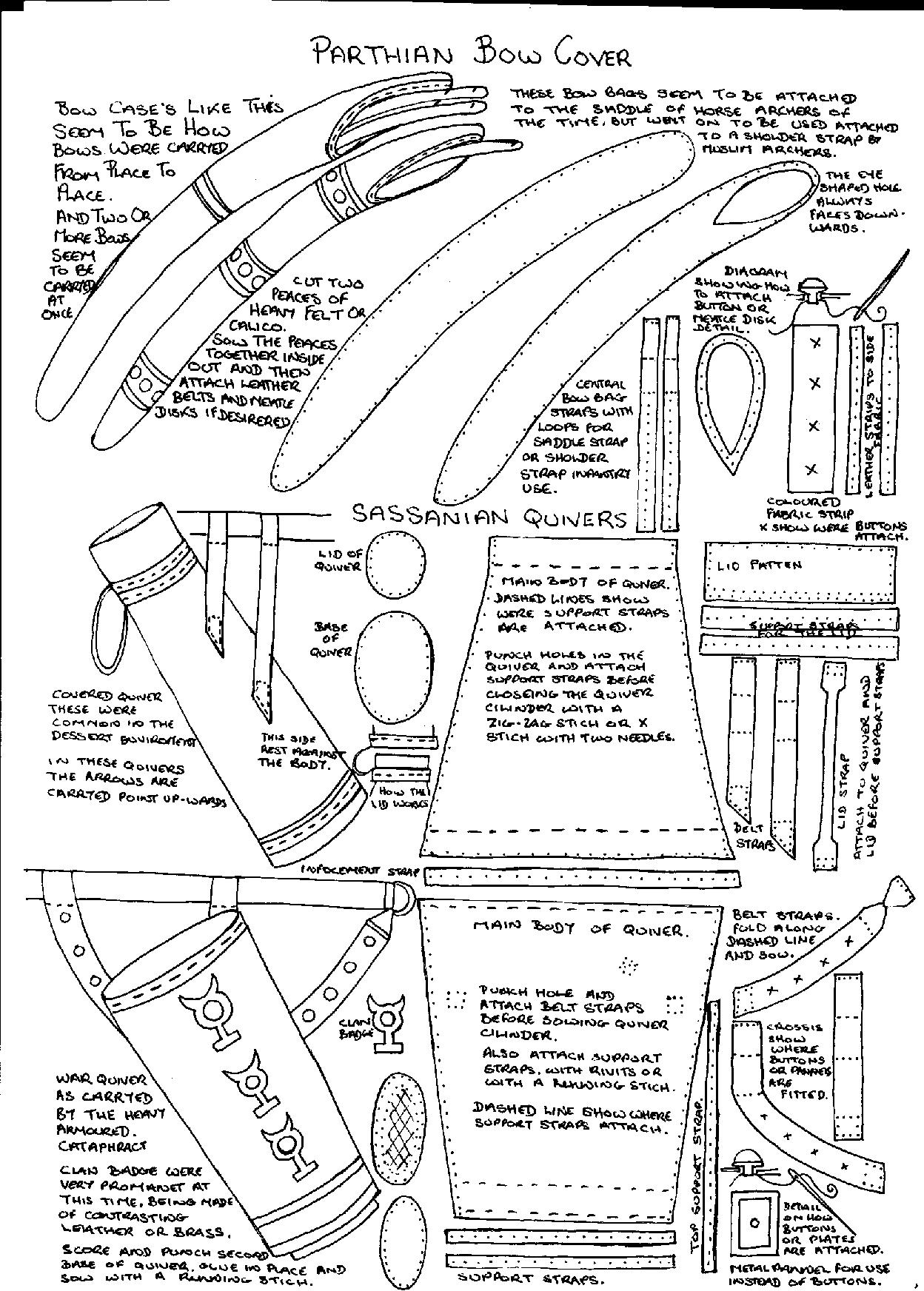
I'm tempted to go for the closed quiver whic is seen on the cataphract picture as they just look nicer and are a lot more protective, but it looks harder to make than just a plain one, and I'm not sure how to max its carrying capacity and add compartments for different types of arrow.
I think I recall seeing one Sassanian plate somewhere where there were little vertical lines in the hanging quiver. It wasn't high res enough to see if it was points or fletches or just decoration.
I'm tempted to go for the closed quiver whic is seen on the cataphract picture as they just look nicer and are a lot more protective, but it looks harder to make than just a plain one, and I'm not sure how to max its carrying capacity and add compartments for different types of arrow.
Here's a pattern for two Sassanian quivers.
http://www.atarn.org/letters/letr_mar04 ... %20001.jpg
http://www.atarn.org/letters/letr_mar04 ... %20001.jpg
Thanks for the link! (not sure how I missed it but ...)
:)
:)
I took this image in Bukhara, not too far from Khorezm. I think I recognize the image but cannot just put my finger on the source. He is riding a horse in the original. It is a nice quiver.
Jack,
That is a drawing from a Safavid miniature from the early 1500s. It has been mislabelled in Pant's book on Indian archery as Moghul. It was probably painted in Tabriz in Western Iran. I can look up the artist (at one time it was attributed to Bihzad). The quiver is a standard Irano-Turkish one of the early Safavid period. Similar ones were popular in Ottoman Turkey.
That is a drawing from a Safavid miniature from the early 1500s. It has been mislabelled in Pant's book on Indian archery as Moghul. It was probably painted in Tabriz in Western Iran. I can look up the artist (at one time it was attributed to Bihzad). The quiver is a standard Irano-Turkish one of the early Safavid period. Similar ones were popular in Ottoman Turkey.