
Iranian Water buffalo horn
At last after 3 years searching for domestic horn in iran i've just find a pair of it.we have water buffalo in both north and south of Iran but they doesn't have triangular base and there is no backing strip more that 3cm wide.
in old days we had borders with India and China and finding good horn was more easy.
I know that Persian bows were wider but could it be the reason that Persian bowyers use many strips on the belly or it was just for using useless material?
in old days we had borders with India and China and finding good horn was more easy.
I know that Persian bows were wider but could it be the reason that Persian bowyers use many strips on the belly or it was just for using useless material?
Dear friend,
If domestic buffalo horn isn't suitable for the bows have you ever thought about several horn parts glued on one limb as it was case of some old Arab bows described in Arab archery book (e.g. goat or sheep horn). It was very possible that hornbowyers used two or more short horn platesfor one limb instead longer ones. I will even try it with goat horn though one goat breeder promised to send me Balkan autochtonous goat horns about 50cm long. I don't think that buffalo horn was always material for bows, am sure that there in Iran was more possibilities.
Does anyone here know how two short horn plates on each limb could work?Did anyone had experience with that?
Best regards,
If domestic buffalo horn isn't suitable for the bows have you ever thought about several horn parts glued on one limb as it was case of some old Arab bows described in Arab archery book (e.g. goat or sheep horn). It was very possible that hornbowyers used two or more short horn platesfor one limb instead longer ones. I will even try it with goat horn though one goat breeder promised to send me Balkan autochtonous goat horns about 50cm long. I don't think that buffalo horn was always material for bows, am sure that there in Iran was more possibilities.
Does anyone here know how two short horn plates on each limb could work?Did anyone had experience with that?
Best regards,
Although there is such an historic bow, the Shiluustei sum bow of Mongolia, I would recommend that Mohammed make a bow in the traditional Persian manner of multiple thin horn slats side by side.
His horns may make a Turkic style bow with a single slat or with the addition of a short grip plate anyway.
It is possible that the information on the multiple slats is based on a single Persian specimen. This technique is well documented for Afghanistan.
Go traditional!
His horns may make a Turkic style bow with a single slat or with the addition of a short grip plate anyway.
It is possible that the information on the multiple slats is based on a single Persian specimen. This technique is well documented for Afghanistan.
Go traditional!
thanks for your guidance.i had seen a buildalong on such bow which have 3 or 4 plates of horn joined butt to butt.
The short butted plates will not make a durable bow. The plates, if positioned in the working parts of limbs, will be worked loose as the bow flexes, even if cross-wrapped with sinew.
The side-by-side strips (often covered with sinew on the belly) are fine and I have seen several old bows made like that. The bow's draw weight may be slightly reduced in this construction.
Adam
The side-by-side strips (often covered with sinew on the belly) are fine and I have seen several old bows made like that. The bow's draw weight may be slightly reduced in this construction.
Adam
Jack,
Do you mean the bow that was exposed in Houston exibition?
Does anyone has any drawing about slats glued side by side? It is very interesting technique i would like to try.
As Jack said: Go traditional!
Best regards,
Do you mean the bow that was exposed in Houston exibition?
Does anyone has any drawing about slats glued side by side? It is very interesting technique i would like to try.
As Jack said: Go traditional!
Best regards,
Zoran, Yes, I mean that bow which was displayed in Houston. Before I saw it, the technique seemed unlikely. It is an early Turkic type but with no ridged section on the limb. It appears to have had the flex centered on the limb. Nevertheless i do not reccommend it for this project.
I have made several experimental bows with multiple long slats. The work is increased but the technique is sound. One was of Mouflon horn. The lesson is that the bends and twist of the horns can be balanced against eachother and the whole is stable.
More than one bow can be made from a set of horns or an otherwise unusable set can be used.
I have made several experimental bows with multiple long slats. The work is increased but the technique is sound. One was of Mouflon horn. The lesson is that the bends and twist of the horns can be balanced against eachother and the whole is stable.
More than one bow can be made from a set of horns or an otherwise unusable set can be used.
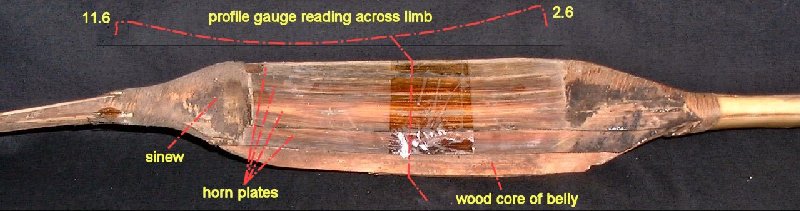
The Khotan Bow was done that way.Zoran Pavlovic wrote:
Does anyone has any drawing about slats glued side by side? It is very interesting technique i would like to try.
http://www.atarn.org/letters/khotan_bow/khot07.jpg
S
Butt joined horn- plates are working fine. I?ve done it, I know some more hornbows working since years long like that. Carefully glued and wrapped at the joint no problem. The pressure at the bow?s belly is keeping the joint , the sinew- wrapping prevents the plates from slipping out of place.
Every failure here is a glueing problem.
For to get more safety it is possible to do a V-, W- or whatever splice.
It is working fine and several times historically proven.
Michael
Every failure here is a glueing problem.
For to get more safety it is possible to do a V-, W- or whatever splice.
It is working fine and several times historically proven.
Michael