
Turkish quivers and bow holsters
Hello everybody
I would like to reproduce a set of turkish quiver/bowholster.
Has anybody got some experience with this or has someone
done this before :?:
I'll be thankfull for any links and suggestions. Thanks.
Alam
I would like to reproduce a set of turkish quiver/bowholster.
Has anybody got some experience with this or has someone
done this before :?:
I'll be thankfull for any links and suggestions. Thanks.
Alam
Alam,
I have designs for both the early 16th century and the late 17th century types. I have built and used quite a few and find them to be excellent quivers and the bowcases are very useful on foot and horseback.
Have you done leather work before?
I have designs for both the early 16th century and the late 17th century types. I have built and used quite a few and find them to be excellent quivers and the bowcases are very useful on foot and horseback.
Have you done leather work before?
Marhaba Bede:
Great !! Thats phantastic. Concerning my experience with leather works-
Nope. I haven't done it before but I have good concentration......
The basic shape is clear to me but I am uncertain of what leather to use......
how to bring the parts together (nicely). Also I am not sure as to what extend
wood is being used in holster & quiver. Can you post me some plan or
something ???I haven't decided on any design yet, but probably simple will be just fine. Greetings ,
Alam
(email address: [email protected])
Great !! Thats phantastic. Concerning my experience with leather works-
Nope. I haven't done it before but I have good concentration......
The basic shape is clear to me but I am uncertain of what leather to use......
how to bring the parts together (nicely). Also I am not sure as to what extend
wood is being used in holster & quiver. Can you post me some plan or
something ???I haven't decided on any design yet, but probably simple will be just fine. Greetings ,
Alam
(email address: [email protected])
Alam,
I would recommend vegetable tanned leather rather than chrome tanned leather. The first can be shaped while wet and dyed to the colours that you wish. The second is good for straps , but is not stiff enough for quiver bodies and will not hold a shape.
Chrome tanned leather can be identified by the grey line between the two surfaces when you cut it. Vegetable tanned leather is usually sold before it has been dyed.
Some quivers were made from dyed or painted rawhide.
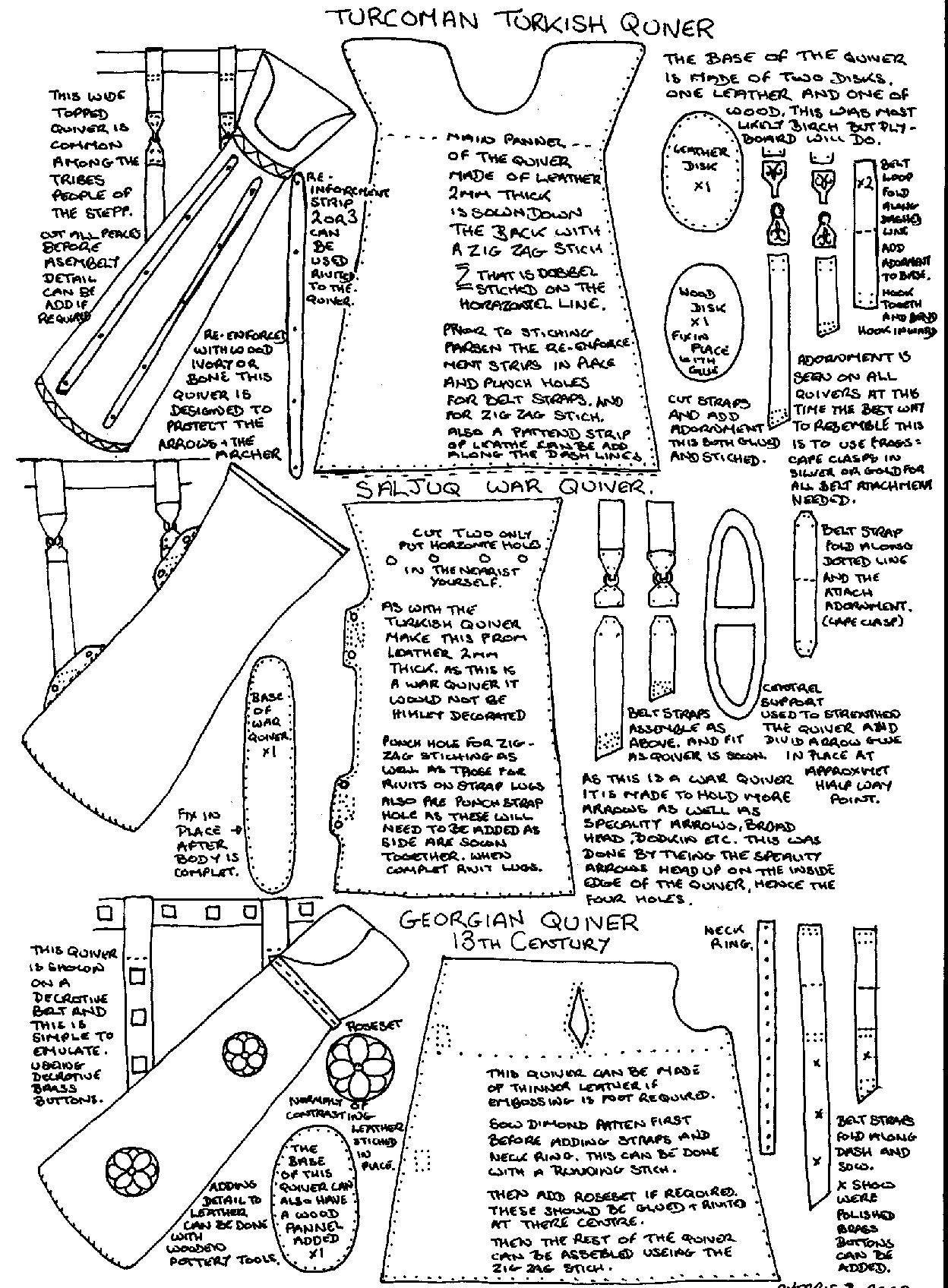
I will post some diagrams with measurements for you. I have already put some photographs of a Turkish quiver in various stages of construction when I showed the one I made for Dr Grayson.
Later Turkish quivers usually had a wooden base, but were otherwise leather. However, I have seen one 16th century one with a wooden frame on two sides: the base and the upper edge. This parallels Manchu quivers, which could be made either way. Tibetan quivers had wood on three sides. This is an old steppe pattern and no doubt early Turkish quivers were made this way too.
There are many styles to choose from.
I would recommend vegetable tanned leather rather than chrome tanned leather. The first can be shaped while wet and dyed to the colours that you wish. The second is good for straps , but is not stiff enough for quiver bodies and will not hold a shape.
Chrome tanned leather can be identified by the grey line between the two surfaces when you cut it. Vegetable tanned leather is usually sold before it has been dyed.
Some quivers were made from dyed or painted rawhide.
I will post some diagrams with measurements for you. I have already put some photographs of a Turkish quiver in various stages of construction when I showed the one I made for Dr Grayson.
Later Turkish quivers usually had a wooden base, but were otherwise leather. However, I have seen one 16th century one with a wooden frame on two sides: the base and the upper edge. This parallels Manchu quivers, which could be made either way. Tibetan quivers had wood on three sides. This is an old steppe pattern and no doubt early Turkish quivers were made this way too.
There are many styles to choose from.
Bede:
Thank you for this information on leather. What about saddle leather?
Is that to thick?I have just been on a German site on a booty taken from
the Ottomans when they invaded Middle Europe in the 17th century.
Some nice quivers and holsters as well as bows & arrows are on display:
[url] http://www.tuerkenbeute.de/sam/sam_waf/
Look at the set of quivers with the intricate gold and silver pattern. This one
looks most arabesque, but was in fact crafted in Siebenbuergen, a part of
Romania that was inhabited predominantly by Germans & Hungarians. It has an inscribtion in latin characters by its maker. Though the quivers I want to
reproduce don't need this embroidery like pattern, I like very much its shape
(as compared with the other quivers). It has got(the arrow quiver) an oval
piece of wood as its base. From outside it is also covered in leather. Anyway,
I prefer this shape. Bede, can you say something about joining the parts
together or stitching the leather? I don't know how it is done as I never came
close enough to a quiver to see it from the near. Greetings & Salaam
Thank you for this information on leather. What about saddle leather?
Is that to thick?I have just been on a German site on a booty taken from
the Ottomans when they invaded Middle Europe in the 17th century.
Some nice quivers and holsters as well as bows & arrows are on display:
[url] http://www.tuerkenbeute.de/sam/sam_waf/
Look at the set of quivers with the intricate gold and silver pattern. This one
looks most arabesque, but was in fact crafted in Siebenbuergen, a part of
Romania that was inhabited predominantly by Germans & Hungarians. It has an inscribtion in latin characters by its maker. Though the quivers I want to
reproduce don't need this embroidery like pattern, I like very much its shape
(as compared with the other quivers). It has got(the arrow quiver) an oval
piece of wood as its base. From outside it is also covered in leather. Anyway,
I prefer this shape. Bede, can you say something about joining the parts
together or stitching the leather? I don't know how it is done as I never came
close enough to a quiver to see it from the near. Greetings & Salaam
Thank you Steven.
A closed Quiver is also very nice. It will be one of my next projects.
Are those made from leather in general or are other materials used as well, such as birchbark.......etc.?
Alam ed Din, Adnan
A closed Quiver is also very nice. It will be one of my next projects.
Are those made from leather in general or are other materials used as well, such as birchbark.......etc.?
Alam ed Din, Adnan
Alam:
After viewing the bows in the museum site you offer, I almost want to throw the bows I build away. I'm very confident about the profile,performence,cross-secction and accurate of my Turkish bows.
But, my drcoration is terrable not even to call it the "third-class". I wonder is there anybody there in Turkey today can still do the paint job like that ? And can you find anyone there? I can offer the top-quality lacquer,varnish and nature dye to someone there and willing to pay him to paint my bow. Can you help me out?
Jang,yuhua
After viewing the bows in the museum site you offer, I almost want to throw the bows I build away. I'm very confident about the profile,performence,cross-secction and accurate of my Turkish bows.
But, my drcoration is terrable not even to call it the "third-class". I wonder is there anybody there in Turkey today can still do the paint job like that ? And can you find anyone there? I can offer the top-quality lacquer,varnish and nature dye to someone there and willing to pay him to paint my bow. Can you help me out?
Jang,yuhua
Yokhua:
Your bow looks great. You know, flight bows where often not so much decorated or not at all. There are some people in Turkey who still practice
calligraphie and arabesque laquer techniques(usually for book covers and the like), but as you can see under "location" I am at the moment in Germany....
The only person who could help you on this(and this would be best for you) is
Adam Karpowicz , he used some of the patterns from Karlsruher Tuerkenbeute for his bows. He knows best about laquer techniques Otherwise I have a friend in Izmir who maybe could help you.
You want an osmanic vers on it as well I guess? Well, better Contact Adam
Karpowicz first. Check his design on ATARN index " two turkish bows"
Greetings & Salaam
Your bow looks great. You know, flight bows where often not so much decorated or not at all. There are some people in Turkey who still practice
calligraphie and arabesque laquer techniques(usually for book covers and the like), but as you can see under "location" I am at the moment in Germany....
The only person who could help you on this(and this would be best for you) is
Adam Karpowicz , he used some of the patterns from Karlsruher Tuerkenbeute for his bows. He knows best about laquer techniques Otherwise I have a friend in Izmir who maybe could help you.
You want an osmanic vers on it as well I guess? Well, better Contact Adam
Karpowicz first. Check his design on ATARN index " two turkish bows"
Greetings & Salaam
PS:
Did you use this horn to make your bow? What are they? Sheep, mufflon?
Please tell me something about your processing.
Greetings & Salaam
Did you use this horn to make your bow? What are they? Sheep, mufflon?
Please tell me something about your processing.
Greetings & Salaam
Alam,
As you can see from Yokhua's comments, even expert bow makers want to become better. Most of us would be happy to do half as well.
When I realised you were in Germany, I was going to suggest visiting the Karlsruhe collection. It has some truly beautiful equipment. Their large-format colour catalogue has been of great use to me. Because it shows the backs of the quivers, I was able to work out the suspension strap arrangement on these short quivers. There is also a museum in Vienna that would be worth a visit. I have to look for its name in my references. It is too long to remember.
It is interesting to see you mention calligraphers because Necmettin Okyay was a calligrapher and a bow maker.
As you can see from Yokhua's comments, even expert bow makers want to become better. Most of us would be happy to do half as well.
When I realised you were in Germany, I was going to suggest visiting the Karlsruhe collection. It has some truly beautiful equipment. Their large-format colour catalogue has been of great use to me. Because it shows the backs of the quivers, I was able to work out the suspension strap arrangement on these short quivers. There is also a museum in Vienna that would be worth a visit. I have to look for its name in my references. It is too long to remember.
It is interesting to see you mention calligraphers because Necmettin Okyay was a calligrapher and a bow maker.
Alam: No! my bows till now are all build by using water buffalo horns. This is a pair of big sheep horns from Tibet. A rare kind of domastic big horn sheep in Tibet. Normally killed and eaten in the festivals. I'm planning to build a horn bow without wood core by this,yet at this stage I'm not confident to do it in case I ruin this beautiful pair of sheep horn. More research work needed.Alam ed Din, Adnan wrote:
PS:
Did you use this horn to make your bow? What are they? Sheep, mufflon?
Please tell me something about your processing.
Greetings & Salaam
Jang,Yuhua
I understand. I have seen tibetans putting these horns(with skull) on those
stonepiles that they often erect on Mountain ridges, as a sort of offering.
stonepiles that they often erect on Mountain ridges, as a sort of offering.
Still I believe that bow decoration was an entirely different technique than what is being used by contemporary calligraphers who mostly paint the outside leather covers of Qur'an or some well known Ottoman seals. I think a complete different technique was being used. The "hatayi" type of floral design differs from what is being used nowadays. Also different types of
thick prime coats and varnishes where being used into which splinters of
brass where being strewn sometimes to get a "metalic like effect". I think
if one would give it to contemporary calligrapher, the outcome would rather be like in Saluki or Grozer painted turkish bows. And I don't mean this in a bad way but just like this. The only person who really follows the old way according to my limited knowledge is Adam Karpowicz. The century old patina and darkening being absent of course..... I like the bows of Karlsruhe Turk booty very much, in particular the one with "Osman Ali" signature.It has a beautiful vers on it which I roughly translate:
" Draw to your chest the arrow of the eyelash, the bow of the brow,
of the ten year old youth, that even Rustam isn't able to draw".
"Enter the arena and proof your Love and Friendship, so that your
name and renown shall not be redeemed until the end of days"
In this sense........
thick prime coats and varnishes where being used into which splinters of
brass where being strewn sometimes to get a "metalic like effect". I think
if one would give it to contemporary calligrapher, the outcome would rather be like in Saluki or Grozer painted turkish bows. And I don't mean this in a bad way but just like this. The only person who really follows the old way according to my limited knowledge is Adam Karpowicz. The century old patina and darkening being absent of course..... I like the bows of Karlsruhe Turk booty very much, in particular the one with "Osman Ali" signature.It has a beautiful vers on it which I roughly translate:
" Draw to your chest the arrow of the eyelash, the bow of the brow,
of the ten year old youth, that even Rustam isn't able to draw".
"Enter the arena and proof your Love and Friendship, so that your
name and renown shall not be redeemed until the end of days"
In this sense........
Bede:
Wheren't you going to post me something on your quiver designs?
Maybe I did get you wrong, then please forgive me....... :oops:
Greetings & Salaam
[email protected]
Wheren't you going to post me something on your quiver designs?
Maybe I did get you wrong, then please forgive me....... :oops:
Greetings & Salaam
[email protected]