
Mongol bow and quiver find in Tsagaan Khad
In Arch?ologie in Deutschland appears in the current volume an article about a new find of Mongolian Archery Equipment, including a complete bow and a fragmented leather quiver with arrows. C14-dated to the 14th century. The bow which is still braced seems to be in fantastic condition. The shape seems to be asymmetric, the bow has non contact siyahs. The limbs are covered in a yellow material (birch bark ?), the grip is of a darker brown colour.
Here?s a pdf of the note:
http://www.aid-magazin.de/fileadmin/use ... ettern.pdf
look on page 3.
JJ
Here?s a pdf of the note:
http://www.aid-magazin.de/fileadmin/use ... ettern.pdf
look on page 3.
JJ
....
Seite nicht gefundenFehler 404 - Seite nicht gefunden
Die angeforderte Seite existiert nicht oder steht tempor?r nicht zur Verf?gung.
Bitte versuchen Sie es sp?ter noch einmal oder rufen Sie die Startseite der gew?nschten Domain auf.
Seite nicht gefundenFehler 404 - Seite nicht gefunden
Die angeforderte Seite existiert nicht oder steht tempor?r nicht zur Verf?gung.
Bitte versuchen Sie es sp?ter noch einmal oder rufen Sie die Startseite der gew?nschten Domain auf.
Fixed the link...
Nice! Lets all travel to the Landesmuseum Bonn next winter, to see the bow and quiver!
JJ, you should contact the museum and have a look at it from a bowyers perspective. - unless they already have the proper experts at hand.
JJ, you should contact the museum and have a look at it from a bowyers perspective. - unless they already have the proper experts at hand.
Kviljo, I just contacted the excavator and he says they have already an "expert" for the research, one of the authors of the famous "Reflexbogenbuch". It?s a shame. I asked him to overthink this decision, but I don?t think it will be possible to see the bow other than behind glass ;-)
JJ
JJ
Ahh, too bad. Let's hope the important details are recorded before it is shipped back. I don't know what the law is in Germany, but as they are here in Norway, anyone who want to see an (archaeological) object has the law-given right to do so. Perhaps the bow will be avaliable for study later.
By the way, is the "Reflexbogenbuch" worth having?
By the way, is the "Reflexbogenbuch" worth having?
There was a thread on the Reflexbogenbuch sometime last year. I think reactions were not to enthusiastic. I looked into it and won?t buy it. There is better information here on Atarn and I personally know more than most of the authors in it. Only if you?re interested in Yumi building, Jaap Koppedrayer wrote about it, this should be good.
JJ
JJ
Thanks for posting!
Fantastic, this is easily the best preserved bow of the earlier Mongolian type found so far. The quiver is interesting too, with the three slots for separate arrows that are also to be found on ater Manchu quivers.
The decoration on the quiver is very interesting too. Although probably unrelated, it reminds of Samurai family crests.
As for the bow, it is almost identical to the one shot by Kubilai in this painting:
http://upload.wikimedia.org/wikipedia/c ... heHunt.jpg
(Posted as a link because of its large size.)
The lot is surely worth a trip to Bonn!
-Peter
Fantastic, this is easily the best preserved bow of the earlier Mongolian type found so far. The quiver is interesting too, with the three slots for separate arrows that are also to be found on ater Manchu quivers.
The decoration on the quiver is very interesting too. Although probably unrelated, it reminds of Samurai family crests.
As for the bow, it is almost identical to the one shot by Kubilai in this painting:
http://upload.wikimedia.org/wikipedia/c ... heHunt.jpg
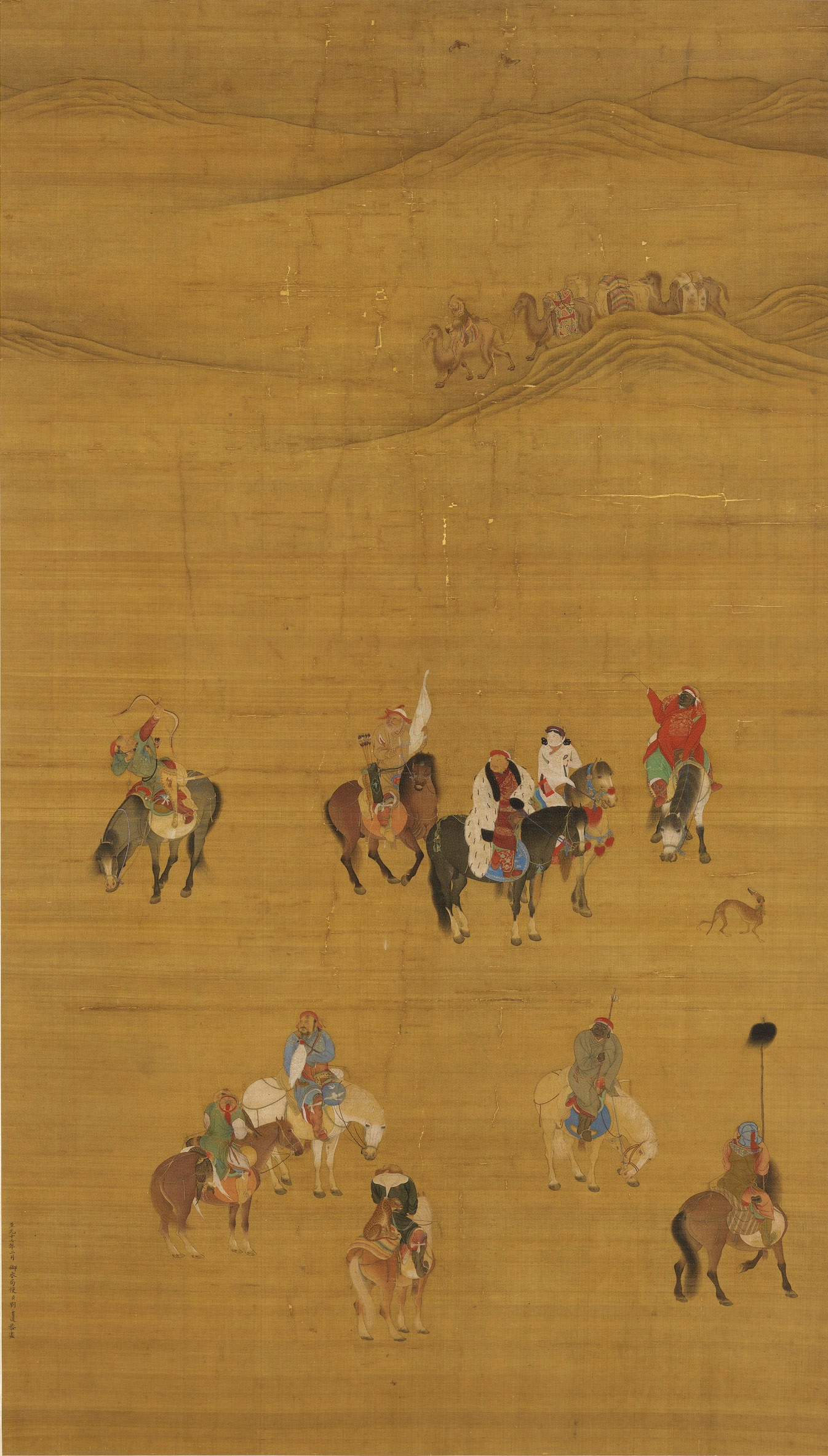
(Posted as a link because of its large size.)
The lot is surely worth a trip to Bonn!
-Peter
JJ,
That is a brilliant find.
Shame about the selection of experts! I share your lack of enthusiasm for Reflexbogen, thought the pictures were good. A correction, Jaap wrote the chapter on modern reflex bow making.
Some of the asymmetry of the bow comes from its long life being strung.
There is one miniature painting from Iran which shows a three slit quiver. It was longer than a Manchu quiver and the slit angle was different. It was strongly Mongol and the wearer was in normal Mongol dress from the late period in Iran. that would put the date close to that of the excavation or at least within a hundred years of it.
That is a brilliant find.
Shame about the selection of experts! I share your lack of enthusiasm for Reflexbogen, thought the pictures were good. A correction, Jaap wrote the chapter on modern reflex bow making.
Some of the asymmetry of the bow comes from its long life being strung.
There is one miniature painting from Iran which shows a three slit quiver. It was longer than a Manchu quiver and the slit angle was different. It was strongly Mongol and the wearer was in normal Mongol dress from the late period in Iran. that would put the date close to that of the excavation or at least within a hundred years of it.
I assume the exhibition showing the finds is listed here:
http://www.rlmb.lvr.de/ausstellungen/vorschau/
Although the quiver shown is different to the one illustrated in the PDF.
http://www.rlmb.lvr.de/ausstellungen/vorschau/
Although the quiver shown is different to the one illustrated in the PDF.
Am I missing something? I do not see any good illustrations of the bow, arrows or quiver(s). The link from Andrew which can be machine translated has virtually no information other than the date.
Has no one from ATARN seen this exhibit who could at least post a drawing or such? And how about a little information on the site etc.
ATARN's info is almost always better than one can find in print. Lets get cracking, guys.
Has no one from ATARN seen this exhibit who could at least post a drawing or such? And how about a little information on the site etc.
ATARN's info is almost always better than one can find in print. Lets get cracking, guys.
:D same question...
I go ! someone else ? :wink:
Not information on the finds in the exhibition, but I recently found a detailed description of previous Mongolian grave finds here:
http://hss.ulb.uni-bonn.de/2009/1958/1958.htm
It has some good photos of the 10th C Arcat Del quiver and arrows and some of the bow.
Not sure why the author does not mention the radio-carbon dating of the Omnogov bow and dates it by typology instead.
Back to the Landesmuseum exhibition, are they likely to allow photography in exhibition?
http://hss.ulb.uni-bonn.de/2009/1958/1958.htm
It has some good photos of the 10th C Arcat Del quiver and arrows and some of the bow.
Not sure why the author does not mention the radio-carbon dating of the Omnogov bow and dates it by typology instead.
Back to the Landesmuseum exhibition, are they likely to allow photography in exhibition?
can't we make an application in the name of ATARN to get some extended access or so ?
It opens in January, Jack... Guess I will go there, but I suppose they don?t allow any photograhy.
JJ
JJ
JJ; Then make good drawings! The eye is able to catch details that the camera may miss. Look for signs of joinery. Thanks. -j-
Andrew; There is some very good material in your link. One quiver of arrows appears to contain 15 random arrows. Maybe grave offerings to a friend? Excellent original fletch shapes, crestings.
Have just started, large uploads. Good find, as usual for you!
Have just started, large uploads. Good find, as usual for you!
Looks like of several hundred sites reported on in their entirety, one only is a rock cave burial with a damaged bow, quiver of arrows, saddle and tack, clothes and human remains.
This is probably the site of Arcat Del, reported by the author Ulambayar Erdenebat, in this, his dissertation. He studied at U Bonn. He also has a book out on the Mongol capitol, Karakorum, with others.
There are very good pictures in part 7. Because of the presence of arrow points and quiver fragments, it would appear that many other graves once held archery grave goods.
I notice that Shiluustei sum (Ss) site is not reported on while an earlier find, the Novgorod bow, is. Neither is the companion bow to the Ss bow. Please correct me if any of this is not so. My German is non existent.
Mr. Erdenebat is also a contributor to the book, Genghis Khan and the Mongol Empire, the book which accompanies the current exhibit in Dallas, Texas, USA; source for material on Ss bow, etc.
This is probably the site of Arcat Del, reported by the author Ulambayar Erdenebat, in this, his dissertation. He studied at U Bonn. He also has a book out on the Mongol capitol, Karakorum, with others.
There are very good pictures in part 7. Because of the presence of arrow points and quiver fragments, it would appear that many other graves once held archery grave goods.
I notice that Shiluustei sum (Ss) site is not reported on while an earlier find, the Novgorod bow, is. Neither is the companion bow to the Ss bow. Please correct me if any of this is not so. My German is non existent.
Mr. Erdenebat is also a contributor to the book, Genghis Khan and the Mongol Empire, the book which accompanies the current exhibit in Dallas, Texas, USA; source for material on Ss bow, etc.
Jack, the search term is "Bogen" = bow in German. There are various sites with at least parts of bows, mostly bone plates. only one with good picutures.
I cannot find Shiluustei Sum either, however my information from the museum is that the finding place of what we call Shiluustei Sum bow was Bumbugur (Бөмбөгөр) Sum in Bayankhongor province - not reported either, will be back if I can clarify this.
(http://upload.wikimedia.org/wikipedia/c ... um_map.png)
I cannot find Shiluustei Sum either, however my information from the museum is that the finding place of what we call Shiluustei Sum bow was Bumbugur (Бөмбөгөр) Sum in Bayankhongor province - not reported either, will be back if I can clarify this.
(http://upload.wikimedia.org/wikipedia/c ... um_map.png)
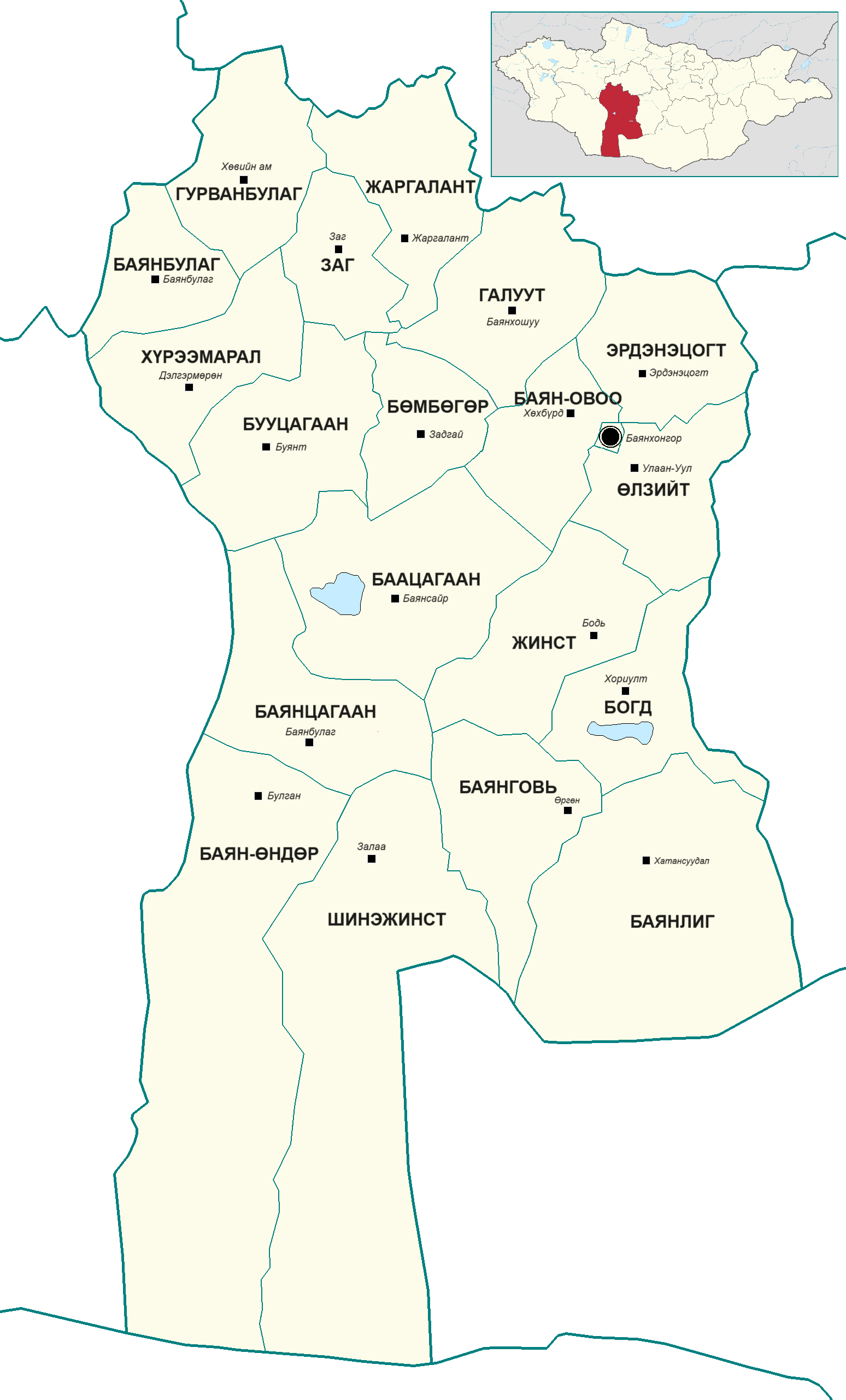
Uli; thanks for the tip. Actually I have reported already on the Ss bow including the best available description of the joinery but some info on the site might be good.
The Arcat Del bow now has good photos but maybe not good enough to describe the joinery. However, the text is most informative but a machine translation makes little of it. For instance bablefish is unable to unwind birkenrindkocher into birch bark quiver.
If I knew German I would translate parts 2 and 3 on pages 308 and 309; part 7, the info on the bow and arrows, and post here on this discussion. A description of how wolf hunters found the site and the artifacts were recovered by the museum, page 307, would be really nice for us English speakers. I know some industrious German speaker will provide this for us. With the color photos in the article, much might be made from it. Thanks Uli.
The Arcat Del bow now has good photos but maybe not good enough to describe the joinery. However, the text is most informative but a machine translation makes little of it. For instance bablefish is unable to unwind birkenrindkocher into birch bark quiver.
If I knew German I would translate parts 2 and 3 on pages 308 and 309; part 7, the info on the bow and arrows, and post here on this discussion. A description of how wolf hunters found the site and the artifacts were recovered by the museum, page 307, would be really nice for us English speakers. I know some industrious German speaker will provide this for us. With the color photos in the article, much might be made from it. Thanks Uli.
The German of this Text semms to be written by a not native German speaker - and is not really good to read, but I will try!
Falls es noch wer von euch ?bersetzen mag, bitte gerne, dann haben wir mehr Versionen, die eventuell mehr Klarheit bringen.
Falls es noch wer von euch ?bersetzen mag, bitte gerne, dann haben wir mehr Versionen, die eventuell mehr Klarheit bringen.
Good idea Jack. I ll translate the sections you mention. If somebody needs other sections: copy-paste the german text and post here. :wink:
PS: Бөмбөгөр is written "B?mb?g?r" in German :D
there are two sites there, one is Arcat Del
quiver and arrows look similar to those displayed with the Ss. bows
but not identical or ?
PS: Бөмбөгөр is written "B?mb?g?r" in German :D
there are two sites there, one is Arcat Del
quiver and arrows look similar to those displayed with the Ss. bows
but not identical or ?
PS: Shiluustei (Шилүүстэй) is written Shil??stei and located in Zavkhan province - no finds reported here.
http://en.wikipedia.org/wiki/Zavkhan_Province
Шилүүс (Shiluus) = Lynx :D
http://mn.wikipedia.org/wiki/%D0%A8%D0% ... 2%AF%D1%81
http://en.wikipedia.org/wiki/Zavkhan_Province
Шилүүс (Shiluus) = Lynx :D
http://mn.wikipedia.org/wiki/%D0%A8%D0% ... 2%AF%D1%81
Well - me and my dictionary are ready. I really hope it is readable and useful! Enjoy!
In June 1999 two local hunters chasing a wounded wolf near the peak of the mountain ?Arcat Del? in the sourthwestern part of the Changaj Mountains (are mor precise infos about the location necessary?) spotted a piece of wood, hanging out of a cervice through their binoculars. They climbed ca. 8-10m upwards and found a niche with a board-coffin tied together wirh a string. They opened the coffin on the headside wit a sharp knive and dug in the headpart of the coffin and took out a wooden saddle and its iron strap fittings lying below the head of the deceased.
Luckily one of the finders was in the end of november 1999 in the capital Ulaanbaatar and introduced the former director of the Mongolian Historical Museum Dr. Id?innorov. He also brought the robbed saddle-tree and rests of the fittings to the museum. The rock cervice funeral one of Mountain ?Arcat Del? was salvaged in August 2001 by the research team of the ?Mongolisch Deutsche Karakorum Expedition? (Mongolian-German Karakorum Expedition).
The Funeral was on the Southside of the peak of the mountain ( ~2686m over sea-level), in a niche, 1-1,4m high wich was oriented with its longitudinal axis to northwest-southeast. The niche can only be discovered from the south-east side, because the opposite entrance side is pretty steep/slopy. The floor/ground of the niche, which is 4,5m long and 0,9m wide, consists of two big boulders.
A board-coffin for a stretched funeral and woodbeams were oriented in the longitudinal axis of the niche. The woodbeams were placed on the lenght sides of the coffin. Everything was covered with dust, mice-poo and excements. The beams of the mule (or some animal to carry, wordly translation is ?beast of burden? instead of mule) were oriented in the same way along the longitudinal axis. Both entrances of the niche had usnorted rocks as protection or cover.
The funeral was started from the headboard, were Hunters started to dig out by curiosity. Here were found - as mentioned, a saddle with fittings for a strap, a iron stirrups and a bowl (wordly tralslated: receptacle) made of birchbark. The headplate of the coffin is big and broad. Its tongued beams were fitted compactly and tied together with a slim rope. The covering plate of the coffin was half destroyed. Never the less, all woodbeams close to the boulder were collected and heaped together by helpers. On the covering plate can be seen another smaller ?roundcornery? covering plate tied to the covering plate with strings. This is the first find of this kind in our research. Along the northern wall, in the headpart of the coffin, were two broken beams. Along the western wall was a broken board of the covering plate and six splitted pieces of wood. Along the eastern wall were three broken boards, two broken splitted pieces of wood, two wooden boards, six woodbeams, leather and woodfragments on the left side of the coffin, sometimes below the beams.
In the beginning of the scientific exposure, we brought the unsorted stones and woodbeams out of the niche. In the boardcoffin was a skeleton, whos head and chest were visible. The Skeleton of a human being, whos anthropological type surely was mangoloide, must be a ca. 50 jears old man. Its in common in the anatomical order, lay in stretch dorsal position (lying on the back) mit the head to northwest. His view was upwards. Instead of his left lower lag was a left arm with a hand. The left lower leg was on the right-hand hip which lay across on the right-hand upper leg. The right-hand Arm lay on the right-hand hip.
Inventory
A: Armory
1. Saber: slightly up bendet, towards the tip two-bladed with undecorated, boaty shaped handguard, downwards little bendy grip, covered with wood and leather and fixed with an iron stud. Twoscaled wood sheath, covered with leather, two clamps directly below the handguard and in the middle of the saber. Total leght 90,3cm, wood sheath 78,6cm, grip 11,0cm, handguard 8,1cm x 1,0cm 1,2cm deep. Clamps made of iron-ribbon with roud end-pieces on leather, stud with an eyelet having a movable ironring inside where the lower clamp of the rack holds. Clap-length is 5,5cm (top) and 4,8cm (bottom). Diameter of the ironring is 1,8cm (top) and 1,6cm (bottom). The preserved leatherband is 5,9cm long and 0,9cm wide. It was located below the righthand leg, the grip below the hip, the tip below the right-hand lower leg.
2. Bow: Unstrung reflexbow with five curves, made of maximum three layers of bandshaped wood wich are rectangular twisted at the ends. Reenforcement in the middle of the grip. Middlelayer nearly rectangular cross section, sidereenforcemence slightly curved outside. The wooden layers are as far as one can see connected with a fibre wrapping. The complete bow is covered in tree bark. The final outside layer is birchbark, and only partly archived. The part of the bow found in the northern part of the grave was partly destroyed. Multiple parts of the bow like the strenghtened endpieces (approx. siyahs) with the nocks for the bowstring wre found in the deranged head and shoulder region on the right-hand side of the body.
Preserved lenght: 103cm
Total lenght (approx.): 135-140cm
inner wodden layer: 2,6 x 0,6cm
outer layer 2,0 x 0,4cm
length of the siyahs: southern end: 9,6cm, northern end: 11,0cm
Location: parralel tot the right-hand coffinwall, partly below the quiver, northern side partly derranged.
3. Quiver and arrows: Quiver made of Birchbark with wooden reenforcements. Four woodstrips with birchbark on the inside form the tubular quiver becoming wider towards the bottom. The upper part is slightly tub-shaped and open to put arrows in and out. Three birchbarkpieces form the corpus of the quiver, a big one at the bottom, a smaller one in the middle and a third wich is sewed only to the wooden reenforcements. On the left-hand side are two hangers made of woody with slit-shaped break-ins for the straps. Pieces of wood and birchbark are connected with leatherstraps.
Total lenght: 90cm
Front covering: 71,5cm
Diameter in the middle: 8,7cm
Diameter on the bottom: 14,7cm
Bottom hanger: 15,7cm
The quiver contains 19 arrows with different arrowheads made of iron. Five arrows reach above the top end of the quiver. Other Arrowparts were found in the derranged part of the head head and on the right-hand side of the torso.
Location: parralel to the right-hand coffinwall, directly above the right-hand leg. Bottom end at the footwall of the coffin. The arrows reach up tot the right upper arm. Upper area partly deranged.
added the more freely translated introduction wished by jack farrel. if you guys think i should add more information about the location of the spot and the one instructing dr. id?innorov - feel free to ask!
In June 1999 two local hunters chasing a wounded wolf near the peak of the mountain ?Arcat Del? in the sourthwestern part of the Changaj Mountains (are mor precise infos about the location necessary?) spotted a piece of wood, hanging out of a cervice through their binoculars. They climbed ca. 8-10m upwards and found a niche with a board-coffin tied together wirh a string. They opened the coffin on the headside wit a sharp knive and dug in the headpart of the coffin and took out a wooden saddle and its iron strap fittings lying below the head of the deceased.
Luckily one of the finders was in the end of november 1999 in the capital Ulaanbaatar and introduced the former director of the Mongolian Historical Museum Dr. Id?innorov. He also brought the robbed saddle-tree and rests of the fittings to the museum. The rock cervice funeral one of Mountain ?Arcat Del? was salvaged in August 2001 by the research team of the ?Mongolisch Deutsche Karakorum Expedition? (Mongolian-German Karakorum Expedition).
The Funeral was on the Southside of the peak of the mountain ( ~2686m over sea-level), in a niche, 1-1,4m high wich was oriented with its longitudinal axis to northwest-southeast. The niche can only be discovered from the south-east side, because the opposite entrance side is pretty steep/slopy. The floor/ground of the niche, which is 4,5m long and 0,9m wide, consists of two big boulders.
A board-coffin for a stretched funeral and woodbeams were oriented in the longitudinal axis of the niche. The woodbeams were placed on the lenght sides of the coffin. Everything was covered with dust, mice-poo and excements. The beams of the mule (or some animal to carry, wordly translation is ?beast of burden? instead of mule) were oriented in the same way along the longitudinal axis. Both entrances of the niche had usnorted rocks as protection or cover.
The funeral was started from the headboard, were Hunters started to dig out by curiosity. Here were found - as mentioned, a saddle with fittings for a strap, a iron stirrups and a bowl (wordly tralslated: receptacle) made of birchbark. The headplate of the coffin is big and broad. Its tongued beams were fitted compactly and tied together with a slim rope. The covering plate of the coffin was half destroyed. Never the less, all woodbeams close to the boulder were collected and heaped together by helpers. On the covering plate can be seen another smaller ?roundcornery? covering plate tied to the covering plate with strings. This is the first find of this kind in our research. Along the northern wall, in the headpart of the coffin, were two broken beams. Along the western wall was a broken board of the covering plate and six splitted pieces of wood. Along the eastern wall were three broken boards, two broken splitted pieces of wood, two wooden boards, six woodbeams, leather and woodfragments on the left side of the coffin, sometimes below the beams.
In the beginning of the scientific exposure, we brought the unsorted stones and woodbeams out of the niche. In the boardcoffin was a skeleton, whos head and chest were visible. The Skeleton of a human being, whos anthropological type surely was mangoloide, must be a ca. 50 jears old man. Its in common in the anatomical order, lay in stretch dorsal position (lying on the back) mit the head to northwest. His view was upwards. Instead of his left lower lag was a left arm with a hand. The left lower leg was on the right-hand hip which lay across on the right-hand upper leg. The right-hand Arm lay on the right-hand hip.
Inventory
A: Armory
1. Saber: slightly up bendet, towards the tip two-bladed with undecorated, boaty shaped handguard, downwards little bendy grip, covered with wood and leather and fixed with an iron stud. Twoscaled wood sheath, covered with leather, two clamps directly below the handguard and in the middle of the saber. Total leght 90,3cm, wood sheath 78,6cm, grip 11,0cm, handguard 8,1cm x 1,0cm 1,2cm deep. Clamps made of iron-ribbon with roud end-pieces on leather, stud with an eyelet having a movable ironring inside where the lower clamp of the rack holds. Clap-length is 5,5cm (top) and 4,8cm (bottom). Diameter of the ironring is 1,8cm (top) and 1,6cm (bottom). The preserved leatherband is 5,9cm long and 0,9cm wide. It was located below the righthand leg, the grip below the hip, the tip below the right-hand lower leg.
2. Bow: Unstrung reflexbow with five curves, made of maximum three layers of bandshaped wood wich are rectangular twisted at the ends. Reenforcement in the middle of the grip. Middlelayer nearly rectangular cross section, sidereenforcemence slightly curved outside. The wooden layers are as far as one can see connected with a fibre wrapping. The complete bow is covered in tree bark. The final outside layer is birchbark, and only partly archived. The part of the bow found in the northern part of the grave was partly destroyed. Multiple parts of the bow like the strenghtened endpieces (approx. siyahs) with the nocks for the bowstring wre found in the deranged head and shoulder region on the right-hand side of the body.
Preserved lenght: 103cm
Total lenght (approx.): 135-140cm
inner wodden layer: 2,6 x 0,6cm
outer layer 2,0 x 0,4cm
length of the siyahs: southern end: 9,6cm, northern end: 11,0cm
Location: parralel tot the right-hand coffinwall, partly below the quiver, northern side partly derranged.
3. Quiver and arrows: Quiver made of Birchbark with wooden reenforcements. Four woodstrips with birchbark on the inside form the tubular quiver becoming wider towards the bottom. The upper part is slightly tub-shaped and open to put arrows in and out. Three birchbarkpieces form the corpus of the quiver, a big one at the bottom, a smaller one in the middle and a third wich is sewed only to the wooden reenforcements. On the left-hand side are two hangers made of woody with slit-shaped break-ins for the straps. Pieces of wood and birchbark are connected with leatherstraps.
Total lenght: 90cm
Front covering: 71,5cm
Diameter in the middle: 8,7cm
Diameter on the bottom: 14,7cm
Bottom hanger: 15,7cm
The quiver contains 19 arrows with different arrowheads made of iron. Five arrows reach above the top end of the quiver. Other Arrowparts were found in the derranged part of the head head and on the right-hand side of the torso.
Location: parralel to the right-hand coffinwall, directly above the right-hand leg. Bottom end at the footwall of the coffin. The arrows reach up tot the right upper arm. Upper area partly deranged.
added the more freely translated introduction wished by jack farrel. if you guys think i should add more information about the location of the spot and the one instructing dr. id?innorov - feel free to ask!
no horn , no bone ? :?
no mentioned horn oder bone, yes.
good job Amarutu !
may I add: C14 date estimate: 1046 ? 38
Dusan, the "reinforcements" of grip and tips are likely bone, though this is not described specifically as bone.
but compare another picture in the catalogue showing a bone handle reinfocement (p.88 ) and compare to the Arcat Del bow picture p.318 - similarity 99%
(there are also bone tips on p.378)
may I add: C14 date estimate: 1046 ? 38
Dusan, the "reinforcements" of grip and tips are likely bone, though this is not described specifically as bone.
but compare another picture in the catalogue showing a bone handle reinfocement (p.88 ) and compare to the Arcat Del bow picture p.318 - similarity 99%
(there are also bone tips on p.378)
now i am really finished. i added the introduction about the wolf-hunters as wished. could someone with good english skills correct my english please? i gave my very best, but i am no native speaker and my english got rusty.
and thaks for the compliments :)
and thaks for the compliments :)
Amarutu; Good job and so quick. Have always admired German detail work.
Here is my editing. Am open to discussion about this. I assumed that the burial beams were used to carry the coffin into place and left there. There is still confusion in my mind between Erdenebat's use of words "beam" and "board."
You can cut and paste my version if you want and I will delete mine. Well done.
Well - me and my dictionary are ready. I really hope it is readable and useful! Enjoy!
In June 1999 two local hunters chasing a wounded wolf near the peak of the mountain Arcat Del in the southwestern part of the Changaj Mountains spotted a piece of wood through their binoculars, hanging out of a crevice. They climbed ca. 8-10m upwards and found a niche with a board-coffin tied together with a string. They opened the coffin at the head end with a sharp knife and dug in the head part of the coffin and took out a wooden saddle and its iron strap fittings lying below the head of the deceased.
Luckily, one of the hunters was in the capital, Ulaanbaatar, at the end of November 1999 and met with the former director of the Mongolian Historical Museum, Dr. Id?innorov. He also brought the saddle-tree from the grave and the rest of the fittings to the museum. The rock crevice burial of Mount Arcat Del was salvaged in August 2001 by the research team of the Mongolian-German Karakorum Expedition.
Rock crevice burial 1 (Catalogue Number 206)
The burial chamber was on the South side of the peak of the mountain ( ~2686m above sea-level), in a niche, 1-1,4m high which was oriented with its longitudinal axis to northwest-southeast. The niche can only be entered from the south-east side, because the opposite entrance side is very steep. The floor of the niche, which is 4,5m long and 0,9m wide, consists of two big boulders.
A board-coffin (?for a reclining interment?) and wood beams were oriented in the longitudinal axis of the niche. The wood beams were placed on the long sides of the coffin. Everything was covered with dust and mouse excrement. The beams of the ?beast of burden? were oriented in the same way along the longitudinal axis.(possibly the coffin was carried to the place of interment on poles. Ed.) Both entrances of the niche had rubble as protection or cover.
The Hunters began tearing at the head end of the coffin. Here was found - as mentioned, a saddle tree (saddle frame) with fittings for a strap, iron stirrups and a bowl (?receptacle?) made of birch bark. The headboard of the coffin is big and broad. Its tennoned beams were fitted compactly and tied together with a slim rope. The cover board of the coffin was half destroyed. Never the less, all wood beams close to the boulder were collected and heaped together by helpers. On the covering plate can be seen another smaller covering plate with rounded corners tied to the main cover plate with strings. This is the first find of this kind in our research. Along the northern wall, toward the headboard of the coffin, were two broken beams. Along the western wall was a broken board of the covering plate and six split pieces of wood. Along the eastern wall were three broken boards, two broken split pieces of wood, two wooden boards, six wood beams, leather and wood fragments on the left side of the coffin, sometimes below the beams.
In the beginning of the scientific work, we brought the stone rubble and wood beams out of the niche. In the board coffin was a skeleton, whose head and chest were visible. The human skeleton, whose anthropological type surely was of Mongolian type, must be that of a 50 year old man. In common in the anatomical type, he was laid stretched out in a dorsal position (lying on the back) with the head to northwest. His view was upwards. In the place of his left lower leg was a left arm and hand. The left lower leg was on the right hip which lay across the right upper leg. The right arm lay on the right hip.
Inventory
A: Armory
1. Saber:Two edged, slightly upward bending towards the tip with undecorated, boat shaped hand guard, slightly downwards bent grip, covered with wood and leather and fixed with an iron rivet. Two scaled wood sheath, covered with leather, two clamps directly below the hand guard and in the middle of the saber. Total length 90,3cm, wood sheath 78,6cm, grip 11,0cm, hand guard 8,1cm x 1,0cm 1,2cm deep. Clamps made of iron-ribbon with round end-pieces of leather, rivet with an eyelet having a movable iron ring inside where the lower clamp of the rack holds. Clap-length is 5,5cm (top) and 4,8cm (bottom). Diameter of the iron ring is 1,8cm (top) and 1,6cm (bottom). The preserved leather band is 5,9cm long and 0,9cm wide. It was located below the right leg, the grip below the hip, the tip below the right lower leg.
2. Bow: Unstrung reflex bow with five curves, made of maximum three layers of band shaped wood which are rectangular, twisted at the ends. Reenforcement in the middle of the grip. Middle layer nearly rectangular cross section, side reenforcement slightly curved outside. The wooden layers are as far as one can see connected with a fiber wrapping. The complete bow is covered in tree bark. The final outside layer is birch bark, and only partly preserved. The part of the bow found in the northern part of the grave was partly destroyed. Multiple parts of the bow, like the strengthened end-pieces (possibly nock pieces, Ed.) with the nocks for the bowstring were found in the disturbed head and shoulder region on the right-hand side of the body.
Preserved length: 103cm
Total length (approx.): 135-140cm
inner wooden layer: 2,6 x 0,6cm
outer layer 2,0 x 0,4cm
length of the siyahs: southern end: 9,6cm, northern end: 11,0cm
Location: parallel to the right-hand coffin board, partly below the quiver, northern side partly detached.
3. Quiver and arrows: Quiver made of Birch bark with wooden reinforcements. Four wood strips with birch bark on the inside form the tubular quiver becoming wider towards the bottom. The upper part is slightly tub-shaped and open to put arrows in and out. Three birch bark pieces form the body of the quiver, a big one at the bottom, a smaller one in the middle and a third which is sewn only to the wooden reinforcements. On the left side are two hangers made of wood with slits for the straps. Pieces of wood and birch bark are connected with leather straps.
Total length: 90cm
Front covering: 71,5cm
Diameter in the middle: 8,7cm
Diameter on the bottom: 14,7cm
Bottom hanger: 15,7cm
The quiver contains 19 arrows with different arrowheads made of iron. Five arrows reach above the top end of the quiver. Other arrow parts were found near the head and on the right-hand side of the torso.
Location: parallel to the right-hand coffin board, directly above the right leg. Bottom end at the foot board of the coffin. The arrows reach up to the right upper arm. Upper area partly disturbed.
Here is my editing. Am open to discussion about this. I assumed that the burial beams were used to carry the coffin into place and left there. There is still confusion in my mind between Erdenebat's use of words "beam" and "board."
You can cut and paste my version if you want and I will delete mine. Well done.
Well - me and my dictionary are ready. I really hope it is readable and useful! Enjoy!
In June 1999 two local hunters chasing a wounded wolf near the peak of the mountain Arcat Del in the southwestern part of the Changaj Mountains spotted a piece of wood through their binoculars, hanging out of a crevice. They climbed ca. 8-10m upwards and found a niche with a board-coffin tied together with a string. They opened the coffin at the head end with a sharp knife and dug in the head part of the coffin and took out a wooden saddle and its iron strap fittings lying below the head of the deceased.
Luckily, one of the hunters was in the capital, Ulaanbaatar, at the end of November 1999 and met with the former director of the Mongolian Historical Museum, Dr. Id?innorov. He also brought the saddle-tree from the grave and the rest of the fittings to the museum. The rock crevice burial of Mount Arcat Del was salvaged in August 2001 by the research team of the Mongolian-German Karakorum Expedition.
Rock crevice burial 1 (Catalogue Number 206)
The burial chamber was on the South side of the peak of the mountain ( ~2686m above sea-level), in a niche, 1-1,4m high which was oriented with its longitudinal axis to northwest-southeast. The niche can only be entered from the south-east side, because the opposite entrance side is very steep. The floor of the niche, which is 4,5m long and 0,9m wide, consists of two big boulders.
A board-coffin (?for a reclining interment?) and wood beams were oriented in the longitudinal axis of the niche. The wood beams were placed on the long sides of the coffin. Everything was covered with dust and mouse excrement. The beams of the ?beast of burden? were oriented in the same way along the longitudinal axis.(possibly the coffin was carried to the place of interment on poles. Ed.) Both entrances of the niche had rubble as protection or cover.
The Hunters began tearing at the head end of the coffin. Here was found - as mentioned, a saddle tree (saddle frame) with fittings for a strap, iron stirrups and a bowl (?receptacle?) made of birch bark. The headboard of the coffin is big and broad. Its tennoned beams were fitted compactly and tied together with a slim rope. The cover board of the coffin was half destroyed. Never the less, all wood beams close to the boulder were collected and heaped together by helpers. On the covering plate can be seen another smaller covering plate with rounded corners tied to the main cover plate with strings. This is the first find of this kind in our research. Along the northern wall, toward the headboard of the coffin, were two broken beams. Along the western wall was a broken board of the covering plate and six split pieces of wood. Along the eastern wall were three broken boards, two broken split pieces of wood, two wooden boards, six wood beams, leather and wood fragments on the left side of the coffin, sometimes below the beams.
In the beginning of the scientific work, we brought the stone rubble and wood beams out of the niche. In the board coffin was a skeleton, whose head and chest were visible. The human skeleton, whose anthropological type surely was of Mongolian type, must be that of a 50 year old man. In common in the anatomical type, he was laid stretched out in a dorsal position (lying on the back) with the head to northwest. His view was upwards. In the place of his left lower leg was a left arm and hand. The left lower leg was on the right hip which lay across the right upper leg. The right arm lay on the right hip.
Inventory
A: Armory
1. Saber:Two edged, slightly upward bending towards the tip with undecorated, boat shaped hand guard, slightly downwards bent grip, covered with wood and leather and fixed with an iron rivet. Two scaled wood sheath, covered with leather, two clamps directly below the hand guard and in the middle of the saber. Total length 90,3cm, wood sheath 78,6cm, grip 11,0cm, hand guard 8,1cm x 1,0cm 1,2cm deep. Clamps made of iron-ribbon with round end-pieces of leather, rivet with an eyelet having a movable iron ring inside where the lower clamp of the rack holds. Clap-length is 5,5cm (top) and 4,8cm (bottom). Diameter of the iron ring is 1,8cm (top) and 1,6cm (bottom). The preserved leather band is 5,9cm long and 0,9cm wide. It was located below the right leg, the grip below the hip, the tip below the right lower leg.
2. Bow: Unstrung reflex bow with five curves, made of maximum three layers of band shaped wood which are rectangular, twisted at the ends. Reenforcement in the middle of the grip. Middle layer nearly rectangular cross section, side reenforcement slightly curved outside. The wooden layers are as far as one can see connected with a fiber wrapping. The complete bow is covered in tree bark. The final outside layer is birch bark, and only partly preserved. The part of the bow found in the northern part of the grave was partly destroyed. Multiple parts of the bow, like the strengthened end-pieces (possibly nock pieces, Ed.) with the nocks for the bowstring were found in the disturbed head and shoulder region on the right-hand side of the body.
Preserved length: 103cm
Total length (approx.): 135-140cm
inner wooden layer: 2,6 x 0,6cm
outer layer 2,0 x 0,4cm
length of the siyahs: southern end: 9,6cm, northern end: 11,0cm
Location: parallel to the right-hand coffin board, partly below the quiver, northern side partly detached.
3. Quiver and arrows: Quiver made of Birch bark with wooden reinforcements. Four wood strips with birch bark on the inside form the tubular quiver becoming wider towards the bottom. The upper part is slightly tub-shaped and open to put arrows in and out. Three birch bark pieces form the body of the quiver, a big one at the bottom, a smaller one in the middle and a third which is sewn only to the wooden reinforcements. On the left side are two hangers made of wood with slits for the straps. Pieces of wood and birch bark are connected with leather straps.
Total length: 90cm
Front covering: 71,5cm
Diameter in the middle: 8,7cm
Diameter on the bottom: 14,7cm
Bottom hanger: 15,7cm
The quiver contains 19 arrows with different arrowheads made of iron. Five arrows reach above the top end of the quiver. Other arrow parts were found near the head and on the right-hand side of the torso.
Location: parallel to the right-hand coffin board, directly above the right leg. Bottom end at the foot board of the coffin. The arrows reach up to the right upper arm. Upper area partly disturbed.
Thank you, Jack.
As you recognized - I really struggled with the word "woodbeam" and "beam". The German word used in all these cases was "Balken" in the original. A "Balken" is a collective word for wooden boards with a sqare cross section - and always bigger ones - something to place the roof of a house on etc. Is there a better English word?
As you recognized - I really struggled with the word "woodbeam" and "beam". The German word used in all these cases was "Balken" in the original. A "Balken" is a collective word for wooden boards with a sqare cross section - and always bigger ones - something to place the roof of a house on etc. Is there a better English word?
Amarutu; A beam is a large structural piece whereas a board is thinner such as used in furniture or a shelf. Lumber is the generic. There are thick and thin wood items in the picture.
I see your use of the word funeral is correctly made but in English this is a ceremony for the dead. I used grave though he is not buried; interment would be most correct but ponderous, so-grave. Deranged more often means crazy, so does disturbed but is used commonly by archaeologists. You did just fine, and thanks.
About the bow. Look on p. 327. IMHO the bow was put in the grave strung as it is in worse condition that the other wood items. The limb on the right split, throwing off the horn slat which rested against the bone (Or maybe more correctly antler) grip reinforcement. The wood core remains intact. The bow was not wound with sinew but was sinewed longitudinally back, belly and sides. The only lashing is a small one between core and grip. There are small rocks or other item sticking to the left of the grip.
The left limb is complete, hiding the horn, but the nock end is missing from the tapered tenon on the far left. The nock end shown, p. 327 upper, looks like a two piece assembly but escapes me how it would be attached. Ideas? The nock piece shown could be right or left. The string loop would be small as the ghost shows. The spatulate, spoon shape nock piece is quite like others of pure Mongol type, as is the narrow limb.
I see your use of the word funeral is correctly made but in English this is a ceremony for the dead. I used grave though he is not buried; interment would be most correct but ponderous, so-grave. Deranged more often means crazy, so does disturbed but is used commonly by archaeologists. You did just fine, and thanks.
About the bow. Look on p. 327. IMHO the bow was put in the grave strung as it is in worse condition that the other wood items. The limb on the right split, throwing off the horn slat which rested against the bone (Or maybe more correctly antler) grip reinforcement. The wood core remains intact. The bow was not wound with sinew but was sinewed longitudinally back, belly and sides. The only lashing is a small one between core and grip. There are small rocks or other item sticking to the left of the grip.
The left limb is complete, hiding the horn, but the nock end is missing from the tapered tenon on the far left. The nock end shown, p. 327 upper, looks like a two piece assembly but escapes me how it would be attached. Ideas? The nock piece shown could be right or left. The string loop would be small as the ghost shows. The spatulate, spoon shape nock piece is quite like others of pure Mongol type, as is the narrow limb.
Can sombody post pics , or link vith this pages ?I cant find book...Thanks
see Andrew Halls link on page 1
:-)
:-)
Ouch... :oops: , sorry i dont understand. I mean you talk about Ulambayar Erdenebat work ... or somthing another...
This is the main page. Go to part 7 on the lower area of that page, The artifacts and discussion starts on page 307.
http://hss.ulb.uni-bonn.de/2009/1958/1958.htm
http://hss.ulb.uni-bonn.de/2009/1958/1958.htm
a little more info:
Dr. Erdenebat writes in his dissertation that
- Acat Del bow is the oldest mongolian bow find
- made with a bone plate reinforcement at grip
- and a scored horn plate at the back (?!) of the bow
- he thinks the bow has been broken before giving it to the grave
- so part of one limb is missing
furthermore:
- complete bows were only found in cave tombs
- here cites the Omnogov bow as one example
- in earth tombs only remain bone plates
- all bows found are composites
:?
Dr. Erdenebat writes in his dissertation that
- Acat Del bow is the oldest mongolian bow find
- made with a bone plate reinforcement at grip
- and a scored horn plate at the back (?!) of the bow
- he thinks the bow has been broken before giving it to the grave
- so part of one limb is missing
furthermore:
- complete bows were only found in cave tombs
- here cites the Omnogov bow as one example
- in earth tombs only remain bone plates
- all bows found are composites
:?
Some comments;
There is additional info on the carbon dating giving the one and two sigma scores for the date.
The scoring could only be seen on the horn backing retrieved from the casket, the other limb is complete. Supposedly both bow tips were present in the casket. Therefore the bow broke in the casket after being strung too long. I think there is some philosophy there.
The deceased would be carrying on in the next life as he did in the present else-wise weapons would not be necessary. It seems a bit sad that he would need to be prepared for combat immediately after the funeral, such that the bow would need to be strung. Or maybe that was a happy situation? The Novgorod bow is the same situation, six or seven centuries later. One siyah is bent permanently at 90 degrees to the other.
In my opinion, most horn bows left strung will eventually self destruct.
The info on the bow is minimal compared to what we now have on arrows; Nineteen arrows, mostly in good to excellent condition. We see crestings, for the first time we see the cut of the fletch, the portion of shaft exposed between nock and fletch, we see many fletches are lashed down, we see several nock lashings are covered with birch bark, we see standard three fletching and common spacing, we see that the vanes are not stripped off the quill but the quill is cut down, and most importantly to me is the strong preference for chisel and spatula points rather than pointed broad types.
This is always something that was a question to me. When one sees a collection of battlefield points, one never knows what percentage of the original points were made up of what kind of point. In the Arcat Del quiver, 11 0f 19 arrowheads did not have a pointed head.
I see this quiver having been filled one each by those attending the funeral. The species of bird feather varies, the crestings are different and etc. They are all different arrows, not a set.
There is additional info on the carbon dating giving the one and two sigma scores for the date.
The scoring could only be seen on the horn backing retrieved from the casket, the other limb is complete. Supposedly both bow tips were present in the casket. Therefore the bow broke in the casket after being strung too long. I think there is some philosophy there.
The deceased would be carrying on in the next life as he did in the present else-wise weapons would not be necessary. It seems a bit sad that he would need to be prepared for combat immediately after the funeral, such that the bow would need to be strung. Or maybe that was a happy situation? The Novgorod bow is the same situation, six or seven centuries later. One siyah is bent permanently at 90 degrees to the other.
In my opinion, most horn bows left strung will eventually self destruct.
The info on the bow is minimal compared to what we now have on arrows; Nineteen arrows, mostly in good to excellent condition. We see crestings, for the first time we see the cut of the fletch, the portion of shaft exposed between nock and fletch, we see many fletches are lashed down, we see several nock lashings are covered with birch bark, we see standard three fletching and common spacing, we see that the vanes are not stripped off the quill but the quill is cut down, and most importantly to me is the strong preference for chisel and spatula points rather than pointed broad types.
This is always something that was a question to me. When one sees a collection of battlefield points, one never knows what percentage of the original points were made up of what kind of point. In the Arcat Del quiver, 11 0f 19 arrowheads did not have a pointed head.
I see this quiver having been filled one each by those attending the funeral. The species of bird feather varies, the crestings are different and etc. They are all different arrows, not a set.
maybe every friend gave an arrow to the deceased ?
Nomads sometimes broke weapons before burying them to prevent the spirits of the dead using them against the living.
The spirit would be pissed that you broke his bow and then use his sword against you.
"Nomads sometimes broke weapons before burying them to prevent the spirits of the dead using them against the living."
I think it would be informative to investigate this notion. A citation would be a useful first step.
Consider this; A mature warrior dies near Arcat Del. His family collects the remains. puts it in a casket along with his saddle , bow and arrows and quiver along with his sword- all valuable items which the living could make use of but out of respect for their relative, they include them in the burial. Then the casket is transported to an inaccessible rock cave pinnacle, not an easy task at all.
Why would they damage the bow and leave everything else intact?
More importantly, why should they have any fear for one so revered?
I think it would be informative to investigate this notion. A citation would be a useful first step.
Consider this; A mature warrior dies near Arcat Del. His family collects the remains. puts it in a casket along with his saddle , bow and arrows and quiver along with his sword- all valuable items which the living could make use of but out of respect for their relative, they include them in the burial. Then the casket is transported to an inaccessible rock cave pinnacle, not an easy task at all.
Why would they damage the bow and leave everything else intact?
More importantly, why should they have any fear for one so revered?
In many cultures spirits of the dead were considered unpredictable and potential malicious. Not all nomadic cultures followed the same customs despite the fact they might look similar to us.
This information is generally available the the literature of nomad religions and north Asian culture. There does seem to be a distinction between the primary weapon of the dead person and their other goods. There might be a valuable area of research to find if swords were considered serious weapons or more important as status symbols. It looks like they might have tried to disarm and placate their ancestors at the same time.
This information is generally available the the literature of nomad religions and north Asian culture. There does seem to be a distinction between the primary weapon of the dead person and their other goods. There might be a valuable area of research to find if swords were considered serious weapons or more important as status symbols. It looks like they might have tried to disarm and placate their ancestors at the same time.
Of course in Shamanism and Tengrinism people revered and feared the spirits of the dead but that does not answer why they should fear their family member. This does not follow and is leading to seeing a broken bow as leading to this convoluted conclusion.
"Literature of the nomad religions" is not a citation on burial practice.
"Literature of the nomad religions" is not a citation on burial practice.
Jack,
I do not believe when I make comments on this forum that I am writing a scientific or historical paper. Nor do I think that this forum is the place to discuss the logic of people's religious views. If you want citations, do some research and read the existing literature. I suggest doing a search in the JSTOR archive or some other reputable source of archived papers and articles.
Feel free to doubt my opinions or memory. I make mistakes as do most people. However, I am not trying to mislead you or anyone else when I offer comments.
I do not believe when I make comments on this forum that I am writing a scientific or historical paper. Nor do I think that this forum is the place to discuss the logic of people's religious views. If you want citations, do some research and read the existing literature. I suggest doing a search in the JSTOR archive or some other reputable source of archived papers and articles.
Feel free to doubt my opinions or memory. I make mistakes as do most people. However, I am not trying to mislead you or anyone else when I offer comments.
Bede; I apologize if my tone was unfriendly. However, if you read the thread just a few posts up I call for a citation. The author of the Arcat Del dissertation has stated that the bow was broken before being put in the grave. I have stuck my neck out and offered that another scenario is more likely. Having heard several times on this forum that nomads were afraid of the spirits of their ancestors, I call for a citation from a noted author on the subject.
You may have been present at WTAF when I presented a paper on just this subject, belief systems of ancient peoples concerning archery. In that paper I published a considerable bibliography on the subject. Possibly you have those proceedings already in your library.
Nowhere do I remember it being stated that in these belief systems that ancients were afraid of their own family spirits. What I am looking for is a citation to the contrary to support the intentional breaking of burial goods especially this bow.
This is the scientific method by which we begin to validate belief systems. This is exactly the place to discuss this topic.
You may have been present at WTAF when I presented a paper on just this subject, belief systems of ancient peoples concerning archery. In that paper I published a considerable bibliography on the subject. Possibly you have those proceedings already in your library.
Nowhere do I remember it being stated that in these belief systems that ancients were afraid of their own family spirits. What I am looking for is a citation to the contrary to support the intentional breaking of burial goods especially this bow.
This is the scientific method by which we begin to validate belief systems. This is exactly the place to discuss this topic.
to add a little more confusion: Dr. Erdenebat does NOT give a citation to support his hypothesis that the bow was broken intentionally before giving it to the grave :?
Dr. Erdenebat has come to the logical conclusion. The great majority of Mongolian graves are in the soil and there is plenty of moisture in Mongolia so that bows placed in the graves disintegrate down to the bone grip plate. In other places the soil composition might even eat this up. There are only several conditions under which an ancient bow might survive and one is a dry burial in a dry place. These are comparatively rare so the archaeologist has little opportunity to compare existing bows from burials.
In the Arcat Del burial all the grave goods are complete- except the bow. It might not occur to the archaeologist that the bow failed, possibly, a year AFTER the burial. So he concludes-rightly- that the bow was broken before the burial.
I offer the other bow which he shows, the Novgorod bow, as evidence. One tip is twisted at 90 degrees to its limb. It would be far greater likelihood that this also occurred in the grave than before.
A survey of ancient bows from Central Asia and Mongolia shows that they have sustained damage consistent with having been left strung in the grave. This is my hypotheses; but the question is why.
Only certain cultures buried people with weapons. Christians generally do not, nor do Jews, nor Moslems. Shamanists do however as do Tengrinists; these are Mongolian worshippers of a sky god and others. Buddhists have been known to bury warriors with weapons. This must be predicated on the notion that these will be useful/necessary in the next life. To bury a relative with a weapon that is intentionally disabled would seem to be counter productive.
I have myself seen Native Americans buried with disabled weapons, the purpose of which, I assume, was to allow the weapon to follow the owner to the next level. This is also done to any number of objects such as ceramics, prayer objects and etc., but the damage done is usually superficial.
In the case of the Arcat Del burial, only the bow is damaged and nothing else, not the arrows, nor the saddle. So I must discount this theory also.
My current thesis is that the deceased was expected to need his bow immediately after the funeral when he met the awaiting spirits of his deceased enemies and prepared to do battle as he did on the terrestrial level. The stringing of the bow is the ultimate good will gesture to a traveling relative.
In the Arcat Del burial all the grave goods are complete- except the bow. It might not occur to the archaeologist that the bow failed, possibly, a year AFTER the burial. So he concludes-rightly- that the bow was broken before the burial.
I offer the other bow which he shows, the Novgorod bow, as evidence. One tip is twisted at 90 degrees to its limb. It would be far greater likelihood that this also occurred in the grave than before.
A survey of ancient bows from Central Asia and Mongolia shows that they have sustained damage consistent with having been left strung in the grave. This is my hypotheses; but the question is why.
Only certain cultures buried people with weapons. Christians generally do not, nor do Jews, nor Moslems. Shamanists do however as do Tengrinists; these are Mongolian worshippers of a sky god and others. Buddhists have been known to bury warriors with weapons. This must be predicated on the notion that these will be useful/necessary in the next life. To bury a relative with a weapon that is intentionally disabled would seem to be counter productive.
I have myself seen Native Americans buried with disabled weapons, the purpose of which, I assume, was to allow the weapon to follow the owner to the next level. This is also done to any number of objects such as ceramics, prayer objects and etc., but the damage done is usually superficial.
In the case of the Arcat Del burial, only the bow is damaged and nothing else, not the arrows, nor the saddle. So I must discount this theory also.
My current thesis is that the deceased was expected to need his bow immediately after the funeral when he met the awaiting spirits of his deceased enemies and prepared to do battle as he did on the terrestrial level. The stringing of the bow is the ultimate good will gesture to a traveling relative.