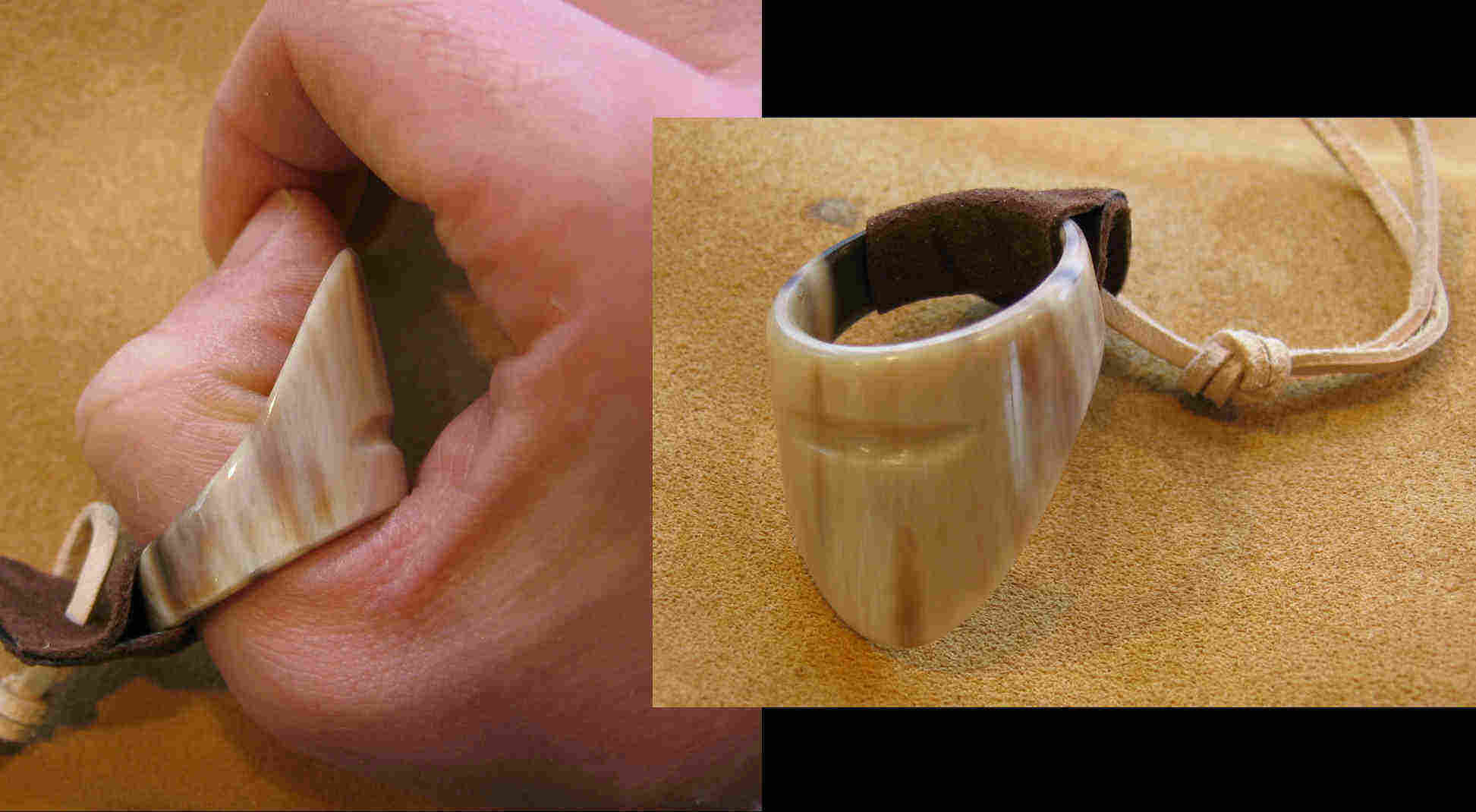
I just finished trying to make a thumb ring.
I do not know if I was overconfident with Lignum Vitae's durability for using it to make a thumb ring. Shape of the thumb ring could be different but to deal with that wood was a challenging experience. Horn and metal one can be more reliable but I really had fun by using that wood. Did you guys use that wood for any purpose ?
Thanks for posting that - interesting!
Lignum vitae is the densest wood known to man. I've got some spindle which I think would work for this as well.
Bede
Hakan,
Try duplicating an original Turkish thumb ring. The lignum vitae is strong enough. Rhinoceros horn was used for thin rings and it is even more fragile. Grooves are fine in some rings, but are not a good idea for wooden rings because they break the grain. This won't be much of a problem with lignum, but if you try something easier to carve like boxwood there could be trouble with time.
cristian_iepure
I made myself a wooden ring for a friend, he was shooting a 35lbs bow, and that ring was more than enough for that Korean bow.
my recommendation is: try making first thumbrings out of cheap and easy material like plexiglass. When you get the shape correct then try with tough or expensive material.
A friend of mine in Istanbul (Yildirim Ekmekciler) made thumbrings from hard wood, they were fine but I didnt try them with high draw weights.
Hakan Bakla
Hi Cristian,
Nice looking thumb ring for sure. What is the wood that you used for that ? Doesnt seem like Lignum Vitae. I am not sure If i should've varnished like that.
Hello Bede,
Thank you for the advice. I ll check some designs for making a turkish thumb ring. There are soo many different thumb ring desings on the net. I just picked one while browsing by my Blackberry in my workshop. I did not make any proper research for that thumb ring design. My intention was to check if Lignum Vitae's cross fibers really lock its grains and prevent from cracking. If its very dry darker part seems to crack easier. I heard that it should be waxed to prevent from overdrying. But without groove makes much more sense for its long term durability.
The design i picked was that. http://www.english-longbow.co.uk/largep ... 20horn.jpg
Merhaba Gokmen,
In my workshop I have dogwood, cherry, Hard maple, and 2 boxes of Lignum Vitae pieces. Only vitae had the most suitable pre-cut pieces for having an experiment for thumb ring. But beside that my goal was testing Lignum Vitae. I should have made a Turkish type of thumb ring but I just made a ring that popped up in my phones browser.
I agree that material could be easy to work on for a first time trying guy like myself. Perhaps softer wood be ok to practise but I would never consider plastic if I tried to make a proper Turkish thumb ring. I personally believe that any synthetic material should not be used in Traditional archery. But thats just me.
cristian_iepure
It was a piece cut from a laminated riser that I had made for my kids. Garapa, cumaru and merbau wood.
Gokmen
Merhaba Hakan,
I kinda tried to give Bede's message in a polite way as well. The thumbring you made has a very wrong design. In this design you will not be able to test if the material is durable or not. So first thing as Bede suggested is to get the design right (angles, thickness, ovalness etc). Only then you can make reliable tests if it is durable or not. Regarding plexiglass, it is not for shooting, only to get experience in making it and getting the shape right. Remember the first 2-3 thumbrings you make will be for the bin :) But it will give you precious experience for the next ones. There is a learning curve in this. That's why I suggested a cheap and easy to use material.
Let me know if I can help you in any way.
Regarding the authenticity, if you are reluctant to use a plastic thumbring, then you should also be reluctant to use anything else than a true Turkish hornbow :D
best wishes
Gokmen Altinkulp
Hakan Bakla
Merhaba Gorkem,
Thank you for your polite message and offer for the assistance. I am having difficulty in believing that you actually understood my message and checked the link I posted. Maybe I was not clear. There are soo many different thumb ring designs. I did not claim to make a Turkish thumb ring so the only comparison would be with the one I tried to duplicate after looking just 3 seconds. I did not end up with that ring shape by mistake. From the beginning my goal was to shape the wood like that. I am not the most talented wood worker but I make my living dealing with hard wood. I simply played and had fun with world's the densest and arguably the most durable wood.
Certain kinds of hardwoods are easily accessible for me due to my occupation but I wanted to test and learn more about working on Lihnum Vitae which is a rare hardwood and has unique features. But even if my goal were different, I kindly tried to point out that synthetic material would never come to my mind as an option once it had anything to do with Traditional Archery.
About authenticity, perhaps you are used to see people in some videos or on TV with their synthetic bows shaped like Turkish Traditional Bow. I never wanted and will never try to be one of them.
Best Regards,
Hakan BAKLA
Justin Ma
Gokmen wrote:
I kinda tried to give Bede's message in a polite way as well. The thumbring you made has a very wrong design.
The ring might not necessarily be of a "wrong" design, as it somewhat resembles the Shang dynasty (1600-?1046 BC) Fu Hao ring ( http://www.asianart.com/articles/rings/4.html ), which has a prominent string groove.
However, the design did lose popularity in China after that early time period. Subsequent archers found alternative (mostly grooveless) designs that probably worked just as well, or perhaps better: http://www.atarn.org/chinese/thumbrings ... _rings.htm
Bede
It is true that grooves gradually disappeared from rings. Event in the Middle East, the earliest rings in the Asian tradition had a pronounced groove plus an extra tear-drop shaped bulge to firmly locate the string. I am thinking particularly of the ring found at Fustat.
Some Korean rings have a shallow groove which is not to catch the string, but only to help the archer put the string in the right position. It is only the depth of a scratch. Others have a much deeper groove.
My advice to copy a Turkish ring was only because I think some Turkish rings have a shape that is very suited to wooden construction. I own some wooden rings in the Manchu cylindrical form which shows that people really did make wooden thumb rings in historical times.
It is important to make thumb guards, whether hard or soft, which fit and are comfortable to shoot with otherwise you will not learn how to make better ones. Each ring teaches you something new.
Justin Ma
Hakan Bakla wrote:
But even if my goal were different, I kindly tried to point out that synthetic material would never come to my mind as an option once it had anything to do with Traditional Archery.
About authenticity, perhaps you are used to see people in some videos or on TV with their synthetic bows shaped like Turkish Traditional Bow. I never wanted and will never try to be one of them.
More power to you for wanting to go exclusively traditional materials in your pursuits. That is admirable and takes discipline. But I'll make one point in defense of synthetics: affordable equipment (which is usually synthetic) democratizes Asian archery.
When I practice at my club --- which primarily focuses on recurve and compound --- people keep asking if they can try shooting an Asiatic bow. And I can give them that opportunity because I can afford extra 20#, 25# Asiatic synthetic bows to bring to practice (synthetic limbs covered in leather with mulberry siyahs). So far I've introduced the basics of Asian archery to a dozen people, and several of them have moved on to purchasing their own Asiatic equipment, which is primarily synthetic. These university students don't necessarily have the budget to afford genuine horn bows --- but by the time they can afford a horn bow, they'll have the technique to shoot it because of their training on synthetics. (Obviously, a horn bow needs a lot more care and maintenance --- but if they practice for that long, then you know they'll be serious about learning how to care for one.)
Now... if you know where to get wooden 20# Asiatic-style bows for < $100, then I'm all ears. :)
Thomas Duvernay
My favorite thumb ring is made of wood (date tree).
jkekoni
date tree
You mean: "The date palm (Phoenix dactylifera) is a palm in the genus Phoenix" ?
Hakan Bakla
I ve made two wooden thumbrings that I am happy to use.

![[external image]](http://i1039.photobucket.com/albums/a478/cristian_iepure3/inel%20lemn/IMG_9592.jpg)
![[external image]](http://i1039.photobucket.com/albums/a478/cristian_iepure3/inel%20lemn/IMG_9598.jpg)
![[external image]](http://i1039.photobucket.com/albums/a478/cristian_iepure3/inel%20lemn/IMG_9599.jpg)
![[external image]](http://i1039.photobucket.com/albums/a478/cristian_iepure3/inel%20lemn/IMG_9600.jpg)
![[external image]](http://i1039.photobucket.com/albums/a478/cristian_iepure3/inel%20lemn/IMG_9601%0A.jpg)