
Osage instead of Horn?
Osage is a good dense hardwood, prized for bowmaking. How well would it hold up in turkish composite style construction?
i've got some cores but no horn, and i have an osage 2x4 that would yield enough strips for several bows.
thanks
i've got some cores but no horn, and i have an osage 2x4 that would yield enough strips for several bows.
thanks
Osage can only be compressed 1% just like other woods give or take a little. In a bow of average hornbow length with same length bending sections you would be asking for far too much from it. However osage will work very well in 'normal' laminated recurve designs.
In other words don't bother unless you like chrysals!
In other words don't bother unless you like chrysals!
And yet Reginald Laubin published an" Osage Turk" bow in his archery book. Miwok Indian made bows quite like Korean type bows of wood and sinew.
Whatchoo sayin, Jack? ya think it's worth a go?
Absolutely! One third the work for a similar performance. Find the book. Probably pretty inexpensive.
Heres the link to that book mentioned above with the osage bellyed turkish bow:
http://books.google.com/books?id=xMF4Oq ... rk&f=false
I think he talks about it on page 80-81 or so, and has a picture of it on page 40... Ya I just registered to dispute that fact that osage would chrysal when reflexed or sinew backed, I have seen plenty of very reflexed sinew backed wood bows from west coast juniper bows to even red oak so I can't help but believe that osage would be a very usable substitute.
http://books.google.com/books?id=xMF4Oq ... rk&f=false
I think he talks about it on page 80-81 or so, and has a picture of it on page 40... Ya I just registered to dispute that fact that osage would chrysal when reflexed or sinew backed, I have seen plenty of very reflexed sinew backed wood bows from west coast juniper bows to even red oak so I can't help but believe that osage would be a very usable substitute.
thanks TMK, i just read that myself.
i'm going for it.
i'm going for it.
Osage is stiffer (MOE), but a lot of less able to handle compression.
You can make a short bow with static recurves and med poundage from sinew backed wood, but a short highly reflexed bow with high poundage and long draw will not work. (it would be wider than 30cm or so.
126cm 42#@27"
http://perinnejousi.fi/~jkekoni/bullet-sinew/
Fake composites are often made with highly reflexed handle, deflex limbs and big static recurves. I would rather take away reflex from the handle than make libs deflex. Such bow would be easier to make and more stable.
It is true that such bow has a slighty different profile, but I think one should be proud to own a short sinew backed wooden bow and not try to fake it being something it is not...
I have heard that sinew bamboo-bamboo could make comparable to real hornbow, but such is even harder to make than real horn bow.
You can make a short bow with static recurves and med poundage from sinew backed wood, but a short highly reflexed bow with high poundage and long draw will not work. (it would be wider than 30cm or so.
126cm 42#@27"
http://perinnejousi.fi/~jkekoni/bullet-sinew/
Fake composites are often made with highly reflexed handle, deflex limbs and big static recurves. I would rather take away reflex from the handle than make libs deflex. Such bow would be easier to make and more stable.
It is true that such bow has a slighty different profile, but I think one should be proud to own a short sinew backed wooden bow and not try to fake it being something it is not...
I have heard that sinew bamboo-bamboo could make comparable to real hornbow, but such is even harder to make than real horn bow.
"but a short highly reflexed bow with high poundage and long draw will not work."
I have seen short highly reflexed westcoast native american bows around 36" before on bowyer forums that pull close to 25" and at decent weights too. Now these are short draw from being so short with wider and thinner limbs than a horn bow would be, as you would think. Yet if you put some 10" siyahs/ears on them you would easily get 30" draw without having to worry, keeping the 36" or so of working limb, so estimating a 50" - 60" long bow. Although some of the smaller hornbows like turkish hornbows I would assume might only have 20" of working limb with a nonworking handle. Even with a reflexed/backset handle I believe you could make it work, but the limbs would have to be substantially wider and thinner then you would see on a hornbow. As with most nonbow woods you hear people tell you to go "wide and long" I believe this wouldn't be a bad idea for a first try. Heat treating can help strengthen the compression properties of wood as well. Wide and thin limb profiles can be quite slow sometimes, so a pyramid taper from wide to small tips and then siyahs/ears would probable remedy this, as least it does on the wide flat bows I make.
"It is true that such bow has a slighty different profile, but I think one should be proud to own a short sinew backed wooden bow and not try to fake it being something it is not..."
This is very true. But at the same time, how can a wood bow maker ignore such performance gains typical of hornbows such as light weight reflexed siyahs allowing leverage at the perfect 90 degree string angle eliminating stack, or pre-stressed design adding early draw weight, or string bridges adding energy to the arrow when released as well as alot of early draw weight? For someone who loves making wooden bows, and loves there bows so shoot well these can be a little tempting... :) :) :) You have some very good points though jkekoni.
I have seen short highly reflexed westcoast native american bows around 36" before on bowyer forums that pull close to 25" and at decent weights too. Now these are short draw from being so short with wider and thinner limbs than a horn bow would be, as you would think. Yet if you put some 10" siyahs/ears on them you would easily get 30" draw without having to worry, keeping the 36" or so of working limb, so estimating a 50" - 60" long bow. Although some of the smaller hornbows like turkish hornbows I would assume might only have 20" of working limb with a nonworking handle. Even with a reflexed/backset handle I believe you could make it work, but the limbs would have to be substantially wider and thinner then you would see on a hornbow. As with most nonbow woods you hear people tell you to go "wide and long" I believe this wouldn't be a bad idea for a first try. Heat treating can help strengthen the compression properties of wood as well. Wide and thin limb profiles can be quite slow sometimes, so a pyramid taper from wide to small tips and then siyahs/ears would probable remedy this, as least it does on the wide flat bows I make.
"It is true that such bow has a slighty different profile, but I think one should be proud to own a short sinew backed wooden bow and not try to fake it being something it is not..."
This is very true. But at the same time, how can a wood bow maker ignore such performance gains typical of hornbows such as light weight reflexed siyahs allowing leverage at the perfect 90 degree string angle eliminating stack, or pre-stressed design adding early draw weight, or string bridges adding energy to the arrow when released as well as alot of early draw weight? For someone who loves making wooden bows, and loves there bows so shoot well these can be a little tempting... :) :) :) You have some very good points though jkekoni.
Now someone find a picture of a California Miwok tribe bow and see something which will really remind you of a Korean hornbow. Made from Nutmeg ? wood.
If I remember correctly they used plant glue. I know Navajos also used plant glue. Maybe bee weed?
If I remember correctly they used plant glue. I know Navajos also used plant glue. Maybe bee weed?
"Now someone find a picture of a California Miwok tribe bow"
Here ya go:
[external image]
[external image]
Heres the guys thread that made it:
http://www.primitivearcher.com/smf/inde ... ic=15679.0
:):):)
Now just slap some 5" or so siyahs on that guy and theres your 30" draw.
[external image]
The bow he said is 38.5" long, so an extra 10" - 15" from siyahs would
make it around 50 - 55" long?
Here ya go:
[external image]
![[external image]](http://i53.tinypic.com/2i6nuoz.jpg)
[external image]
![[external image]](http://i55.tinypic.com/2w4dymb.jpg)
Heres the guys thread that made it:
http://www.primitivearcher.com/smf/inde ... ic=15679.0
:):):)
Now just slap some 5" or so siyahs on that guy and theres your 30" draw.
[external image]
![[external image]](http://i56.tinypic.com/125requ.jpg)
The bow he said is 38.5" long, so an extra 10" - 15" from siyahs would
make it around 50 - 55" long?
Toomany; To be specific, the above is a COPY of a Miwok bow. Here is the real deal. Good illustration you made, I agree.
http://www.yosemite.ca.us/library/miwok ... ate_59.jpg
And a much shot in one at that. I will try to find another pic of a fresh one.
Here is some reading material on manufacture. Chumash is only secondary to Miwok. California archery is second to none in the USA. Start p. 253.
http://books.google.com/books?id=qSRLW5 ... ow&f=false
and; What a deal; http://cgi.ebay.com/REFLEXED-SINEW-BACK ... 0665059657
http://www.yosemite.ca.us/library/miwok ... ate_59.jpg
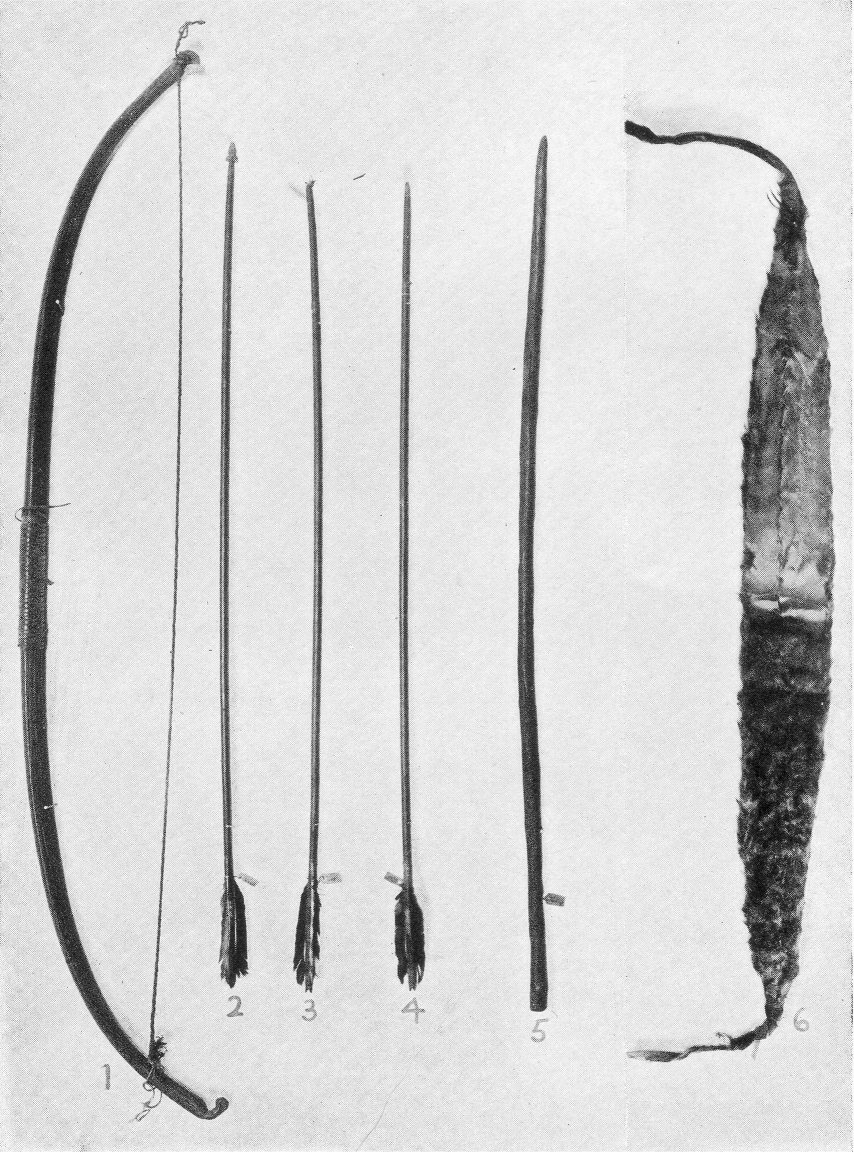
And a much shot in one at that. I will try to find another pic of a fresh one.
Here is some reading material on manufacture. Chumash is only secondary to Miwok. California archery is second to none in the USA. Start p. 253.
http://books.google.com/books?id=qSRLW5 ... ow&f=false
and; What a deal; http://cgi.ebay.com/REFLEXED-SINEW-BACK ... 0665059657
"California archery is second to none in the USA."
After reading/looking at some of these bows , I agree!
After reading/looking at some of these bows , I agree!
For the draw weight i want, osage might be perfect. I'm going to make a thin-limbed composite that draws only 50 or 60#. I think one layer of sinew will be enough.
The Osage "composite" which i found example of on PP developed longitudinal belly cracks as the sinew which draped over the edge of the bow shrank. I think i will put on a layer of sinew which is concentrated along the center of the bow, and which thins considerably as it reaches over the edge to tie everything together. The object is to reduce the amount of shrinkage that occurs at the edge, so that the transverse forces on the belly slat do not rip the fibers open and create those longitudinal cracks.
Don't get me wrong: i'd use horn if i had some. But i also don't want a giant draw weight. I'm not a horseback archer riding off to war. I think the osage should be fine.
thanks for your input
The Osage "composite" which i found example of on PP developed longitudinal belly cracks as the sinew which draped over the edge of the bow shrank. I think i will put on a layer of sinew which is concentrated along the center of the bow, and which thins considerably as it reaches over the edge to tie everything together. The object is to reduce the amount of shrinkage that occurs at the edge, so that the transverse forces on the belly slat do not rip the fibers open and create those longitudinal cracks.
Don't get me wrong: i'd use horn if i had some. But i also don't want a giant draw weight. I'm not a horseback archer riding off to war. I think the osage should be fine.
thanks for your input
First off the original question was 'Osage is a good dense hardwood, prized for bowmaking. How well would it hold up in turkish composite style construction?'
The pictured bows are not even a little like a Turkish hornbow.
I have made quite a few reflexed, recurved sinew backed bows from juniper, yew ,osage, elm etc and have experience of what wood can take when sinew backed.
I think the 'experiment' is well worth doing, even if it's just to see if it's possible for yourself.
I will stand by my statement that osage will not work for an accurate replica of a Turkish bow. It doesn't have the required properties.
The pictured bows are not even a little like a Turkish hornbow.
I have made quite a few reflexed, recurved sinew backed bows from juniper, yew ,osage, elm etc and have experience of what wood can take when sinew backed.
I think the 'experiment' is well worth doing, even if it's just to see if it's possible for yourself.
I will stand by my statement that osage will not work for an accurate replica of a Turkish bow. It doesn't have the required properties.
"I will stand by my statement that osage will not work for an accurate replica of a Turkish bow. It doesn't have the required properties."
Hey mike, do you mean osage will not work in a turkish hornbows design because:
-of how reflexed a turkish hornbow is
-of how short a turkish hornbow is
-of how much weight a turkish hornbow pulls
-other,... ?
...and if so, what would you recommend changing if attemptingt to make a turkish hornbow style bow with osage as the belly?
Hey mike, do you mean osage will not work in a turkish hornbows design because:
-of how reflexed a turkish hornbow is
-of how short a turkish hornbow is
-of how much weight a turkish hornbow pulls
-other,... ?
...and if so, what would you recommend changing if attemptingt to make a turkish hornbow style bow with osage as the belly?
i'm thinking less reflexed, maybe a little longer, full sal bend, lower draw weight?
It does often amaze me what have been done. I would assume that by every succesful one there quite many that did not last full draw. I cannot be sure of course.toomanyknots wrote:
I have seen short highly reflexed westcoast native american bows around 36" before on bowyer forums that pull close to 25" and at decent weights too.
However what I meant is something like:
under 120cm(47") bow with 80cm(31") draw and over 100# and over 20cm(8") reflex when unbraced.
And word wood here does not include monocot plants(=bamboo).
here is the first cured out and "finished" attempt. it's a copy of the composite shortbow i made with horn and sinew. Having copied the horn bow, i am able to compare the performance of the two, although i have to say the osage-bellied bow is considerably narrow, intentionally built for a lighter draw weight.
[external image]
[external image]
[external image]
[external image]
[external image]
the bow draws to 28" without a hint of tension trouble. 3 layers of sinew. Draws 45#@28". The osage took a bunch of set, but i will try to straighten it with heat. In this aspect, the horn definitely proves superior. However, i will continue the experiment with wider and thicker pieces of osage and i have a few pieces of ipe and new cores ready to go.
here is a turkish composite made of yew and sinew with osage belly lams. It has never yet been strung, but this is how it looks while being flexed.
[external image]
[external image]
![[external image]](http://i283.photobucket.com/albums/kk314/NomadArchery/039.jpg)
[external image]
![[external image]](http://i283.photobucket.com/albums/kk314/NomadArchery/038.jpg)
[external image]
![[external image]](http://i283.photobucket.com/albums/kk314/NomadArchery/040.jpg)
[external image]
![[external image]](http://i283.photobucket.com/albums/kk314/NomadArchery/First%20Composite%20Short%20Bow/072.jpg)
[external image]
![[external image]](http://i283.photobucket.com/albums/kk314/NomadArchery/First%20Composite%20Short%20Bow/073.jpg)
the bow draws to 28" without a hint of tension trouble. 3 layers of sinew. Draws 45#@28". The osage took a bunch of set, but i will try to straighten it with heat. In this aspect, the horn definitely proves superior. However, i will continue the experiment with wider and thicker pieces of osage and i have a few pieces of ipe and new cores ready to go.
here is a turkish composite made of yew and sinew with osage belly lams. It has never yet been strung, but this is how it looks while being flexed.
[external image]
![[external image]](http://i283.photobucket.com/albums/kk314/NomadArchery/002.jpg)
Since resources like buffalo horns are sometimes rare or not easy to get, and instead of osage, have you ever tried bamboo?
R
R
I have used bamboo as backing but never as the belly. I have some: might as well try it.
Should the bamboo belly lam be noticeably thicker than one i would use for a backing strip?
Should the bamboo belly lam be noticeably thicker than one i would use for a backing strip?
[external image]
this is that same bow on my stringing board. This board is insufficient, so i'm in the process of making a wider one.
![[external image]](http://i283.photobucket.com/albums/kk314/NomadArchery/059.jpg)
this is that same bow on my stringing board. This board is insufficient, so i'm in the process of making a wider one.
[external image]
[external image]
[external image]
[external image]
[external image]
[external image]
[external image]
I have not yet drawn this one, just braced it. Obviously there is a more pronounced kink in one limb than the other. The wood has chrysalled there, as Mike predicted, and so until i give it the right kind of love, i don't want to draw it back.
Any tips?
should i feather in a thin piece of osage? Or just wrap it with sinew? or something else? thanks
![[external image]](http://i283.photobucket.com/albums/kk314/NomadArchery/001.jpg)
[external image]
![[external image]](http://i283.photobucket.com/albums/kk314/NomadArchery/002-1.jpg)
[external image]
![[external image]](http://i283.photobucket.com/albums/kk314/NomadArchery/003.jpg)
[external image]
![[external image]](http://i283.photobucket.com/albums/kk314/NomadArchery/004.jpg)
[external image]
![[external image]](http://i283.photobucket.com/albums/kk314/NomadArchery/006.jpg)
[external image]
![[external image]](http://i283.photobucket.com/albums/kk314/NomadArchery/007.jpg)
[external image]
![[external image]](http://i283.photobucket.com/albums/kk314/NomadArchery/008.jpg)
I have not yet drawn this one, just braced it. Obviously there is a more pronounced kink in one limb than the other. The wood has chrysalled there, as Mike predicted, and so until i give it the right kind of love, i don't want to draw it back.
Any tips?
should i feather in a thin piece of osage? Or just wrap it with sinew? or something else? thanks
btw
the sal was straight without noticeable reflex before the bow was braced.
the sal was straight without noticeable reflex before the bow was braced.
Respect for trying! :D
To fix the chrysaled area cut out a rectangular portion of the belly (with the chrysal in the middle). Go down to the core depth-wise. Cut a new piece of osage to fit. The tricky part is making the bottom of the cut flat for a good gluing surface but because you've got a core it shouldn't be too hard. Make the new piece of osage a couple of mm thicker than needed so you can work it down to the correct thickness once glued. When you start bending it be really really careful that it isn't too stiff or else you will chrysal the belly towards the handle....then you will end up chasing chrysals along the belly :roll:
There is no point wrapping with sinew as the damge has been done.
Good luck.
To fix the chrysaled area cut out a rectangular portion of the belly (with the chrysal in the middle). Go down to the core depth-wise. Cut a new piece of osage to fit. The tricky part is making the bottom of the cut flat for a good gluing surface but because you've got a core it shouldn't be too hard. Make the new piece of osage a couple of mm thicker than needed so you can work it down to the correct thickness once glued. When you start bending it be really really careful that it isn't too stiff or else you will chrysal the belly towards the handle....then you will end up chasing chrysals along the belly :roll:
There is no point wrapping with sinew as the damge has been done.
Good luck.
Radius; I have built many backed bows before discovering hornbows. What you need is a design change. In a Turkish bow the bend is trapped in a small section (sal- arm) between the grip and the kasan (ridged section). This is too intense for wood. In a backed bow, most or all of the bow must bend. And the beginning reflex should be much less.
With some experimentation a design can be found which will out perform all except master made horn bows.
With some experimentation a design can be found which will out perform all except master made horn bows.
Super cool project Radius. What material did you use for the core and kasans? I assume you substituted the osage for horn? I'd really like to experiment with this build like you have done (since I have plenty of osage to play with at the moment.
thanks guys. i agree: the bend is too sharp. haha
lee, the core was made of yew heartwood.
lee, the core was made of yew heartwood.
i wonder how well it would work to simply widen the sal? The little recurve i showed first took alot of set, and has a soft release, but still draws 45#. It is only an inch wide.
I'm starting to think that it is too much work to make such complex bows for draw weights this low. I mean, it looks cool, shouldn't break, and does the trick, but i could make a similar bow of all wood construction much more easily and cheaply. If i were to widen the sal to prevent set, i'd get a higher draw weight and have to use thinner material.
I am glad i made these, and i'll keep whacking away at them til they're done, but hmm....no.
i also recently bought some ipe and milled enough slats to belly up a few more bows, and have the cores in various stages of readiness. In a few months i'll get an idea of how ipe holds up. I've never used it.
I'm starting to think that it is too much work to make such complex bows for draw weights this low. I mean, it looks cool, shouldn't break, and does the trick, but i could make a similar bow of all wood construction much more easily and cheaply. If i were to widen the sal to prevent set, i'd get a higher draw weight and have to use thinner material.
I am glad i made these, and i'll keep whacking away at them til they're done, but hmm....no.
i also recently bought some ipe and milled enough slats to belly up a few more bows, and have the cores in various stages of readiness. In a few months i'll get an idea of how ipe holds up. I've never used it.
Radius; here are other ideas. If the bending limbs will each equal the arrow length, a bow of osage alone will work. Sinew will not improve the cast of osage because of the weight, but it will protect against breakage. If a slightly thick bow of osage or other material is made and bandsawed through the middle width, the two sections can be glued to a form in some pretty bendy shapes.
Designs with long limbs and no kasan include Mongol era bows, Hunn and Manchu. Hickory, Black locust and ash would be really good for these designs (two layers of wood and sinew back). With the addition of sinew backing, the bending limb can be shorter than the draw. A board of choice grain kiln dried ash will suffice nicely and the slats can be table sawed. Additions of very tapered wedges can fill out the siyahs. Limit the reflex.
Hermit posted some like these.
Designs with long limbs and no kasan include Mongol era bows, Hunn and Manchu. Hickory, Black locust and ash would be really good for these designs (two layers of wood and sinew back). With the addition of sinew backing, the bending limb can be shorter than the draw. A board of choice grain kiln dried ash will suffice nicely and the slats can be table sawed. Additions of very tapered wedges can fill out the siyahs. Limit the reflex.
Hermit posted some like these.
Jack, this sounds very interesting to me since I have a nice stash of Hickory & B. Locust. Do you have any links or specific pictures of these designs that would work well with these materials as I don't have a deep knowledge from a category or classification perspective on these Mongol bows.jack farrell wrote:
Designs with long limbs and no kasan include Mongol era bows, Hunn and Manchu. Hickory, Black locust and ash would be really good for these designs (two layers of wood and sinew back). With the addition of sinew backing, the bending limb can be shorter than the draw. A board of choice grain kiln dried ash will suffice nicely and the slats can be table sawed. Additions of very tapered wedges can fill out the siyahs. Limit the reflex.
When you are saying 2 layers of wood are you meaning a core and a belly lam? What would be a good wood choice for the kasans or are these style of bows without kasans and only have longer limbs?
Wonderful site here folks, such a deep knowledge base.
Lee
Jack, i appreciate you taking the time to advise me this way. I really am just making it all up as i go!
I have about 5 new cores almost ready for the addition of the belly strip. I will post pictures of them in a new thread, and ask you for advice: which type of material would be the best belly material for each core? The cores are all different, with varying reflex, length, and degree of recurve. Coming soon.
and Lee, yes he meant, a core strip and a belly strip both of wood, and sinew backing.
I have about 5 new cores almost ready for the addition of the belly strip. I will post pictures of them in a new thread, and ask you for advice: which type of material would be the best belly material for each core? The cores are all different, with varying reflex, length, and degree of recurve. Coming soon.
and Lee, yes he meant, a core strip and a belly strip both of wood, and sinew backing.