
Crab Bow 2
Hello everybody,
after quite a while i was finally able to finish tillering in my second crab bow project.
I was quite nervous, so to get the bow used to the curvature and to reduce the risk of delaminating I left it on the tepeliks for 3 weeks, then slowly began bending it into bracing position. I used mild heat to reduce reflex, too.
Unlike the first one this bow proved to be more stable because of a lower knee angle in the siyahs and could be strung without problem. I had to correct some sideway twist and brought the limbs to even tiller by scraping the horn.
I had it on the tiller board at 28" but only a few seconds, the bend in the limbs was impressing. I measured 73 pounds at 26 inches so it will be over 80 pounds at 28.
[external image]
[external image]
[external image]
[external image]
[external image]
The dimensions of this bow are based on an original Crab bow in the possession of a friend, only the siyah knee angle was reduced a bit.
JJ
after quite a while i was finally able to finish tillering in my second crab bow project.
I was quite nervous, so to get the bow used to the curvature and to reduce the risk of delaminating I left it on the tepeliks for 3 weeks, then slowly began bending it into bracing position. I used mild heat to reduce reflex, too.
Unlike the first one this bow proved to be more stable because of a lower knee angle in the siyahs and could be strung without problem. I had to correct some sideway twist and brought the limbs to even tiller by scraping the horn.
I had it on the tiller board at 28" but only a few seconds, the bend in the limbs was impressing. I measured 73 pounds at 26 inches so it will be over 80 pounds at 28.
[external image]

![[external image]](http://i281.photobucket.com/albums/kk224/upo546/Crab-2_0093IMG_1007.jpg)
[external image]

![[external image]](http://i281.photobucket.com/albums/kk224/upo546/IMG_1033.jpg)
[external image]

![[external image]](http://i281.photobucket.com/albums/kk224/upo546/IMG_1032.jpg)
[external image]

![[external image]](http://i281.photobucket.com/albums/kk224/upo546/IMG_1036.jpg)
[external image]

![[external image]](http://i281.photobucket.com/albums/kk224/upo546/IMG_1044.jpg)
The dimensions of this bow are based on an original Crab bow in the possession of a friend, only the siyah knee angle was reduced a bit.
JJ
great work, looks perfect, congrats.
congratulations! very nice
Geiles Teil! Gratuliere!
Peter
Peter
Nice bow! Gratulerer!
Is it drawn 28" in the pictures? (can't read the numbers on the tillerstick)
Very impressed with crabs keeping straight! Looks like it's bending very nice, maybe a little less on the right side, last picture?
Btw, does leaving the bow for weeks on the tepliks make bending safer?
Is it drawn 28" in the pictures? (can't read the numbers on the tillerstick)
Very impressed with crabs keeping straight! Looks like it's bending very nice, maybe a little less on the right side, last picture?
Btw, does leaving the bow for weeks on the tepliks make bending safer?
super :D
Thank you!
I?m happy that it is stable and quite surprised I must say ;-)
On the pictures it is drawn to 65cm (ca. 26"), I didn?t leave it for longer at 28 inches to take a picture. I was a little too scared...
Now smoothing it, some sinew binding at critical places and then bracing again, adjusting and some shooting. For decoration I chose not to put sinew on the belly. The original bow has the painting directly onto the belly horn in the bending parts of the limbs. There?s a crack where you can see it. Other parts including the back and the parts closer to the siyahs show some light brown priming coat of powdery consistency where the decoration layers flaked off.
Does anybody have an idea what this could be made of?
It?s probably less than half a millimetre thick and under it theres a whitish layer, maybe sinew.
JJ
I?m happy that it is stable and quite surprised I must say ;-)
On the pictures it is drawn to 65cm (ca. 26"), I didn?t leave it for longer at 28 inches to take a picture. I was a little too scared...
Now smoothing it, some sinew binding at critical places and then bracing again, adjusting and some shooting. For decoration I chose not to put sinew on the belly. The original bow has the painting directly onto the belly horn in the bending parts of the limbs. There?s a crack where you can see it. Other parts including the back and the parts closer to the siyahs show some light brown priming coat of powdery consistency where the decoration layers flaked off.
Does anybody have an idea what this could be made of?
It?s probably less than half a millimetre thick and under it theres a whitish layer, maybe sinew.
JJ
Congrats! - and good to see that you are back into making horn bows again :)
I would perhaps consider shortening the string slightly, so that the string would lift a little more off the "kasans". How much overall reflex or deflex did it have after the full draw? It seems to me that these bows needs to loose a lot of the reflex to become stable enough. I suspect yours should have done very well with the wide horn.
I would perhaps consider shortening the string slightly, so that the string would lift a little more off the "kasans". How much overall reflex or deflex did it have after the full draw? It seems to me that these bows needs to loose a lot of the reflex to become stable enough. I suspect yours should have done very well with the wide horn.
Thanks, Kviljo,
yes it is very stable indeed and I think it will perform better with a longer string like this.
After unstringing it didn?t have much reflex left. The limbs showed quite some deflex from being on the tepeliks for so long and of course being strung for some days. Now it is recovering in the warm weather...
BTW, I don?t see much real reflex in the old bows. In fact the reflex in the limbs is quite moderate compared to the turkish or korean bows. Only the sharp angled siyahs give the impression of a very reflexed shape...
JJ
yes it is very stable indeed and I think it will perform better with a longer string like this.
After unstringing it didn?t have much reflex left. The limbs showed quite some deflex from being on the tepeliks for so long and of course being strung for some days. Now it is recovering in the warm weather...
BTW, I don?t see much real reflex in the old bows. In fact the reflex in the limbs is quite moderate compared to the turkish or korean bows. Only the sharp angled siyahs give the impression of a very reflexed shape...
JJ
I could shoot the bow a little today. I could draw it to around 26 inches only...
It sort of hammered the arrows into the target, and I was really impressed by the speed.
[external image]
It sort of hammered the arrows into the target, and I was really impressed by the speed.
[external image]

![[external image]](http://i281.photobucket.com/albums/kk224/upo546/KopievonIMG_1146.jpg)
Later I put it on the tiller to see what it?s poundage was.
At 27" where it had 83 pounds, I had already heard a soft cracking sound, and when I drew it to 28 inches there was a hell of a bang!
Both horn strips had delaminated at the same time. The glue seems to have become brittle.
[external image]
The bow is otherwise quite intact, some minor cracks in the wooden core only. Well, let?s see if I can glue them on again ;-)
At 27" where it had 83 pounds, I had already heard a soft cracking sound, and when I drew it to 28 inches there was a hell of a bang!
Both horn strips had delaminated at the same time. The glue seems to have become brittle.
[external image]

![[external image]](http://i281.photobucket.com/albums/kk224/upo546/KopievonIMG_1152.jpg)
The bow is otherwise quite intact, some minor cracks in the wooden core only. Well, let?s see if I can glue them on again ;-)
Oh shit!
Hope you can fix it....
Hope you can fix it....
sche... :shock: :x
That's really too bad. Good luck with glueing it back together.
I think you are quite right in that the old bows does not have much reflex in the bending parts. At least some. Then there are others which have a fair amount, like this one:
http://kviljo.no/bue/krabbe3.jpg
I wonder what they did to make it want to creep back this much...
That's really too bad. Good luck with glueing it back together.
I think you are quite right in that the old bows does not have much reflex in the bending parts. At least some. Then there are others which have a fair amount, like this one:
http://kviljo.no/bue/krabbe3.jpg
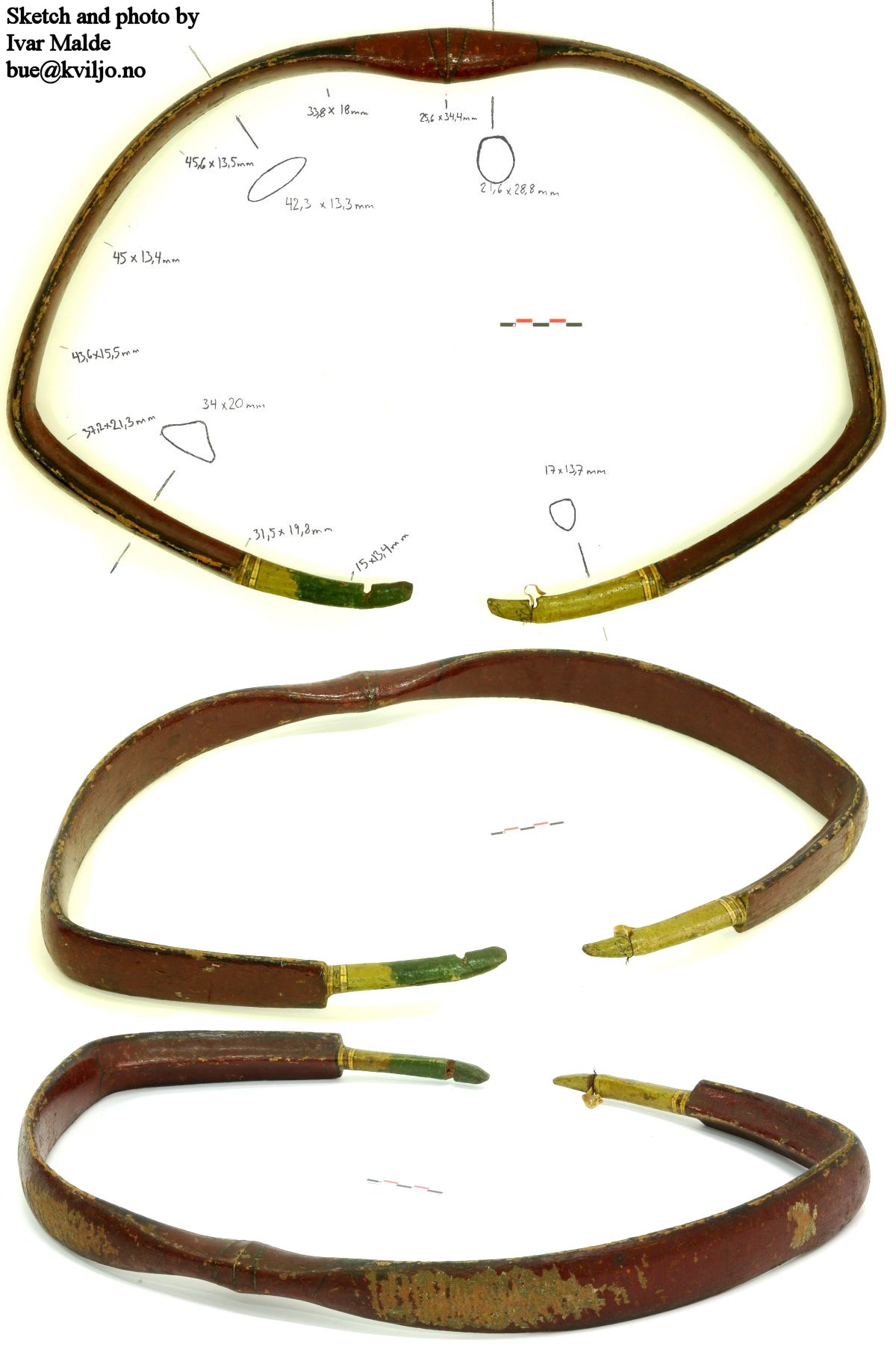
I wonder what they did to make it want to creep back this much...
Lurz said what I say whenever one of my arrows snap! hahaaha
I cannot imagine if one of my bows snapped.
I cannot imagine if one of my bows snapped.
This I could finish before it broke (28" value interpolated of course). A nice fat curve....
[external image]
[external image]

![[external image]](http://i281.photobucket.com/albums/kk224/upo546/kennkurvekraftweg.jpg)
An observation:
[external image]
On both horn strips the area around the "kasan eye" zone the glued horn surface looks as if tiny flat flakes are rising. I think the delamination of the horn started at this place. On both limbs...
[external image]
In this area the lever effect of the long siyahs has probably the greatest force...
So perhaps the horn should be thicker at this place??
JJ
[external image]

![[external image]](http://i281.photobucket.com/albums/kk224/upo546/copyvonIMG_1168.jpg)
On both horn strips the area around the "kasan eye" zone the glued horn surface looks as if tiny flat flakes are rising. I think the delamination of the horn started at this place. On both limbs...
[external image]

![[external image]](http://i281.photobucket.com/albums/kk224/upo546/KopievonIMG_1172.jpg)
In this area the lever effect of the long siyahs has probably the greatest force...
So perhaps the horn should be thicker at this place??
JJ
But isn't it a gluing problem rather than a horn problem?
First of all, great bow!
Since this is a good opportunity to ask, there's a few things that I'm curious about. The original bows were wrapped with a thin layer of sinew as a read, and also the horn is supposed to be very thin?
Did you plan to wrap it in sinew? How thick is the horn that you used?
Since this is a good opportunity to ask, there's a few things that I'm curious about. The original bows were wrapped with a thin layer of sinew as a read, and also the horn is supposed to be very thin?
Did you plan to wrap it in sinew? How thick is the horn that you used?
I tend to agree with Mongolianarcher, that it may be a problem with glue. If the horn delaminated I would have expected to see bits of horn remaining on the wooden core?
Did you use matching groves btw? If not, I'm thinking of a debate here some time ago about the grooves being sufficiently filled with glue?
Did you use matching groves btw? If not, I'm thinking of a debate here some time ago about the grooves being sufficiently filled with glue?
http://198.170.107.188/phpBB2/viewtopic.php?t=2569
I agree. It looks like the same problem as I have had with some bows. On mine I have concluded that the joint have not been filled with enough glue, which is strong enough for sectons that have little glued in reflex, but not strong enough for the "pulling apart" forces in sections with more reflex. The horn on mine have always popped off at the most reflexed sections, and the delaminated surfaces look very similar.
The main reason for having a larger portion of horn at some place along the bow, as I see it, is that you want that place to be bending more than the rest. On the other hand, too little horn will simply give the bow more string follow at that area. In any case, some of these bows apparently had very little horn, even down to 2mm and only 1/3 of the total limb width (?!).
I agree. It looks like the same problem as I have had with some bows. On mine I have concluded that the joint have not been filled with enough glue, which is strong enough for sectons that have little glued in reflex, but not strong enough for the "pulling apart" forces in sections with more reflex. The horn on mine have always popped off at the most reflexed sections, and the delaminated surfaces look very similar.
The main reason for having a larger portion of horn at some place along the bow, as I see it, is that you want that place to be bending more than the rest. On the other hand, too little horn will simply give the bow more string follow at that area. In any case, some of these bows apparently had very little horn, even down to 2mm and only 1/3 of the total limb width (?!).
:? meh..
good luck with repair and thanks for sharing experience !
good luck with repair and thanks for sharing experience !
Bj?rn, I will wrap it now I guess (because I?m a little cautious about two cracks in the horn).
Originally I wanted to paint directly onto the sinew/ horn without adding additional mass to the bow.
And yes there were small and thin flakes of horn on some places on the core. Unfortunately i do not remember the spots exactly.
But the horn seems to have developped tiny cracks on the inside at the siyah splice. I?m not sure if they were the reason for the delaminations or if they developped during the separation when the horn suddenly straightened.
Anyway i have glued it together again and hope it will hold better this time.
[external image]
Originally I wanted to paint directly onto the sinew/ horn without adding additional mass to the bow.
And yes there were small and thin flakes of horn on some places on the core. Unfortunately i do not remember the spots exactly.
But the horn seems to have developped tiny cracks on the inside at the siyah splice. I?m not sure if they were the reason for the delaminations or if they developped during the separation when the horn suddenly straightened.
Anyway i have glued it together again and hope it will hold better this time.
[external image]

![[external image]](http://i281.photobucket.com/albums/kk224/upo546/KopievonIMG_1177.jpg)