I may be mis-remembering some details hre, but if I'm right, the bows made in Mongolia now are not the same as what was made in the time of Chinghis Khan, but rather more like Manchu bows of northern China.
If so, what did the original Mongolian bows look like? Do we have any reliable artistic representations or decent archaeological examples? If so, where can I see them?
Cheers,
Dave
Andrew Hall
Dave
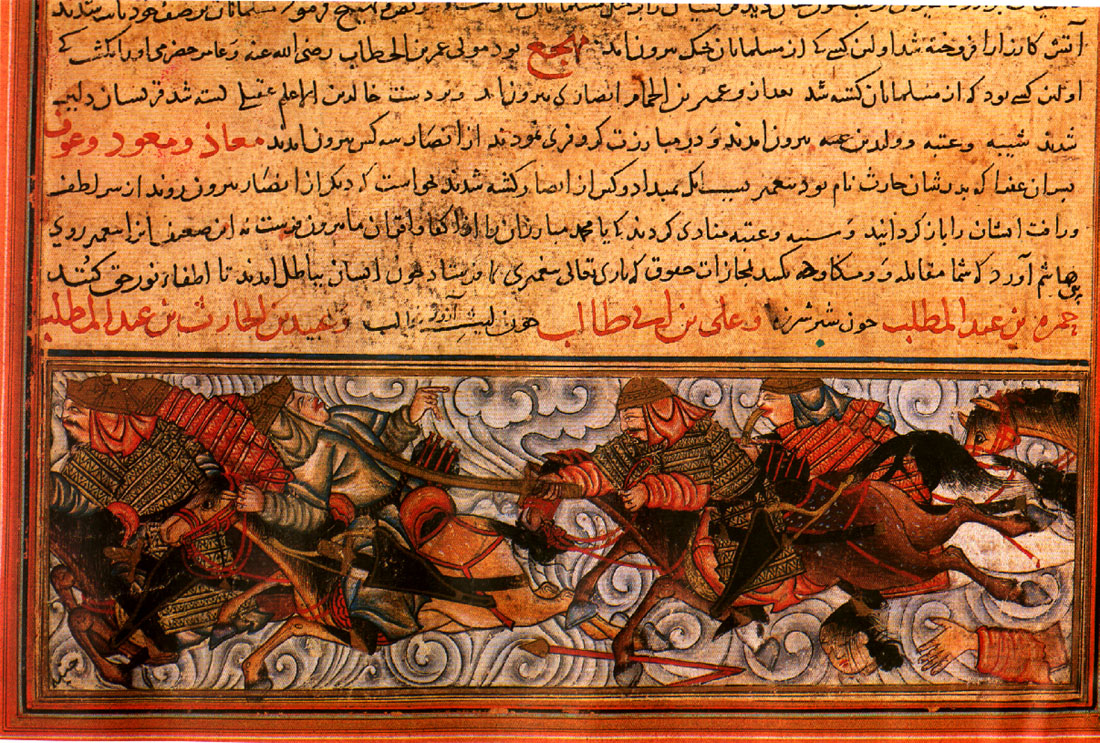
The Mongolian bows of the Chingis Khan era appear to have had a slightly set-back grip (from the archaeological evidence - often with a bone grip belly plate), quite short and wide bending limbs, with a slight angle to long curved siyahs without bone plates.
There is a write-up of a late example of this type from Mongolia in "The Omnogov Bow" by W. Alex & G. Menes, Journal of the Society of Archer-Antiquaires, 1995.
There is also a photo of the grave of a Mongolian warrior showing the bow and arrows in "The Grey Goose Wing" by E.G. Heath.
Regards
Andrew
Stephen Selby
I asgree with Andrew. But I would add that 'Mongol' forces of the time of Chinggis Khan included many cultures who probably had more than one standard design of bows.
S
Bede
I agree with both Stephen and Andrew.
There is definitely a change in bow design in the period of Chinggis Khan and it is almost impossible to say which group was responsible. The shape of the ears changed so that by the end of the period the tips of the ears had become recurved.
Stephen is right about the composition of Mongol armies. Large numbers of tribal Turkish troops were absorbed as the Mongols expanded. Kitans were enlisted too and even disaffected Jurchens. With conquest of North China, large numbers of Chinese troops were recruited. Craftsmen were brought from the cities of Central Asian and Iran. With this mix, there must have been cross-cultural interchanges which greatly affected the development of bow design.
Stephen Selby
Here is a little background about Mongolian archery in the Qing Dynasty (1644-1911) that may not be so well-known.
While there were Mongol troops in the army of Qing China and many Mongolian commanders were held in high regard, the Mongols in the heartland were banned from making bows or practising any form of archery. In fact, the Mongols tried to keep up their skills by playing a miniature archery game with tiny crossbows inside their yurts where they couldn't be seen.
During this period, the Mongolian troops in Chi8na would have used the standard Qing Manchu equipment, which is what has persisted until the present. The Mongolian word for the Khalkha Mongolian bow is 'Gung', which is the same as the Chinese. The original Mongolian word 'nom' is only used as a generalized term.
So during the Qing Dynasty, the art of making the pre-Qin bows died out, and only skill in making Qing-style bows remained, preserved by people such as Choijelsuren. After the Soviets allowed traditional archery to be revived for the Nadam from the 1950s, Choijelsuren had to go to Beijing to find sufficient bows to arm the competitors in the first Nadam.
In the 1960s/1970s, during the Sino-Soviet split, most Mongols were driven away from Inner Mongolia into Qinghai, where they maintain an archery tradition that has become assimilated with Tibetan archery in Henan County.
S
S
Dave
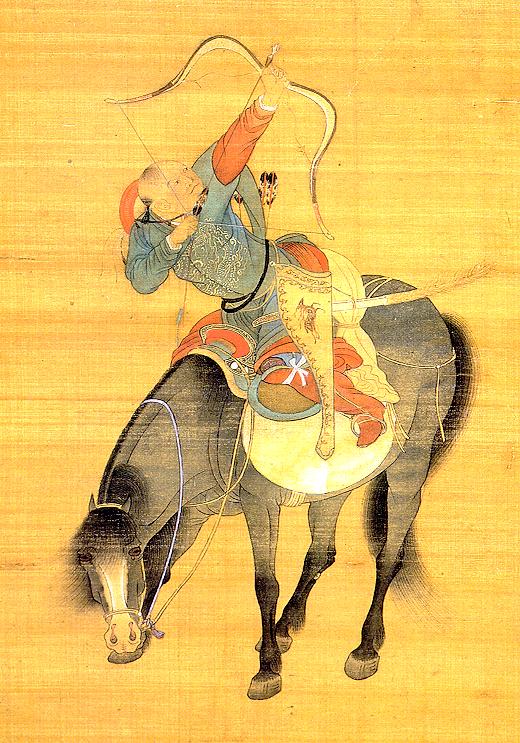
That first link from Andrew is just amazing! I put the image into CAD and found that the NTN length of the bow is about 2.19 times the length of the draw, which is interesting.
What is also interesting is the shape of the bow-quiver. It would seem that if the bow were to fit snugly into it, the braced shape of the bow would be a barely contact recurve.
Are there any more picture like this, and how far can we beleive the representation by these artists?
Thanks also for the input from the others, it's very helpful.
Cheers,
Dave
Bede
Dave,
In the same painting, there is an attendant to Qubilai holding a bow wrapped in cloth. The bow is strung and there is recurvature, though not prominent.
There are several contemporary and near-contemporary paintings of these bows. They appear to belong to a distinct type with a number of descendant classes of bow. Andrew has pointed out elsewhere that there is a developmental history of bows going from non-contact ears to recurved tips. However, Stephen is right to emphasise the variety that could be used in one place. Bows were like cars are now: you chose what you liked, what was fashionable and what you could afford.
With the curved shape, length and narrowness of the siyahs, the bracing height would be set so that the string would barely touch the belly of the siyah. Any more contact and there would be a serious risk of the bow unstringing itself on any limb twist or imbalance.
I agree with Stephen and Bede's statements on the variety of bows in use. At it's peak, the Mongolian Empire stretched over a vast area, and very few of it's inhabitants were native Mongolian. Bows from different groups would have been traded and captured, and different archers and bowyers would have had their own preferences. We only have a few paintings and a couple of intact bow finds from the edges of this empire from which to base our assumptions. Anything viewed from this distance in time with so little evidence is likely to be a drastic simplification.
Regards
Andrew
Alam ed Din, Adnan
Are there any texts that deal with the transition from pre Qing bows towards
the Qing style bows. I remember having read a text years ago about the fines that Mongols had to pay when caught engaging in anything related to archery, which was prohibited by the Qing Govt. I remember that the text mentioned that some fines had to be paid in green tea bricks......
Now I can't find that text, anyone help please
Dwanyin
Part of a Song dynasty (960-1279) painting "Goddess of the Luo River" [宋] <洛神賦圖>
ming dynastic has administer manchu before they are betray , it seem manchu has use ming bows, the weapon is control and purvey by country. the manchu name nuzhen , they are build jin dynastic end by Mongolia at year 1234, the nuzhen one part in the Mongolia army, one part in chinese,
so has some problematic, what style of jin dynastic hornbows? after yuan dynastic end who invent the qing style hornbow? i rember here who said manchu learn how made a hornbow from Mongolia
jack farrell
"The ulus(polity) of Jochi became a large state called the Golden Hoard. The GH stretched from the river Irtysh to lake Balkash in the east and from the Black Sea to the Danube in the west.
The population of the eastern part of the GH, subjicated by spear and sword, was rather motley. It practiced Islam, Christianity, Tengrianism and other religions, and used Uighur writing, although Chagatai Turkic was the state language. Humanities, literature and handicrafts developed in Berke, the capitol of the GH, and in the cities of Batu, Urgench, Khorezm and Syganat.
The ethnic composition of the population of the GH was heterogeneous, and thus the types of econony and culture that co-existed were also diverse. Desht-i Kipchak, the steppe part of the state, was populated by Turkic-speaking tribes, including Kypchaks, Argyns, Konaryts, Kereits, Uaks, Kanguys, and Naimans. They were engaged mainly in raising cattle. "
From "Kazakn National Customs and Traditions", 2002.
I include this photo of a Mongol bow tip taken in Korea. The bow is nearly identical to the other two already referenced. The bow is a third found in the Taklamakan desert of Turkestan, now a province of China. -j-
I have one (in the middle) made of fiberglass/mapple lamination, siyah is cherry and maple, instead of wood and front-bone (after the ones from the 10-13th Cent, found in the russian steppes, maybe of kipchak/kuman origin). Just to show how the shape looked like in my opinion, compared with a magyar and with a present (and with incorrect siyah-angle:-(( ) mongolian bow.
Zolt
Stephen Selby
Bottom bow in the previous post looks a good approximation of the shape of the archaic Mongol bows; but note how close to the tip the original string nocks were carved.
@full draw: http://www.salukibow.com/images/hornbowyuan53drawn.jpg
Can anyone point out the differences/similarities between the Yuan bows and Mongolian bows of the conquest times or are they actually one and the same?
(picture links goes to his website - if there is problems I will remove the img tags)
robno
Just....wow! That must be one of the most beautiful bows I have ever seen.
Dusan
Fantastic looking bow ! This is very close design old mongolian bows to me. Everytime when i see Lukas work i am proud, that he is from late Czechoslovakia like me .
jack farrell
The Mongol conquest spawned the Yuan Dynasty of China so these terms are similar, The Mongol conquest was, however, much more encompassing in scope.
About the Novatny bow. I hold Lucas' talent in the highest regard. I actually sighed when I saw this bow.
Now some minor critique. That I know of there have been only three bows found from this exact era and place. Unfortunately, the conditions for good preservation have all occurred in the Taklamakan desert, This does not allow for much variation in provenience.
Where Lucas has triumphed is in the arm to siyah transition, which is roundish as in the originals. This is a difficult thing to achieve especially since there is no ridged section, kassan, as in later Turkic bows. The siyahs though are not shaped as the originals and somewhat lack the forward bend and the spatulate tips. As Stephen has pointed out, bows of the era had nocks cut very close to the ends.
The birch bark is masterful, the grip cover novel as are the rattan lashings.
This bow sets a very high bar to emulate.
Alam; Thanks eversomuch for posting the bow. If the images were smaller one could appreciate the curves better -j-
Alex S.
This is really nice work!
I have one question, about bark.
I notice he has the grain of bark perpendicular to limb, is this safe?
Will the bark not split?
M Hardman
I am highly impressed by his hornbows, they weren't shown on the site until recently. I notice that they are going for $2400 dollars, whereas Grozer hornbows are going for just 900 euros. (Roughly ?1200 and ?700, with this economic downturn who know knows what it might be in a weeks time). Quite a big difference. Is there such a massive difference in quality?
I'd jump at Novotny's bows, but the price tag keeps me off slightly...maybe when I'm richer.
I'm surprised that he has a section that seems to be aimed at educating non-archers...I'd never sell any form of hornbow to a novice.
Alam ed Din, Adnan
How and in what way did this bows differ from the ones used by the Ming?
If I was rich, I would buy from Lukas - but a good composite bow was never cheap, even 800 years ago it was a novelty. Which is why we have this great forum, we can actually learn to do it all ourselves, and even Lukas is very helpfull should you need any information.I also love his Mughal Kaman: ( slightly off topic - History Channel documentary) If some Indians could be taught how to build these, they could sell for as little as 250$ and the Sikh community would love some traditional archery, because their Gurus practiced it and judging from old paintings, they used the Kaman .Sikhs would certainly have an issue with the English word "Mughal Bow" though.
Harjinder S. Obhi:One of the most notable incidents involving archery in Sikh history relates to the death of Guru Gobind Singh Ji, the 10th Guru and a co-founder of the Sikh religion. In 1708, 2 Pathan assassins attempted to kill him. One stabbed him in the chest, but the Guru responded with his sword and beheaded the attacker. The other Pathan was dealt with by the Guru's guards. The Guru's wounds were tended to by a Dr. Cole, I believe. Now, around this time, Guru Gobind Singh Ji had received a gift of a new, powerful bow. While his wounds were healing, he could not resist the temptation of trying the new bow out. Sadly, drawing the bow re-opened his chest wound and it began bleeding profusely. As a result, he died in October 1708, but by then the Sikh faith was well established.
Sikhs were known to hunt game for sport and as a means of sharpening their martial skills.
It is evident from historical records and paintings, that short recurve bows were used, probably shot using a thumb ring.
http://www.youtube.com/watch?v=IGcYGwqb3So
Kyudohund
Mike,
I think one of the reasons for this price-difference is, Novotny lives in the United States and Grozer in Hungary.
Hungary is directly in my neighbourhood and I am often there. I don?t discuss quality, but many things are much cheaper there than here in Austria. :idea:
Peter
Hyarmendacil
Alam ed Din, Adnan wrote:
Have a look at the amazing Yuan horn bow build by Lukas Novotny
That damned bow is too pretty to be described with words...
*wipes drool off the keyboard*
PjSingh
Hello everyone,I just thought i would mention there are not many traditional sikh archers left,I have personaly seen only 2 and their bows were not recurves but more like longbows and had metal springs to provide more tension like the cable backed bows.I was actually mentioning to a friend on line that if i lived in my grandmothers town (Agra)I could gather all the material to make the hornbow within 2 hours and within an area of 10 kilometers at the most,The wood like mango,mulberry,(growing in garden)Horn,To the halal butcher he's located in the Idgah 2 km from the house also would get sinew from him and then when the bow was ready I could have it decorated by a mastercraftsman.Agra is still a centre for mughal arts and crafts,I dont think that Sikhs will have a problem with the name Mughal bow as they were always more than happy to incorporate newer weapons into their arsenal,irregardless who they were made by.
Dusan
Kyudo. was right. In post socialist countrys was 1000 euro evan 18 years big money. But mi friends (from western Europa) 2400 dol. is not too much for you.In principle 1000 euro is for us same medium wages for one months work like 2400 US dol. for you...
Orda Khan
The bows are beautiful, but I also think they are over priced. Good luck to anyone who has that amount of spare cash to lay out on a bow.


![[external image]](http://img37.picoodle.com/img/img37/3/7/31/f_luoshenfum_52b8700.jpg)
![[external image]](http://www.salukibow.com/images/hornbowyuan53set02.jpg)
![[external image]](http://www.salukibow.com/images/Hornbowyuan53strung.jpg)
![[external image]](http://www.salukibow.com/images/Hornbowyuan53unstrung.jpg)
![[external image]](http://www.salukibow.com/images/Hornbowyuan53set.jpg)
