
Bow String Knot
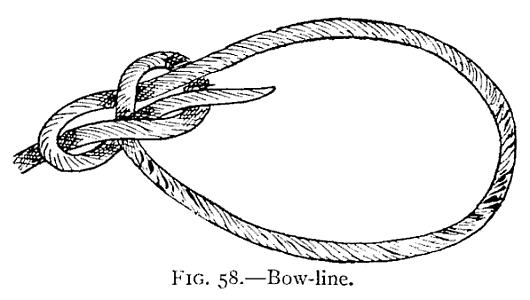
The loop is adjustable and the string length can be altered. I was present when Dr Grayson used this knot on a gut string he had made for a Turkish flight bow. The string knot never pulled loose or elongated.
I need to make some new bowstring(s) for my Grozer Hungarian base model, I'm using Dacron B 50. So far I have used modern, original Grozer and self-made, endless strings for the bow. Now I consider trying a bowstring with knotted loops, the main reason is I wouldn't need to bother with a string jig and could adjust the string lenght if that would be initially wrong.
Do you think if using the above knot, or the tundj, as shown in Payne-Gallwey's 'Treatise on Turkish Bows', and as well in Klopsteg would do any good when using with my Hungarian bow with non-contact ears? (I know it perhaps won't be traditional.)
Or perhaps there are some more appropriate knots to be used here (I don't want to change the size of the loops I'm using so far.)?
I'm courious what is your experience in that matter, I've also seen Andrew Hall used knotted bowstrings on his MB and Omnogovi bow replicas.
I would appreciate any feedback.
http://www.youtube.com/watch?v=ocpKLPX1tnU
My bow is in the 50# range.
modern string materials are very slippery compared with hemp , silk , etc ...
old knots work best with old materials ...
the knot in the video was for me the only one suited for fastflight string on a strong bow .
That is why I would consider serving the string in the area of the knot before making the knot itself (I think I would like to make the string and loops from one piece, like on the picture above).
From the same reason I don't like to use the timber hitch with a Dacron longbow string, too slippery to keep the bracing height as consisten as I want. I have no experience with fast-flight, but have read that it's even more slippery than B 50?
The string I made with the integral knot was made from three strand sheep gut. Gut is not slippery when dry and take a knot very well. Untying them after some use can be a major job though since they become very hard.
More relevant to your Dacron question, I have just made a silk Turkish style string with filament silk for the centre section and for the tunc. I made the tunc in the Chinese fashion by completely serving the end pieces. I had tried impregnating with wax and twisting tunc, but the wax made the knot too slippery. The serving made the knot firm and precise. Silk is much more slippery than Dacron. Even the centre serving was capable of moving around.
Making a string with tunc for a contact siyah bow requires just as much precision as any endless loop string, perhaps more. Using that kind of string for a non-contact siyah bow is inefficient (too much extra weight), unhistorical (there is no evidence for tunc before the development of contact siyahs) and inelegant (it looks clunky).
I was rather going for the one-piece string. I was worried about the excesive string weight too, so you say I better stay away from those knots :wink: .
BTW I remember there is some evidence on using shorter loops on non-contact ears than are common today?
Just one question about your sinew string, you did the serving before tying the tunc, or you served the whole area of the knot afterward?
That is an interesting comment because in the book, Arab Archery, the translators remark that the old sailors they approached including some who had sailed on tall ships did not recognise the knot. I will have to look up the "admiral's knot" and see if there is some minor difference that these sailors thought was more important than we would.
For Ashbow:
The string was silk and I did not use sinew tunj because I made them in the Chinese fashion with silk loops. I made the loops to size and then served them from end to end. The core of the string had small served loops at the ends which I tied the knots through.
Most, if not all, surviving strings for non-contact siyah bows had small loop knots. They were usually just big enough to slip over the end of the bow. The early Hungarian archaeological articles on excavated bows compared them to contemporary (to the archaeologists) Manchu bows. Since they were working with only the remaining bone plates from the bows, they reconstructed the strings from the only thing they had at hand for comparison, the Chinese bowstring. This was a reasonable hypothesis until strings for similar bows were discovered in Central Asia.
If you are looking for a really good knot , use Zeppelin .
(this post is a kind of "all purpose knots" not a particular case of "knots to be used on bow-strings")
While I haven't had one of these knots break, I haven't used it on any material that was not very strong in itself. I have seen sinew and rawhide strings made this way and I made one of gut. All of these materials are strong and tough.
I have broken linen strings. Linen becomes brittle when it dries out. The low humidity on the Great Salt Lake can often kill a good linen string. In my case the strings broke all along the central skein. However, a knot is the natural weak point of a string because many forces concentrate there. It doesn't mean the string has been made badly, but it could reflect a weakness in one of the strands.
fusizoli wrote:
Bede wrote:
Most, if not all, surviving strings for non-contact siyah bows had small loop knots. They were usually just big enough to slip over the end of the bow. The early Hungarian archaeological articles on excavated bows compared them to contemporary (to the archaeologists) Manchu bows. Since they were working with only the remaining bone plates from the bows, they reconstructed the strings from the only thing they had at hand for comparison, the Chinese bowstring. This was a reasonable hypothesis until strings for similar bows were discovered in Central Asia.
Bede
You've sad "Most, if not all, surviving strings for non-contact siyah bows had small loop knots. They were usually just big enough to slip over the end of the bow."
Schould we know something from this ones? Just think you mean Niya ,Gansu amd Khotan bows but I ve seen just the last ones string. "strings for similar bows were discovered in Central Asia"
Working on to reconstruct the 9.-10th century Hungarian bows string as close as possible.
"Making a string with tunc for a contact siyah bow requires just as much precision as any endless loop string, perhaps more. Using that kind of string for a non-contact siyah bow is inefficient (too much extra weight), unhistorical (there is no evidence for tunc before the development of contact siyahs) and inelegant (it looks clunky)."
(What is the meaning of tunc in this case?)
Like to ask your opinion from what kind of loop and string would U prefer on a bow like this? https://docs.google.com/a/botondbow.com ... GF0QQ/edit
Best regards Zoltan
Is it from the internet or You made it? Have you got a better quality and some more data?
Original knots are used with original materials. Modern materials are much more slippery and original knots may not be so good for them.
Linen breaks specially easily in sharp twists.
Modern materials can be twisted without losing much strength at all. This is one reason why original wooden bows often have big tips, but modern ones have tiny tips. Philosophi? naturalis principia mathematica is the other one.
Practically all knots weaken rope. The exceptions are Bimini twist and Australian braid and such. All of these knots are big.
Several old wooden bows had narow tips since the stone age.
Other wise on wooden bows the non streching plant fiber strings
working better especially on the longer ones.
Today the problam is the factory made linen, hemp etc. made from 10 cm pieces and not from the whole lenght of the plant. If schould make a string from 1 m or longer fibers than could have an exellent strong and light string for any kind of wooden bow.
Mary Rose bows with about 120-140# had just a bit more than 3 mm hemp string with twisted loops and knots. Bede had brakes at the salt lakes Arizona on about 15-20% Rh. That extreme dry condition weaken the plant fibers.
Kevlar and similar materials proved tricky with separate tunc sections, but that could be overcome using served loops or using a wax resin mix on the strands. It is pretty much the same thing necessary for filament silk. Gut strings need to be wetted where the string has to bend in the knot otherwise they are too stiff to tie. Pre-stretched gut strings showed no appreciable lengthening in different conditions, but they had to be pre-stretched and dried under considerable tension.
http://www.animatedknots.com/
Would it be good w/ any synthetic materials besides polyester(dacron and kevlar(breaks after a while..)?
Would that be the knot used in the Mongolian bow above?..
It'd be nice if there was something between UHMWTFBBQpolyethylene and polyester... that had good friction.. and low mass... and good strength...
In the first part of the experiment we made rawhide strings.
Our goal was to make a useable string for our hornbows.
Most of tham made from goat skin and it works fine with knoted ears.
The long lasting test still on, but the best was 1500 shots with archer ring and hornbow.
It had broken partly at the arrownock.
So I think its enough good if made the " right" method.
From the last year we use this rawhide strings on our long ear hornbows.
The silk project not finished jet...
Nice!fusizoli wrote:
We in the society have been made experiments with natural strings.
In the first part of the experiment we made rawhide strings.
Our goal was to make a useable string for our hornbows.
Most of tham made from goat skin and it works fine with knoted ears.
The long lasting test still on, but the best was 1500 shots with archer ring and hornbow.
It had broken partly at the arrownock.
So I think its enough good if made the " right" method.
From the last year we use this rawhide strings on our long ear hornbows.
The silk project not finished jet...
I heard Magyars might've used gut...
I don't follow... are there any more comprehensive sources on this? There was one picture but I still didn't understand it. It seems like a double loop that's more complicated than the "Turkish" knot.osmiu wrote:
the one and only knot that don't fail on me on knotted loops of strings made of fastflight at 85-90 lbl is this knot :
http://www.youtube.com/watch?v=ocpKLPX1tnU
I'm wondering whether, with "fast flight" (polyethylene: dyneema or spectra) reverse twisted ends padded with a few strands of nylon or B-50, the knot in the OP would hold at heavier draw weights without any slipping
might try serving. should just make an endless jig but the possibility of being able to make strings more easily with less tools is interesting..
I was wondering if you've made a knotted string like that with slippery dyneema/spectra just by serving the loop area? Hm, with a jig and some experience it may not be as worth it.
wonder if small game gut would be any good...
isn't it very bad for a hornbow to suddenly unbrace though?
Should've padded the loop ends with a couple of strands of nylon..
After checking knots by bracing & pulling the bow, burned off tag ends and saturated knots in thin CA glue (superglue)
(I did this knot instead of the Korean knot this time because this knot is adjustable and I wouldn't have to make a precise main string ... also, it's easier...)
Will REALLY test it at the range soon...
What material did it break with? I really hope it won't break with this UHMWPE (D 97)...
Can anyone identify the knots in this page? I'm not sure if those strings are actual artifacts used with Magyar bows in the 9th-11th centuries. http://magyarij.hu/index.php/amagyarij/reszei/ideg.html