Right im soon getting all my materials together to start this bow, ive been speakin to pip bickerstaffe and hes advised me to do a magyar bow, with a core and siyahs of ash, ive done the siyahs and need to get some ash for the core soon, the siyahs ive done are ash, and 3/4" thick, and i have cut a 4" v splice in them m the splice is narrow about 1". hows that? anyone can give more some help that would be great!
jack farrell
Seb; It may be that a fishtail splice was not a feature of that bow but a later improvement to other style bows. I have pondered on that idea. Hopefully Andrew hall has some idea on the subject. jack
Seb_bishop
thanks, im gettin the core hopefully tomorow, should the core be about 1/4" thick, 40" long, 4cm wide, 4" splice. With a magyar bow i should bring the handle in setback ? and glue the riser on the back of the bow?
Andrew Hall
Seb
From the somewhat limited archaeological evidence it is likely that the Magyar bows had steamed rather than spliced siyahs. The Moshcheveya Balka bow in the St. Petersburg Hermitage had most of the horn nibbled off by rodents so the core is exposed and shows no splices.
The siyahs were probably formed by thinning, steaming and gluing another piece of wood onto the back to stiffen the siyah in a similar manner to Stephen Selby's much earlier Khotan bow. The grip was also probably formed by steaming and gluing a "riser" section to the back (this differs from the Khotan bow).
I know of an archaeological find of an angled-eared bow which does have spliced siyahs - an 11th-12th century Uigur Turk find from Uluguy kurgan 2 in the Transbaikal. This featured long angled ears of a slightly-curved "Hunnic" shape with a 4.5 inch V-splice to the limb but without bone siyah plates.
I have used both steamed and spliced construction. Splicing is easier to get more consistent angles. Your choice.
40 inches from siyah base to siyah base is plenty - my last MB bow was 35". A longer bow will be less stressed but may make it more difficult to find suitable horn. Do you have a very long draw length?
I would leave the core at 1/4" thick during initial construction, but thin down to nearer 1/8" thick after you have glued the horn on (assuming you are not going for a 120lb bow). I don't know whether this is a traditional method but I find the bows rather floppy and difficult to work if the core is thinned before the horn attached. What draw weight are you going for?
Regards
Andrew
Seb_bishop
Thanks alot !!, i think i woudl like to do it with siyahs, my drawlength is 28" and im only planning on a 45-50# .. Im getting the horn from highland horn, they have 18" long horns ready for me, and im buyin 12 leg sinew , i need some backstrap sinew maybe about 2 . is that enough?
also ive done some siyahs of ash, im not sure if they are correct, they are 10" long, with a narrow 1" wide 4" splice, and 3/4", is that ok.?
Andrew Hall
Seb
Careful buying 18" horns as the horns get thin at the head end and you will probably lose several inches. The horns would also have to be unusually straight to get virtually all of the remaining length usable. Note that if you are getting complete horns you will get plenty of spare bits which you could use in the handle if the limbs strips are too short, but the strip may still be too narrow at the pointy end for the full width of the limbs.
I usually use more than 12 leg sinews, but I am not very good at processing them economically. What were you planning to do with the backstrap sinew? I just use leg sinew.
A useful hint is to leave finishing the core until you have your horns. You can then adjust the design to match the horns somewhat if required.
Regards
Andrew
Seb_bishop
thanks, i was goin to use backstrap becuase they are longer. But about the siyahs? have i done them right?. i will get the core tomorrow, and ill wait until i have the horn to start anything.
jack farrell
Andrew; What about designs with the grip piece on the belly? If one built up the siyahs, might it make more sense to place an adjacent piece in back of the limb strip? Lastly, the Khotan bow had the centermost horn strip continue up the length of the siyah. These construction techniques stand apart firmly from Turkic construction.
I find that even a #30 prototype made by this method absolutely requires wrappings above the grip and below the siyah to survive. Aren't bone reinforcing slats scored to accept wrappings at those exact locations? and wouldn't all this be made redundant by Turkic type construction? Just some thoughts. Jack
Andrew Hall
Seb
A siyah of 10" long, 1" wide at the base is fine. If using bone plates, they would touch at the tip, if not, go for 1/4+" wide. Keep about 3/4" deep in the nock-bulge, depending on the type of wood and grain orientation.
Jack
When querying on designs with grip piece on the belly, do you mean bone grip plates? Also not sure of what you mean by adjacent piece in back of the limb strip. See attached drawing for the siyah construction I used on a bow and may have been done on the originals. I have not tried it without bindings, but I would have thought that the sinew backing would have held it together. I had assumed that the wrappings were to keep the bone plates attached.
As I mentioned before, archaeological remains showing construction are quite rare, so any discussion is based on limited evidence. But earlier "Hunnic" bows appear to have been constructed from separate limbs joined with a scarf joint (Khotan bow, Yingpan M30) or mortice and tenon (Gogops) in the grip. Bone grip belly plates were common during this era, but not fitted to all bows. The mortice and tenon joint in the Gogops bow is scary enough even with bone plates.
Later bows appear to have used a continuous core with a riser glued to the back (as with the more recent Chinese bows). I have not seen any archaeological reports of finds with spliced-in grips, so I don't know when this construction appeared.
Careful with the term "Turkic", as the Hunnic design was developed by the ancient Turkic tribes from the 6th-10th centuries into some distinct Ancient Turkic variants, which are still angle-eared and unrelated to the later Turkish bow. I spent ages trying to sort out the terminology for my forthcoming article in the JSAA, what with bows called Ancient Turkish by the Russian archaeologists, bows used by the Ancient Turkish tribes (of which the Ancient Turkish type is the most common), and the later Turkish type.
Note that the Alan/Khazar bows from Moshcheveya Balka had bone plates on the siyah belly. The related but slightly later Magyar bows lost the belly plates. Not much evidence to indicate at what point in time the horn stopped running part way up the siyah.
Regards
Andrew
Seb_bishop
The ash has very staright grain so that good, im not sure what bone plates are though ?
Tomaz
But earlier "Hunnic" bows appear to have been constructed from separate limbs joined with a scarf joint
Really interesting bit of information. I wonder how well that worked. Scarf joints are not very strong per se. Where the bone plates expected to provide a lot of extra strength in that design?
Andrew Hall
Seb
The Magyar bows (and many others) were reinforced at the grip and sides of the siyahs by thin bone plates. In virtually all of the archaeological finds, these are the only parts that remain.
It is not essential to use bone plates on these bows, at least not a 45-50lb draw weight bow. I have used strips of wood instead. You can also make the siyahs without any side plates by making them a bit wider.
Regards
Andrew
Rapsod
Are you sebastian bishop that make good longbows?
Seb_bishop
Andrew , so the bone plates, are glued on the sides of the length on the siyah, why was this done, also cud i use antler for this?
rapsod , yes i make longbows =]
Seb_bishop
Andrew , so the bone plates, are glued on the sides of the length on the siyah, why was this done, also cud i use antler for this?
rapsod , yes i make longbows =]
Seb_bishop
Andrew , so the bone plates, are glued on the sides of the length on the siyah, why was this done, also cud i use antler for this?
rapsod , yes i make longbows =]
Seb_bishop
Andrew , so the bone plates, are glued on the sides of the length on the siyah, why was this done, also cud i use antler for this?
rapsod , yes i make longbows =]
Andrew Hall
Tomaz
As the joints are in the grip, the gluing surfaces are quite large. The Yinpan M30 has a back-to-belly scarf of roughly 8-10" long by about an inch wide. This bow does not appear to have been fitted with grip plates. The sinew backing would stop the end of the joint lifting.
The Khotan bow has two shorter side-to-side scarf joints, I would guess 3.5-4" long and about 1.25" deep. These are surrounded by bone on three sides with sinew on the back.
The scariest has to be the Gogops bow, with a short tenon secured with a dowel. I can't see this holding without the bone. I did not use this construction with my approximation.
Seb
The reasoning for the siyah plates has been lost and we are left with educated guesswork. Probably to reinforce some dodgy joints and improve stability - maximising stiffness against weight. Some of the Hunnic bows had very long siyahs, if they warped sideways there is a risk of them unstringing or putting a lot of sideways stress on the grip joints.
No problem using antler - if you can find a straight enough piece.
Regards
Andrew
Seb_bishop
thank, i should be buying the horn and sinew 2moro, and get started!
jack farrell
Andrew; I should have known better than to describe a bow feature as Turkic, as I know that bow designs were exchanged between groups. At any rate, I meant Turkish design, meaning late designs, as differentiated from those of Central Asian origin of a time before the rise of Turkic culture.
This bow with bone reenforcing plates has antecedents from Siberia from BC. Can we agree that The Khotan bow (c300AD)has the riser on the belly side of the core laths and that the horn slats do not touch?
The mortoise and tennon joint in illustration 4 is actually a slot and tennon, or more correctly, a fish tail type splice, secured by an oval pin. Truely a scarey choice of joinery, but only one step different than Stephen's Gansu bow.
Redhorse
Seb, the bone on the side makes it to a I-beam. It would not bend. Only wood can break or straighten from the weight.
Seb_bishop
Has anyone got any pictures of the bone plates on a siyah?,
sorry but i dont really understand that drawing :?
Andrew Hall
Jack
I think we are getting some problems with terminology here (not helped by my lack of woodworking training).
My understanding of the Khotan bow from the X-rays is that the the two limbs are joined to a spacer piece in the grip. See 'B' on attached drawing. The horn strips are separated by a grip belly strip of bone.
I think the illustrations in the Kaminsky article are drawn with the horn at the top (as indicated by the limb reflex), so that the riser piece is glued to the back of the core.
The only bow I can think of with the riser glued to the belly is the Yrzi bow, which has almost no grip-limb reflex. Strangely, the riser is in two parts joined by a side-to-side scarf joint - presumably because this was the tradition. This bow has no bone grip plates.
aha i understand, does the plate go into the splice or not?
Andrew Hall
No, just glued to the sides of the siyah.
jack farrell
Andrew; Nice schematic. you now have me agreeing with you on C. On the site they made the sinew black and the horn white but showed it the same on the siyah. Good for you.
If you arent too weary with me could i ask you about your section of the Khotan bow grip?
1. why have you inserted the centermost piece into the grip core? are you seeing that? That construction would be so weak.
2. I am seeing the limb as separate from, and overlaid onto/notched into the grip piece. Can you consider that?
I suppose the assistance of a radiologist would be helpful, ha! Maybe Dr. Grayson could assist. -j-
This appears to have been the demise of the bow. From the end view of the broken grip, one can see two slats on the right and only one on the left. The two on the right are wood inside and bone outside. The single slat on the left would be bone only.
Then what of my second point? -j-
Andrew Hall
Jack
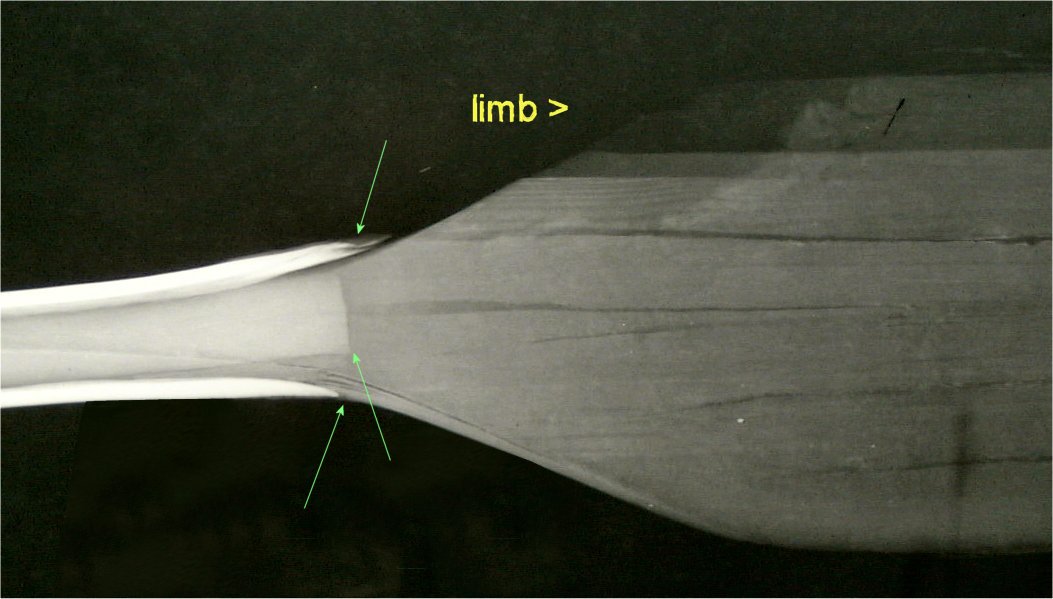
Looking again at Stephen Selby's article on the bow, the end of the splice with the grip insert piece can be seen in X-ray 2 of the lib/grip transition http://www.atarn.org/letters/khotan_bow/xray02.jpg . The ends of the scarf joints can be clearly seen in the side view in X-ray 3, so I would have thought that any limb/riser joints should be visible in this one if they were there.
The only X-ray that may hint at the limb being attached to a riser piece is X-ray 3 http://www.atarn.org/letters/khotan_bow/xray03.jpg which has a lighter line by the horn on the belly of the limb fade, but I think this is just the dished belly showing through. All the other splices show up as dark lines. There is a slight dark patch at the thin end of the limb fade, I think this is where the insert ends (compare with X-ray 2).
Though as the grip insert piece stretches from limb fade to limb fade, you could almost call it a riser. It is just the than limbs fill the full depth of the grip to attach to the sides of it.
To modern eyes used to band saws and electric planers it is a strange construction. I assume they had their reasons for doing it their way, possibly because it could be made with an axe and knife.
The ends of the grip would appear to be a weak point in the Khotan bow against sideways force, as the limbs are so wide it would be difficult to bend the bone grip side plates round into the fade. The more normal Hunnic bows with narrower limbs generally seem to have longer grip side plates than belly plates to protect this section of the fade. I would guess that the bow was buried strung (as many of the Niya bows were), warped sideways over time and overpowered the end of the grip.
With the length of time the composites have been in use, and the immense area they have been used in, I am sure almost every imaginable construction method has been tried. We only have a tiny proportion of survivors to discuss.
Regards
Andrew
Seb_bishop
The horn and sinew should arrive tuesday, No to the glues, what glue is best to use to glue the horn on?
Tomaz
I'd just like to say that this has been a very interesting thread so far. Many good points and a lot of ideas that have been helpful to my personal project, too. (I just started working on my first Hungarian bow, I actually decided to make spliced siyahs very close to Andrew's suggestion and glued the horn today). It's really refreshing to see this kind of discussion on an online message board. Keep it going, guys! ;)
Seb_bishop
Where do i get Isinglass Glue to glue on the horn?
Seb_bishop
heres the siyahs , ash, 10" long , 4" long 1" wide splice
Andrew Hall
Seb
Your siyahs are rather more Turkish than Magyar in shape. For a spliced Magyar-style siyah, you need a circa 4" splice to the limb, a 40-45 degree bend, then a circa 8-10" straightish section, often with a slight reflex kink at the start of the nock bulge (circa 3" from the tip). You can see the approximate shape (if with different construction) from the drawing I attached to a previous post (see page 1). For a slightly less strained bow on your first attempt, you can drop the limb to siyah angle slightly.
As to glues, I was hoping someone else would answer, as I have cheated and used a modern epoxy glue (slow set Araldite) to attach the horn to core on my bows. I have been discouraged from using a natural glue by the ease at which I have picked drops of hide glue spilt during sinewing from the horn. Even with the epoxy, I have had a couple of problems with adhesion.
Regards
Andrew
Seb_bishop
So ill just make some new ones then. So the overall length for such a siyah wud be 14" long. How would resourcinol be to glue horn to wood.
Seb_bishop
The horn and sinew cam yesterday , the horn is 18" long, and i have a 12 deer leg sinew might not be enough, but dont need to worry about that now. the backstrips of the horn are 18" long and quite thick. how do i start thicknessing it, what tools? and can it be done with some power tools,. what thickness should the horn be when done?
Andrew Hall
Seb
No idea on Resourcinol.
You can work the horn with a variety of tools - band saw (very carefully nibbling bits off), angle grinder, belt sander, rasps etc. I tend to get the bulk off with an angle grinder, farrier's rasp to tidy up, belt sand, then scrape to final thickness.
It is useful to cut out a paper template of the required limb shape to position the strip within the horn. If the horn gets a bit thin at the head end, or you have trouble positioning the template within the strips, you can use one of the spare pieces for an insert in the grip. It is usual to place the grip end of the strip at the tip.
Regards
Andrew
Seb_bishop
thanks . ill get started on that as soon as i get my core, anyway im making some more siyahs made from pacific yew. 12" long. how does the shape look .?
Seb_bishop
heres all the materials, ash core 1/4" thick 35" long, is 35" long ok?
jack farrell
Andrew; Several days ago a friend sent me a photocopy of your article in JSAA on Some Well-Preserved Composite Bows (of Central Asia) I cannot tell you just how fantastic that article is! Absolutley brilliant. This is the type of article that I look forward to seeing. I am sure that it will be the gold standard for those wanting to reconstruct one of these bow types.
Seb, you might want to get a hold of Andrew's article before proceeding. Ps. I have had two recent failures using ash for a core. Both were carefully worked. -j-
enno
Jack, I'd like to see this article as well. please :-)
Seb, concerning wood core- pick a maple or bamboo.
Andrew Hall
Seb
35" siyah-base to siyah-base is fine. As your siyah angles are fairly low (as was my first composite), it is best to keep the grip set-back fairly low as well, otherwise it will stack. Steam the core into a bend at the grip and shape the riser piece to fit. Try to get as much of the limb bending as possible. The originals had circa 6" long grip side plates, and the limbs were probably bending an inch or so outside those.
Jack
Glad you liked the article. It is just a collection of all the information I managed to track down rather than a guide to reconstruction (things like limb thicknesses are usually missing, and horn/wood/sinew proportions always are never given in the sources). There are still a few bows missing, I never managed to track down any information on the Karabulak finds (I just have a photocopy of an interesting, but slightly cryptic drawing). I also look forward to seeing further information about the Kurgan Tepe 12 burial you mentioned in the Glade.
I have promised Stephen Selby I will repurpose my article for ATARN. Not sure of whether to format it as part of a catalogue of all known archaeological finds, or split up and add to the various ATARN sections (e.g. a description of the Moshcheveya Balka finds with my attempts at reconstructions added to the Magyar section). This is complicated by the ancient types not necessarily fitting well into the more recent regional section headings. Anyone have any suggestions?
I have used ash as the core for most of my composites. The only failure I have had was using maple, but that was my fault, not the wood.
Regards
Andrew
tom sawyer
Seb I used resorcinol to glue my horn strips to the belly. I haven't bent anything but the lines look decent. Will keep you posted on the effectiveness of this glue, but it is my experience that the stuff is just about the best for joining natural materials in stressed applications.
Seb_bishop
yes, thanks that will be a lot of help
Seb_bishop
Right ive started to thin down the horn to 3mm thickness, and ive noticed on 1 horn strip has a dip starting from the head end in about 61/2", and it goes way to thin in the dips, i put it in the light and i can almost see through it, what could i do, cut 6 1/2" off both horns , this will leave the horns about 14" long, then place a spacer in the handle about 7" long. the riser is 8" long. hows that ? any ideas?
seb
Andrew Hall
Seb
You can use an extra strip of horn in the grip. Just butt joint the strips ensuring a tight fit and bind the joints with sinew (after the sinew backing is dry). I would keep the joints out of the bending sections of the limb though.
Regards
Andrew
Seb_bishop
yes i will, thanks, the extra peice of the horn in the grip will be 7" long and the handle is 8" so it wont be in the bending section.
thanks
Seb_bishop
just encounted another problem with the horn, they are quite twisted and do no follow the straight limb, what should i do?
thanks
seb
Andrew Hall
Seb
You have a couple of choices. Either ignore the twist and glue to the core ensuring the core is straight or steam the horn straight before gluing. In either case the bow may twist slightly afterwards, but as long as the core is straight, the bow can usually be encouraged back into the correct shape with a bit of gentle heating and twisting.
One thing to note when steaming horn is to clamp the horn between two flat pieces of wood. If you clamp directly onto the horn the clamps can dent it.
Looks pretty minor. I know when I boiled my horn I got them nicely straightened. Seemed to hold after they dried too.
Twist the horn strip straight by hand, does it take much force? If not then it won't be introducing much twist to the bow when its glued.
How thick is your core? How heavy of a bow are you shooting for? I made my core a good 1/4" and the bow feels like its going to be pretty hefty. Although I guess pulling the thing with a long string is fooling me to some degree, those siyahs make very effective levers.
What glue are you going to use? Resorcinol seems to be working well for me. No sign of any glue failure and as you know I glued up two long strips.
I do hope you're going to bandsaw off that excess riser material. That would be a bear to remove by hand. My handle is nowhere near as bulky, in fact I wish I had a little more wood in that area so I think you are looking good there.
Seb_bishop
Thanks, yes im thinking of using resourcinol, when u glued your horn on did u make them parallel grove lines. on both horn and core?.
thanks again
seb
tom sawyer
Yes I prepped both surfaces with a hacksaw blade held sideways, my version of a toothing plane.
Seb_bishop
funny i was guna use the same thing :lol: i shud start glueing up soon once i get the glue.
jack farrell
Since you guys are moving toward ancient design, real horn belly, wood core and sinew backing, why not make the final step and assemble with traditional glue? just a little more effort and you will be there.
It is not really a great effort to use hide glue to assemble the core to the horn. I find about 20 coats or less will be plenty. Use a fan at close range to dry between coats. the drying time starts at a half hour for the first couple of coats and speeds up to about 10 minutes, with the last several coats going almost directly over eachother.
I assemble with strips of innertube, be sure to leave a small space between wrappings to inspect the glue joint. If it should be necessary to close an open joint, just use a brush to work some water into the open joint and add heat, the wrappings will continue to clamp down evenly and the heat will penetrate the wrappings squeezing out hot hlue.
This can be used in conjunction with a form.
Then you can proudly proclaim that all is ancient, 100% traditional. PS. Hide glue is some of the highest quality glue in the world. -j-
tom sawyer
Jack, you are absolutely correct and I intend to make another using hide glue in the near future. Might even try to find some fish air bladders (carp or catfish are plentiful here) and make that glue. I have learned a lot doing my project. I have another set of horn strips identical to this stuff I used (the other half of the gemsbok horn). I suppose my only excuse was that I was using two skinny strips glued parallel on the limb, so I was worried that this would not hold with anything less than a space-age glue. Certainly the modern glues allow a quicker result to be obtained, and for a practice bow I don't see this as a bad thing. I got a whole lot of experience in a single month.
I also got Duvernay's DVDs. I'm halfway through those, and I am getting more out of them for having just performed most of the steps. Even the Korean master used a sander! The fellow can really wield an adze with authority. I am saddened to think that he has been incapacitated by a stroke.
Seb, you might consider trying hide glue yourself. one advantage you would have, is that you can make heat adjustments to tiller afte you get it that far. I'm afraid to heat my bow too much with the resorcinol in the construction. Also, you are doing the right thing by tapering your core. Check my thread for the poundage I got with my 1/4" untapered core.
Seb_bishop
yeah ill think about it thanks, anyway, im pretty much stuck at the moment waiting till i sell a bow to get some money for the glues , also my bandsaw got stolen a few weeks ago :x , waiting till i get a new one from the insurance.
Seb_bishop
do you reckon cascamite powered resin wiould be good to glue the horn onto the core?
cheers.
Seb_bishop
I have 12 deer legs sinew, about 8-10" long, how many more sinew do u think i would need?, and how many layers need to be put on?
Seb_bishop
I have 12 deer legs sinew, about 8-10" long, how many more sinew do u think i would need?, and how many layers need to be put on?
Here it is quite ready for sinew, but im not sure weather to put the bone plates on now or after i sinew.?
Seb_bishop
when shall i put the bone plates on , after i sinew or before. and also i used cascamite glue to glue the horn to the wood :\, im hoping it will hold, i think it might.
Stephen Selby
Bone plates go on before sinew.
Seb_bishop
thankyou
Stephen Selby
Perhaps I should clarify: in this style of bow, apart from sinew backing, there was also a certain amount of sinew winding to strengthen important points. Some sinew winding was used to secure the ends of the bone plates at the tips where they fade into the limbs, as well as the ends of the grip plates where they fade into the limb. Many modern bow-makers seem to like to use hemp cord at those points.
Andrew Hall
Seb
Make sure you clean off all the glue from the siyahs where you will be attaching the sinew, as the natural glues do not stick well to modern ones.
Also leave applying the sinew wrappings at the grip ends and siyah base until the sinew backing has dried and shrunk. Otherwise the backing will shrink out from under the bindings leading to a wrinkly binding under no tension.
Regards
Andrew
Bede
Stephen,
I think the thin cord bindings have developed as a result of some early archaeological drawings where proposed bow shapes were shown. These things often get confused with what they are trying to represent, particularly when they look reasonable and there are no artifacts to contradict the image.
Seb_bishop
cheers guys, its now ready for sinew.
M Hardman
seb
where abouts did you get your bone plates from (assuming you've already got them) ?
cheers
Mike
Seb_bishop
i didnt use bone, i just used ash, as i couldnt seem to get any bone, or antler that was straight enough
the glue looks good. I prefer to do the glue in a plastic-bowl and put it in a steel-bowl filled with water on a cooker, to keep the temperature at about 50 degrees Celsius. Hideglue does not stick on plastic, so you can remove dryed glue easy and use again.
Peter
Seb_bishop
cheers , will do, How long do you reckon i shuould leave the sinew to dry for?
thanks
seb
Kyudohund
Hi seb,
I think 2 weeks before doing the next layer will be enough. After the last layer at least half a year, up to 3 years in case of given a big reflex. As longer, as better.
Peter
Seb_bishop
yeah ok , thanks. also how many layers? 4?, and should each layer be throughout the whole bow length ?
thanks
seb
Kyudohund
Hi seb,
the critical points are from the grip to the "throw"-arms and from the "throw"-arms to the stiff siyahs. You should do extra-layers at this points. One, better two should be enough.
Peter
Andrew Hall
Seb
I tend to work to an approximate sinew thickness, rather than putting on a particular number of layers. The thickness of a layer will depend on the size of the bundles you apply and how much you spread them out.
Regards
Andrew
Seb_bishop
thanks .
Kyudohund : im not quite understanding. like the places just outside midlimb both ways?
Andrew: how thick would you say about 1/8" thick or more?
thanks
seb
Kyudohund
Hi seb,
I mean the transitions(!) from the stiff parts, grip and siyahs, to the elastic parts, the limbs.
Peter
Seb_bishop
ooooo.. thanks, also wheres the best place to leave the sinew to dry?
Andrew Hall
Seb
You can try about 1/8" of sinew to start with, and add more if the bow comes out too light. Note that this is the dried thickness, the thickness immediately after application will be about 50% thicker.
The bows should be hung up to allow the sinew to dry. My initial drying is done with the bow hanging from a light fitting.
Regards
Andrew
M Hardman
Seb
How exactly did you construct your siyahs?
Cheers
Mike
Seb_bishop
a 1" wide, 4" long , V spice.
seb
M Hardman
Thanks very much,
and how did you make the actual ear up? I myself am trying to find a reliable construction method. From your photgraph it looks like two laminated strips of wood but was any steaming involved?
Cheers
Mike
Seb_bishop
yes steaming was invovled , if you look at page 3 on this thread you should see i used 2 .. 3/4" strips glued together.
thanks
seb
Peter Dekker
Hi,
Very, very interesting thread.. keep those pics coming!
I'm planning on reproducing an antique "Sino-tatar" bow I've got. Where did you get that horn and sinew?
I've also read that Chinese bowyers preferred sinew from the back of working oxes. Does any of you know if there is much difference between sinew from one animal to another, and on how the animal lived?
-Peter
M Hardman
Peter
I think I remember reading in Klopstegs book on the turkish bow that for war bows they used ox and for flight they used deer. I can only assume this would be because an ox would have large strong tendons (for war) after doing lots of hard manual work, and because a deers tendons would be long and springy (for flight) because of all the running they do.
I dont actually know how different the tendons are, as I've only handled deer sinew (however the cow sinew I have seen was rather more fatty)
Cheers
Mike
Seb_bishop
right ok, the second layer of sinew is on now. all good so far.
M Hardman
Seb, a question about your horn
I'm currently shaping mine into the strips and its coming out well, except for the convex on the inside of the horn, did you rasp the horn down to perfect flatness or did you get it flat durnig the steaming process?
Many thanks
Seb_bishop
hi,
i tried to get it as flat as i can, making sure it didnt go under 1/8" thick in the middle.
i think you can also shape the core to fit the convex of the horn.
seb
Seb_bishop
just some more pictures, with second layer of sinew. third layer goin on the week!.
right, i need to make a pair of templiks or whatever they are called for this bow. Has anyone got any dimensions and the shape of the templiks? Also, I prefer not to cover the sinew , so what finish wud be good to protect the bow from the weather ?
thanks
seb
M Hardman
I think I remember from klopstegs 'Turkish archery and the composite bow' he states that the outside length (i.e. the bit you put the bow on) of the tillering blocks is as long as the bow limb, i would suggest looking at some of the info on magyar bows to approimate the curve on the tillering block. I think the blocks also affect the curvature of the bow or at least thats the impression I got from the book. http://www.atarn.org/FAQ/stringing_c.htm check out that if you haven't already seen it.
regards
Mike
Bede
Tepeliks are used for two purposes in Turkish archery. One is to set the curves in a bow and the second is to help bracing a strongly reflexed bow.
The Koreans still use their version of Tepeliks for bracing and the Chinese used to do the same last century. Klopsteg quoted the Turks as tying on the tepeliks and drawing the bow on a tiller and leaving it for a while to set the curves of the braced bow. Afterwards they heated and reflexed the bow again.
Have any modern bowyers tried this process?
Seb_bishop
first major problem has occured.
I partly strung the bow today using tepliks, did the first limb that went fine , the second limb didnt , the horn delaminated from the core, so i took both of the tepliks and i manage to take the horn cleany off the core. now im re glueing the horn back on. hoping next time it will hold.
Orda Khan
Seb,
Can I ask what glue you decided on? Did you decide on isinglass in the end? Sorry to hear about this set back and I hope it all goes well next attempt.
Seb_bishop
i used cascamite, it was the only glue i could get at the time. it seemed to work on the other limb,, if no luck next time, ill go onto another horn bow.
thanks
seb
Botondbow
Some (four) of my newly designed HUN bows are quite close to tillering phase (March and April).
In order to avoid the possible damage (brake or de-lamination) and due to the new design (bigger reflex) I would really appreciate all your comments, critiques, warnings as well as advices!
First at all- nice viedo ! :lol:
Bows looks good too. I love big reflex. This is what i love in composites !
Why you still work vith cow horns ? Is any historical or archeological evidence about ? I dont know about it. Oposite i know about 90% bone plates in siahs...Anyway very good craftsmans look and other you see i practice. I vish you fast and speed bows ! :D
Botondbow
Dusan wrote:
First at all- nice viedo ! :lol:
Bows looks good too. I love big reflex. This is what i love in composites !
Why you still work vith cow horns ? Is any historical or archeological evidence about ? I dont know about it. Oposite i know about 90% bone plates in siahs...Anyway very good craftsmans look and other you see i practice. I vish you fast and speed bows ! :D
Dusan thanks for your kind reply!
I need to use cattle horns (hungarian grey cattle) 'cause they're more common in my country than others.
Concerning the reinforcements (stiffeners) you are right, only bone plates have been found in graves. However, horns are much easier to use as well as no acheological evidence against this theory.
daryush
Botondbow - those are NICE :)
jack farrell
Botond; Quite an effort. I hope it all pans out sucessfully. Certainly you will learn a lot from this effort.
I published in JSAA and stand by my statement that the Miran bow appears to have HORN side plates in at least one of the Hunn type bows. I could not recieve permission to handle this bow but under the circumstances am convinced.
Your use of local materials (cattle horn) seems admirable.
Botondbow
jack farrell wrote:
Botond; Quite an effort. I hope it all pans out sucessfully. Certainly you will learn a lot from this effort.
I published in JSAA and stand by my statement that the Miran bow appears to have HORN side plates in at least one of the Hunn type bows. I could not recieve permission to handle this bow but under the circumstances am convinced.
Your use of local materials (cattle horn) seems admirable.
Thanks Jack!
Frankly, I predict that only two bows will survive the tillering. In order to gain experience I've got to test also these reflex types. However, I keep my fingers crossed to keep them alive!
Concerning the horn plates, I have an idea.
Many arrowheads were found in Hun graves without bone plates, meaning that not all bows were reinforced by bones. Consequently the possible horn reinforcements vanished like other parts of bows.
jack farrell
I forgot if you said that you have read Andrew Hall's two articles on Hunn type bows from Xinjiang western desert of China. Of those and the ones we reported on there is little to suggest a circular type shape was ever used. Bow guys are enamored by this attribute which is an attribute of master made bows and was probably unknown in antiquity except for some Turkish bows; maybe a few others.
Even most Korean war bows did not have this attribute. Therefore it is probably putting the bar at an unrealistic level. It may also lead to short life span for a typical bow. Besides bow cases for strung bows, it was common in the Hunn era to carry unstrung bows in bow bags. The shape was no more recurved than a banana.
Botondbow
jack farrell wrote:
I forgot if you said that you have read Andrew Hall's two articles on Hunn type bows from Xinjiang western desert of China. Of those and the ones we reported on there is little to suggest a circular type shape was ever used. Bow guys are enamored by this attribute which is an attribute of master made bows and was probably unknown in antiquity except for some Turkish bows; maybe a few others.
Even most Korean war bows did not have this attribute. Therefore it is probably putting the bar at an unrealistic level. It may also lead to short life span for a typical bow. Besides bow cases for strung bows, it was common in the Hunn era to carry unstrung bows in bow bags. The shape was no more recurved than a banana.
Honestly, in the past I was quite weak-hearted and I did not dare to give any reflex to my bows.
Now, it?s changed and I?m too brave. My bows are over-reflexed and their drying shapes (during seasoning) are very extreme. In general, I?m sure that the truth is somewhere between the two ways. I agree with you, the banana shape might be the correct one!
During the tillering I?ll open the ?C? shape and try to keep them in an original (before sinewing) banana shape.
Dusan
Huh, Jack you destroy mi lovely shape in this bows ! :lol:
I cant agree vith you . Even simple North American indians bows vithout horn was in sinew process curved in min. C shape. Japanes kyudo bows vithout sinew layers... Siberian Yakuts bows too. Why not serious hornbow ? You lost very important "material memory" adwantage if you dont do it.
And beatiful shape too :wink: .
While I agree that not all bows had to be dried with the tips touching, I am not sure how one can tell by looking at the old bows. Perhaps in the case of extremely straightened bows one can assume the bows were not so reflexed initially, but even then it will not be absolutely certain.
For example the (recently discussed) Turkish bows from Dresden which were kept strung for years. If the string is removed, the bow stays bent and we can be tempted to say they were never recurved so much. Fortunately we know they were. It all depends on the bows' use, on the storage in a museum and on the abient conditions.
The only bows which came to us unfinished are the Korean and Turkish. Both have the tips touching for drying. I'd rather follow that as a rule rather than make a guess. Moreover, the tip-touching bows will open to the banana shape anyway once used enough.
Adam
jiao
the tips touching for drying and will open to the banana shape anyway once used enough,
so i can consider why and not need do it ?
if use the nature growth bend wood like use a string bend the branch, it will be all time in c shape not like banana ?
JJ
The modern Korean hornbows go back to the closed shape when they are stored in a heated cabinet after shooting. But they are an exception because they are the only bows which are reflexed to the full circle already before applying the horn to the core.
I conclude that a bow returns more or less to the shape the core had when the horn strips are glued on. Obviously with heavy sinewing the reflex can be kept higher up to a certain degree, but I think it can never keep the circle shape when at that stage the reflex was not nearly full circle.
JJ
Adam Karpowicz
Horn is the most resilient material in the bows. Wood does not count as much, since it is inside the limbs and rather thin in the bending section - so the pre-bending helps to keep the siyah and grip shapes, but does not do a lot to the bending parts. But gluing the materials together in the recurved (or straight) shape helps to keep the bow reflexed later in use.
To me, it is actually very simple. In an old bow, one needs to look only at the bending section, not at the siyahs or the grip (with some exceptions), because this is where the string follow sets in the most. Then imagine this section either straight or reflexed (not too much reflexed though for reasons I gave in the book). Then you have the minimum "as-made", or "as-glued" reflex. This "as-glued" reflex in the bending section had nothing or little to do with the desire to increase performance. It is the only logical way to manufacture the bows, because the deliberate application of deflex to the wood and to the horns would be a waste of time. (The only exception was the Yanghai bow for other reasons.) To change the behaviour of the bows the bowyers modified either the siyah and tip angles, or the grip angles.
The sinew that comes next increases the reflex, but will not prevent the string follow as much as the other two materials. I mean the string follow in use, which influences the cast of the bows, not at rest when the reflex has time to recover. I believe the tip-touching reflex applied to the bows for drying helps the performance, but less than horn, and only for a relatively short time. Heavy use and long time at brace, plus humidity would first affect the sinew layer.
Adam
jack farrell
Let me just recap my thesis. Increasing recurve does increase cast as well as well as threatening the structure of a bow. The gradual increase in recurve is a function of historical progression, as a design of bows. As related to the discussion of Hunnic design bows, recurve was not nearly so great as in later designs.
Applying extreme recurve to Hunnic type bows appears to be anachronistic to their original design.
I do not disagree with with other design statements.
Botondbow
Why did I change the seasoning reflex angle?
Old style method, which caused string-follow: Shape after tillering (seasoning shape was not so different) [external image]
Shape after heavy use (present resting shape of above bow after several Months) [external image]
New approach (style): Bow shape before sinewing and hopefully the final banana shape after heavy use (my aim) [external image]
Botondbow - I predict you will not see much of a difference in cast between these two, because you applied the extra reflex in the sinewed bow, while the as-glued (horn only) limbs look the same (straight). As I have tried to say, the sinew alone would not add much cast, although there will be some positive change if the bow is allowed to season longer in the pretzel shape and is not used too much. If your as-glued reflex in the bending section was greater before sinew, then you could expect an increase in cast.
Jack - I am not sure which parts of the bow you are talking about when you say the later bows were more recurved. If you mean only the bending section, not the grip or siyahs, then you can not really be sure if this section was not recurved (as in the last picture of Botonbow), and later straightened in use as we see now. These bows could look quite extreme when fresh, or maybe nearly straight. We just do not know.
If you talk about the siyahs only, then some of the later, more recurved bows would store more energy, but that does not mean the bows had a better cast, because of the increased mass. I understand you do not mean the grips actually, since the grip angle in some of the older bows was pretty high, while in many later Tatar bows it was not.
The most obvious difference between the old and newer could be the "invention" of the small tip by dividing the long ear into the tip and the kasan sections, which eliminated the heavy "knee" thus perhaps reducing the mass a little and de-stressing the bending limbs with the somewhat flexible kasan/kasan eye.
Adam
Botondbow
Adam Karpowicz wrote:
Botondbow - I predict you will not see much of a difference in cast between these two, because you applied the extra reflex in the sinewed bow, while the as-glued (horn only) limbs look the same (straight). As I have tried to say, the sinew alone would not add much cast, although there will be some positive change if the bow is allowed to season longer in the pretzel shape and is not used too much. If your as-glued reflex in the bending section was greater before sinew, then you could expect an increase in cast.
Adam
Adam,
I appreciate your advice!
Maybe I need again re-consider the core and as-glued shapes (straight limbs might not give a solution to avoid string-follow in future). This is what I love in bow-making, the continuous challenge!
Two bows have been drying for eight months so I can see soon whether I improve or not!
jack farrell
Adam; Thanks for the info on reflexing during glue-up as opposed to during sinewing. I have always followed the technique you describe in imagining the limbs straightened out or somewhat reflexed to indicate the original shape of the bow. Not an exact technique but a good indication.
Botonds first two images are a good example. I find the second pic not too far off from originals. This would slide into a bow bag easily to be worn.
I like to return to originals when possible for reference, eliminate the wishful thinking. Let the reader decide for himself.
Dusan; A tomb mural of a North Korean bow of the Hunnic period, maybe 4-5 C AD. Bone siyah slats have also been found. From the catalog of the Military Museum, Seoul. I do not think the image is copyright protected.
There is a change from less reflexed bows to more reflexed bows historically, but it seems to me to be tied to the cross section of the bending part of the bow limbs. Early composite bows, like the angular composite of the Ancient Middle East and the family of bows we call Scythian, had relatively thick limbs that could not sustain too much reflex without failure. With the introduction of bone stiffened ears and relatively flat bending section as in the Yrzi bow, much greater reflex could be built into the bow. I know at least one bowyer who made reproductions of these non-contact siyah bows with large reflexes and they performed much better than the same type of bow with a lesser reflex.
If Jack hadn't accidentally mistyped the date on the mural it would be in the same period the Xiongnu in Mongolia. However, it is dated to Koguryo (Goguryeo) period in the area north-west of present day North Korea. The date is somewhere between the 4th and fifth centuries CE and the horsemen are using early stirrups, which are a very significant invention for mounted archery.
jack farrell
I had this thought about Hunn era bows. Many bone slats are made so that the bone can be seen except at the base. The edges are rounded and the tips are believed to touch at the nocks and are glued together there. If the bone is on the surface, for the knee to be triangular, both bone slats would need to have a twist to them, an opposite twist. Cannot remember ever seeing this detail, but then again the twist would be small. Anyone seen such a thing?
Bede; We are talking about the same date! I gave an online reference. Check it out. Or google Goguryo tombs. One of the WTAF seminars published the bone plates. North Korea.
Bede
Jack,
You wrote "maybe 4-5 C AD.".
Dusan
This could be an interesting topic for debate. Koreans have an idea how to bow develops in their history in relation to a significant transformation from static siahs to engage in modern shape of a bow?
It was under the influence of the Chinese bow?Because China has been developing rich in many ways and relegated to return outdated disain.
Bede
1600 hundred years is a long time between bow types. A lot can happen. The problem with many modern bow types is that they do not leave much in the ground. We have plenty of bone and antler pieces which we can measure and check angles from the old type of bows.
Dusan
If we take into account the arguments of today's Turks, the Koreans are one of many Turkic ethnic groups, then the Korean bow is logically included in the line of development together with the Turkish archery bows and Yuan period in China. Of course China is a country where Turkic ethnic group lived and still lives.
Not everything comes from China- is Chinese ...
:D
Still, it would be interesting to know whether the Korean professionals interested in developing their bow and what occurred.
Nothing was also delivered to WTAF?
Botondbow
Two weeks ago we accomplished a bow test under the umbrella of Hungarian National Archery Federation (HUNAF) . Should you interested in our national testing please visit this page: http://www.botondbow.com/bow-and-arrow-test---2011
Regards,
Peter
jack farrell
Peter; that was so professionally done. And we got to ride on an arrow! How did you do that?
Botondbow
jack farrell wrote:
Peter; that was so professionally done. And we got to ride on an arrow! How did you do that?
Jack,
Thanks for your words, we tried to be professional; however, some unpredictable condition slightly influenced the final outcome. Any way, it was only a stage of the test series!
Concerning the ride on an arrow, we taped a mini-cam to the arrow and that?s it! Unfortunately the date and time were not set correctly under the video (please disregard), the movie was surely shot during the test day!
Uli
great work thanks for posting !
amatuccio
Do you have made tests on comerrcial Magyar bows (Grozer, Kassai etc.) ?
Botondbow
amatuccio wrote:
Do you have made tests on comerrcial Magyar bows (Grozer, Kassai etc.) ?
Yes we do; however, I'm not authorised to identify the laminated bow makers-sorry!
Kviljo
Nice 8) That looks like a brilliant happening!
Thanks for sharing! - and so many interesting bows!
jack farrell
Peter; I did not see draw weights. Looks like your snakeskin bow did very well, one of Sandor's and a Laminated also.
Botondbow
jack farrell wrote:
Peter; I did not see draw weights. Looks like your snakeskin bow did very well, one of Sandor's and a Laminated also.
Draw weights (#) are found at the bottom of bow sheets (page-1)
Another big surprise is how well the little plains Indian bow did. Considering that it was used to shoot arrows far longer than those for which it was intended, it did well. Imagine how well it would have done shooting the 24 " arrows for which it was intended. Conversely, imagine how well the Magyar bows would have done shooting the 24" arrow for comparison!
This also illustrates, for target purposes, how well a backed bow stands up against a hornbow; again, at the poundages we shoot.
By the way, NA backed bows are rarely or never of Osage. This is another of those misconceptions about NA's. Some originals were made into a shallow V and strung insideout, as a hornbow. I have seen many. There was lots of smooth sinew.
The short Osage bow without a backing may out perform one with and it can take a draw of half its length.
paku
I agree Jack. Probably it is because the light weight of the bow tips.
It is interesting to hear that osage bow were not backed. What kind of wood was used for backed bows?
S?ndor
jack farrell
Sandor; In the Southwest, some of the finest backed bows were Apache and Navajo. Mountain mahogany and Chokecherry and Serviceberry are mentioned as is Desert Willow and Nuttal oak of which I have my doubts. These are all inferior bow woods but when well done may out perform Osage.
It is difficult to identify species in a backed bow but assume such as Hickory, Hornbeam and White ash were used; maybe Sassafras, Pecan and Walnut, White oak, 2 kinds of Locust, probably many others.
Californians used Nutmeg among others. The Miwok made the finest of these. Plant glue which was chewed and spit onto the sinew was used there as well as among the Navajo.
Osage self bows were wide spread in antiquity and are well represented in museums.
Sinew strings were also quite impressive.
Zarasp
TY for sharing, this is very interesting jack , the tests are also Nagyon J?.
fusizoli
Thanks Jack for the input from NA bow woods.
As I know Miwok used cedar for that fine sinew backed flipped tips bows.
In primitive classes flight shooting the short wooden bows perform very good with flight arrows.
Anyway they haven't used "light weight" arrows. For example dogwood shafts are one of the heavyest from all kind of materials. Most of tham made for 23 drawlenght on the plains.
Patrick Menzies
The most common dogwood used however is Red Osier dogwood which is on of, if not the lightest, dogwoods there is.
jack farrell
There were so called "unarmed" arrows on the plains which made up about half of all Plains arrows. These were sharpened hardwood shafts with no point at all. On the Southern plains, the Rough Leaf dogwood was a popular arrow making material. It is dense, hard and somewhat heavy. It would be interesting how well this sinewed NA bow would shoot an armed and unarmed hardwood arrow for proper comparison.
There is a fascinating text of a US Army surgeon who extracted many NA arrows from victims and reported on their survivability.
I understand we vary from the stated theme of Magyar, which I enjoy and admire greatly.
Botondbow
I've reconstructed a bow iaw. a grave (Szeged-?thalompuszta 4/1950). This bow is my strongest one (136@28") and I'm hoping it will stay alive long.
I know it?s been far from a perfect bow (look at the string follow), however I?m quite happy now. Further corrections might be necessary later but it?s very close to the final stage.
Some info and pictures are available here: https://picasaweb.google.com/1050345962 ... ukcioja136# http://www.botondbow.com/sszetett-ijaim
All concerns and comments are highly welcome!
Dusan
:lol: thats a MAN bow now ! Congratulation !
Kviljo
Wow! Is there any indication that the original bow had a similar draw weight/size?
What's the overall length, and the width/thickness at the middle of the bending section?
A very impressive bow, both the draw weight and the way it looks!
Dusan
Kviljo ... :shock: again the same question. We 1000 times talked abut it. :lol:
Kviljo
I might have missed it somewhere here, but I find it interesting what kind of limb thickness and width that would give such a high draw weight in this kind of design. To my knowledge there has not previously been shown any bow of this design here with such a high draw weight...?
Dusan
:lol: misunderstud-i mean -haevy weight question.
Kviljo
Aha :wink:
Nah, I don't doubt that also these bows could have been that heavy.
What I find quite cool, is that this bow basically has the same stiff parts as any bow of this type, showing how overbuilt these parts are in lower weight bows. Must be pretty efficient.
Adam Karpowicz
Very impressive. I understand the ntn length is 118cm, but (after Ivar) what is the width and thickness at mid (bending) limb?
I like the knees so round, as they should be.
Adam
Botondbow
Thanks for your kind comments and words!
I translated the Bow sheet which includes all datas:
Sorry for the big picture, I'll edit it later!
Uli
Your're the MAN !
Congratulations !
PS: we have had the discussion about draw-weight of the Zargalant bow reconstruction. The fact that you have 136 lbs with 1,4 cm limb thickness shows how much performance depends on material and manufacturing technique rather than measures.
PS: we have had the discussion about draw-weight of the Zargalant bow reconstruction. The fact that you have 136 lbs with 1,4 cm limb thickness shows how much performance depends on material and manufacturing technique rather than measures.
Uli,
thanks for your words! Concerning the achieved draw-weight, I think it did not depend on my manufacturing technic, I was only lucky enough!
Reply for your PSS, yes it is. I chose that specific finding on purpose, 'cause those ear stiffeners are quite short. I wanted to build a bow which at least 100lb and it's easier to achieve with a relatively short reconstruction.
Adam Karpowicz
You are making a very god point Uli. But this bow bends mostly over a relatively small section of the sals, unlike the Zargalant bow, where the entire sections bend, which lowers the weight. Also, the grip reflex is less in the Zargalant bow. It is possible as well that the Zargalant has more "pointy" oval shape for the belly. Still, I believe it should come at over 80lb weight.
One can get lucky and find an exceptionally stiff horn, although not by more than some 20-30% more stiffness ("educated" guess on my part), but even that will not raise the weight by much at all in the laminate construction. Materials are only a minor factor - what counts the most is solid construction and the design.
Adam
lukostrelec
Botondbow wrote:
I've reconstructed a bow iaw. a grave (Szeged-?thalompuszta 4/1950). This bow is my strongest one (136@28") and I'm hoping it will stay alive long.
I know it?s been far from a perfect bow (look at the string follow), however I?m quite happy now. Further corrections might be necessary later but it?s very close to the final stage.
Some info and pictures are available here: https://picasaweb.google.com/1050345962 ... ukcioja136# http://www.botondbow.com/sszetett-ijaim
All concerns and comments are highly welcome!
Wonderful work, P?ter. Very nice pounds, really a bow for a man!
Impressive finish, so old-style looking, yet, delicate.
I am eager to test any of your bows, perhaps I will be more lucky next time, when in contact with Peter Bogar ;-)
Botondbow
lukostrelec wrote:
Botondbow wrote:
I've reconstructed a bow iaw. a grave (Szeged-?thalompuszta 4/1950). This bow is my strongest one (136@28") and I'm hoping it will stay alive long.
I know it?s been far from a perfect bow (look at the string follow), however I?m quite happy now. Further corrections might be necessary later but it?s very close to the final stage.
Some info and pictures are available here: https://picasaweb.google.com/1050345962 ... ukcioja136# http://www.botondbow.com/sszetett-ijaim
All concerns and comments are highly welcome!
Wonderful work, P?ter. Very nice pounds, really a bow for a man!
Impressive finish, so old-style looking, yet, delicate.
I am eager to test any of your bows, perhaps I will be more lucky next time, when in contact with Peter Bogar ;-)
Dusan,
Thanks a lot! I'm hoping you can test one of my bow in future!
By the way, last time Peter (Bog?r) participated on and went trough (with other four folks) a competition (called Hungarian Shield-Magyar Pajzs) with my snake-skinned bow.
That competition was also a kind of "stamina" test for my bow, whether it was able to tolerate (even survive) 5x30 shots (50-75-100m) accomplished by five archers (with different archery style) in an extremely hot (32-34 ?C) condition. The bow did survive it and worked well like other horn bows!
The bows are very good looking and are performing well. However, I have one negative comment regarding the assistant in the bracing scenes. Even when the bows are not powerful, it is unwise to stand in front of the person bending the bow back in case it slips out of his hands or the string breaks. It is always best to stand to one side and out of range of the arc the tip would follow if it escaped the bracer's hand. The person putting the loop in the bow nock is a valuable assistant and he should avoid potential bruising in case of an accident.
Perhaps it is just me, but there is a time bending back a strong bow as it digs into the skin below your knees when you don't want to worry if a friend is going to be hurt if you let go unintentionally.
Getting back to the bows, I think their strung and drawn shapes are really good. They must be very close in performance to the old bows they are replicating.
lukostrelec
Hi P?ter,
Botondbow wrote:
by five archers (with different archery style) in an extremely hot (32-34 ?C) condition. The bow did survive it and worked well like other horn bows!
...this does not surprises me much as hot and dry climate was the natural climate of the old nomads and if one does everything right, a bow survives - which implies that you did everything right ;-)
The harsh test would be to test your bows under wet weather conditions; at least according to the historical notes, composite bows of nomads attacking Europe often disintegrated during wet and cold European autumns. However, being in your place, I would be too afraid to test them in such a way.
There are very nice bows in your new video. I like your way of molding the bows to give them a correct shape :-)
I like especially your magyar bow drawn and shoot by a guy in sunglasses and by Monus.
One of the archers draws with a thumbring, which was very pleasant surprise for me.
The flight results are not so good :-) During the last orthodox/extreme traditional tournament in Bestvina (Czech republic) I shot 250m with Grozer Turk Bioc 73lbs and 31g arrow with big and long commercial shield feathers and a target point - and I was not the best at all there ;-) ....(tell J?zsef :-D )
I think, however, that it is not a fault of your bows but the shooters' one :-) Hornbow is much more a subject to hysteresis and thus it is contra-productive to stop in a full draw which all of the shooters did....but this is understandable as all modern ways of shooting teach to do so.....when shooting a flight with laminated bows, there is very low hysteresis, so usually a shooter is not plagued with this error although stopping in a full draw.
To me personally the following proved to be the best for flight release - draw steadily and smoothly, but very sharply along the last inches to the full draw and then release immediately....of course, I have not invented this :-), such a draw is described in Arab archery ("release with a jerk") and I think this type of a draw was a practical mean how to deal with a natural hysteresis of hornbows massively produced in those times....
Adam Karpowicz
Peter - great video, thanks for posting. I feel inspired to try making one of these bows (another Zargalant perhaps?).
What I noticed it seems some of the bows are under-drawn, maybe the heavier ones, plus the shot angle seems less than 43deg (except by Monus). And one can hear the arrow striking the grip which reduces the cast.
How do you find your arrows in the tall grass?
Adam
Uli
great video, thanks !
Daniel
Looks like there is something missing. Big time! I mean your bows look awesome, you know how to use them and there are those poor numbers in distances achieved...
Kviljo
That's very cool to see! The bows are stunning, and it looks like a lot of fun :)
I understood from Facebook (which have many fairly interesting growing archery communities at the moment) that the 130 pound bow shot 231 meters with a light but fairly standard fletched arrow?
Maybe this type of bow would perform better as a flight bow with a more round bend in the limbs, or even with most of the bend in the outer half of the bending parts of the limbs? It might not be as pretty as having the majority of bend close to the handle, but it should make it perform better with lighter arrows.
lukostrelec
Kviljo wrote:
That's very cool to see! The bows are stunning, and it looks like a lot of fun :)
I understood from Facebook (which have many fairly interesting growing archery communities at the moment) that the 130 pound bow shot 231 meters with a light but fairly standard fletched arrow?
Maybe this type of bow would perform better as a flight bow with a more round bend in the limbs, or even with most of the bend in the outer half of the bending parts of the limbs? It might not be as pretty as having the majority of bend close to the handle, but it should make it perform better with lighter arrows.
Well, as I have spoken with Peter Bogar, our Hungarian fellows do the flight shooting with historical heavy war arrows with forged points. They were presented in the beginning of the video. On some of the competitios to have the arrow at least 40 and even more gramms is a must condition. P?ter's bows with traditional Turkish flight arrows, properly released with a thumbring would be fenomenal, I believe ;)
fusizoli
The guy in sanglasses was me :)
This short bow was over my weight limit. Have stuck before full draw.
The arrows haven't fit well for the bow so the distances less than this bow could shot.
After the race we make some more test shots some of tham on the video.
On this flight we shoot only with hungarian arrowheads and with the historical arrow form which fits for it. So try to reconstruct the original arrows and not just the bows.
I've shot with my new BL longbow.
It was a great time and a plesure to shot with Peter's bow.
More bows, more tests and more expiriance comming :)
Botondbow
Bede wrote:
The bows are very good looking and are performing well. However, I have one negative comment regarding the assistant in the bracing scenes. Even when the bows are not powerful, it is unwise to stand in front of the person bending the bow back in case it slips out of his hands or the string breaks. It is always best to stand to one side and out of range of the arc the tip would follow if it escaped the bracer's hand. The person putting the loop in the bow nock is a valuable assistant and he should avoid potential bruising in case of an accident.
Perhaps it is just me, but there is a time bending back a strong bow as it digs into the skin below your knees when you don't want to worry if a friend is going to be hurt if you let go unintentionally.
Getting back to the bows, I think their strung and drawn shapes are really good. They must be very close in performance to the old bows they are replicating.
Bede, thanks for your comment! You're right, safety is paramount! Next time I'll brace my bows accordingly!
Botondbow
Adam Karpowicz wrote:
Peter - great video, thanks for posting. I feel inspired to try making one of these bows (another Zargalant perhaps?).
What I noticed it seems some of the bows are under-drawn, maybe the heavier ones, plus the shot angle seems less than 43deg (except by Monus). And one can hear the arrow striking the grip which reduces the cast.
How do you find your arrows in the tall grass?
Adam
Adam, I?m hoping you?re inspired enough to continue the Zargalant project and you?ll build similar bows later. All arrows were found ?cause the grass was ?cut? by some grey cattle earlier, look the pics here: http://s1212.photobucket.com/albums/cc4 ... 2010%2020/
Gents, thanks for your all kind comments and advices!
Concerning the poor results, you should be informed that the weather conditions were not ideal. The weather was very wet and foggy in the morning that?s why we had to start quite late. Later, when the sun was shining the humidity was even much higher than in the morning.
This is a general problem in my country, the humidity is very high.
Even in summer time (see my early post) when the temperature is extremely high (33-38 C?) we (also the bows) suffer a very sweating and high humidity.
I'm not an expert of flight archery (our latest event was my third flight shooting) but experienced folks assumed very poor results due to the thick and heavy air!
Additionally - as Dusan said - we were to use heavy (35-65 gramm) Hun (Magyar) war arrow replicas (forged tips, big fletching and eg. willow shafts) standardized by our association.
So when experienced flight archers (like M?nus and F?sp?k) achieved "only" fewer than 300 meter results, I would never complain my distance. In general, I only disappointed about my short draw length (max. 23"), which resulted shorter distance result than lighter bows with adequate draw length.
Zoran Pavlovic
Peter,
If weather conditions in area are not so ideal, and there are four seasons don't you think that entire bow should be covered whether by rawhide or birch bark? Take a look at Chronica Picta and you'll see that bows are represented without horn exposed. It was case in whole area as i came to know. This is what i had in my mind while i was reading your mention about humidity.
Cheers out!
}|{opukc
Peter, 136# is very special. This bow is just for me. I have no problem with this pounds. Maybe next summer to visit in Hungary, I have the ability to pull the this animal.
Peter,
If weather conditions in area are not so ideal, and there are four seasons don't you think that entire bow should be covered whether by rawhide or birch bark? Take a look at Chronica Picta and you'll see that bows are represented without horn exposed. It was case in whole area as i came to know. This is what i had in my mind while i was reading your mention about humidity.
Cheers out!
Zoran,
You're right but it may give only a partial solution.
If I covered my bows with eg. birch bark it would surely provide better protection and less performance degree for a bow; however the heavy and thick air is still not ideal for arrow flight!
Again, I'm not a flight archer but in my reading, each four variables has the same importance!
It means an experienced flight archer with an effective bow and a precisely designed arrow can not achive a good distance if the teritory conditions (terrain, wind, humidity, temperature, etc...) are not ideal.
Maybe Bede or other experienced flight archers can confirm or argue with this statement!
Zoran Pavlovic
Peter,
Sorry cause i didn't take into consideration flight archery since i considered your bow as historical warbow /hunting bow so i did mean about its efficiency in these aspects of life.
Greets!
Botondbow wrote:
Zoran Pavlovic wrote:
Peter,
If weather conditions in area are not so ideal, and there are four seasons don't you think that entire bow should be covered whether by rawhide or birch bark? Take a look at Chronica Picta and you'll see that bows are represented without horn exposed. It was case in whole area as i came to know. This is what i had in my mind while i was reading your mention about humidity.
Cheers out!
Zoran,
You're right but it may give only a partial solution.
If I covered my bows with eg. birch bark it would surely provide better protection and less performance degree for a bow; however the heavy and thick air is still not ideal for arrow flight!
Again, I'm not a flight archer but in my reading, each four variables has the same importance!
It means an experienced flight archer with an effective bow and a precisely designed arrow can not achive a good distance if the teritory conditions (terrain, wind, humidity, temperature, etc...) are not ideal.
Maybe Bede or other experienced flight archers can confirm or argue with this statement!
Fenris
First of all: This is great work that you show over here and I am very thankful that you share the results!
Since I am also working on a somewhat similar design I took some of your generously published data to maybe give an indication for an answer that was posted in this thread before. The question showed up on page 8 an as far as I saw altough the data was there nobody further discussed it. It was all about the benefit of a more reflexed bow. Therefore I believe you made two similar bows (you gave the pictures) while one was with far more reflex. The question was now whether there is a difference in cast. Peter please correct me if I am wrong. but I identified the bows as B 4 and B5 of your test. Since the data over here http://www.botondbow.com/bow-and-arrow-test---2011 is well provided I had nothing more to do than putting the measured speed and the gr/lbs together in one spreadsheet (see attachment).
The regressions follow no certain model. I just chose what fit best. For B 4 the coefficient of determination is very high, nearly one, indicating that all testing was done with high precision. For B 5 it is less but still good. Despite the regressions I see the data points in one narrow scatter plot between 7 and 11 gr/lbs. The data above that should maybe not be taken into account since there are too few data points in too mich distance. Also I would expect all kind of bows to be quite equal from a gr/lbs ratio above maybe 14.
I would like to leave it open for discussion but for me it seems that despite maybe other design factors the additional reflex did not add too much cast to bow B 4. If this would be the case it is for me an indication that it may not be necessary to add much reflex/setback to a magyar style bow to have a good cast. Maybe others can comment on this.
Again great work Peter. Please correct me if I mixed up data (I can also send you the raw file)
With best regards
Kevin
Botondbow
Kevin,
Great to hear that you're working on a similar project! Your calculations as well as the final conclusion were quite close to mine with a slight difference.
One of the main purpose of this test was whether a relatively big grip angle can give better performance and efficiency for a bow?
In order to get an answer I compered test results of B-3 with B-4 (instead of your evaluated B-4 and B-5). Both two bows have the same 57 lb draw weight, however B-3 has 180? grip-angle, meanwhile B-4 has 150?. In the table below the arrow speeds (f/s) are highlighted in yellow meanwhile the distance is white. [external image]
As you can see significant advantages were not identified, moreover in some cases results of the less grip-angle bow were better. This evaluation can be true for light bows but may not in war bow category.
Comparison of only two bows should never give an objective answer that is why I still continue the big grip-angle bow study.
Kevin, you did a good job thanks for sharing your calculation!
Feather
Hi Kevin
My name Jonathan. Seems to me from your graph that the bow with more reflex does perform better with arrow weights between 10gpp and 14gpp. This may just be just be due to a limited number of data points but that kind of makes sense to me. I don't know if there are any FD curves but it would seem that the more reflexed bow stored a greater amount of energy which may make it somewhat more efficient with heavier arrows.
J
Pat Menzies
Definitely lots of extreme underdrawing in most of those shots although one bow in particular looks very soft to draw and overbuilt for the apparent draw weight.
Not sure about all the screaming and yelling with the guy doing his big chief act. :roll: Just shoot the bow and let it do the talking.
Uli
Right it always seems like only few people draw bows of 80+.. be that as it may, you can probably not compete in flightshooting with this "guy" :wink:



![[external image]](http://i6.photobucket.com/albums/y214/kingdom_of_heaven/PIC00001-3.jpg)
![[external image]](http://i6.photobucket.com/albums/y214/kingdom_of_heaven/PIC00002-3.jpg)
![[external image]](http://i6.photobucket.com/albums/y214/kingdom_of_heaven/PIC00004-3.jpg)
![[external image]](http://i6.photobucket.com/albums/y214/kingdom_of_heaven/PIC00005-2.jpg)
![[external image]](http://i6.photobucket.com/albums/y214/kingdom_of_heaven/PIC00017-1.jpg)
![[external image]](http://i6.photobucket.com/albums/y214/kingdom_of_heaven/PIC00018-1.jpg)
![[external image]](http://i6.photobucket.com/albums/y214/kingdom_of_heaven/PIC00019.jpg)
![[external image]](http://i6.photobucket.com/albums/y214/kingdom_of_heaven/PIC00020.jpg)
![[external image]](http://i6.photobucket.com/albums/y214/kingdom_of_heaven/PIC00017-3.jpg)
![[external image]](http://i6.photobucket.com/albums/y214/kingdom_of_heaven/PIC00018-3.jpg)
![[external image]](http://i6.photobucket.com/albums/y214/kingdom_of_heaven/PIC00019-2.jpg)
![[external image]](http://i6.photobucket.com/albums/y214/kingdom_of_heaven/PIC00027-1.jpg)
![[external image]](http://i6.photobucket.com/albums/y214/kingdom_of_heaven/PIC00026-2.jpg)
![[external image]](http://i6.photobucket.com/albums/y214/kingdom_of_heaven/PIC00026-3.jpg)

![[external image]](http://img.janforman.com/th/00152ca9e.jpg)
![[external image]](https://lh4.googleusercontent.com/_2giU3RMfsYU/TXDtQYMav9I/AAAAAAAABgA/I1aetgp1b4k/s800/Saj%C3%A1t%20MB.jpg)
![[external image]](https://lh5.googleusercontent.com/_2giU3RMfsYU/TIzIbD5QFHI/AAAAAAAABOI/zZwLBYf55_4/s912/IMGP8872.JPG)
![[external image]](https://lh3.googleusercontent.com/_2giU3RMfsYU/TXDu2E0am6I/AAAAAAAABgc/hxUd5Sq58_s/s912/IMGP8983.JPG)
![[external image]](https://lh3.googleusercontent.com/_2giU3RMfsYU/TXDvzmbst-I/AAAAAAAABgg/0REj99TSlKs/s800/2011-02-19%2010.32.17.jpg)

![[external image]](https://lh3.googleusercontent.com/-se1VjJhgRlU/Tm9_9cI-JcI/AAAAAAAACYw/h-F0n13SIRU/s512/B_5-00001.jpg)
![[external image]](http://prikachi.com/images/921/5433921T.jpg)
![[external image]](https://lh3.googleusercontent.com/-NeDLZqsBBu8/Tm-C2HvPCmI/AAAAAAAAB_A/3cDQKvB3L68/s1600/SZ%2525C3%25259C%252520szarus.jpg)